
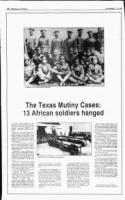

Soldier of the Tuentu-tourth-Lntantrp.
In 1917, while a debate over the
philosophy and administalton of milt
tary criminal law was being heatedly
debated at th War Department. 13
African American soldiers were
hanged at Fort Sam Houston for mu
tiny.
This case. and the dishonorable
discharge and imprisonment of a
·group of soldiers at Fort Bliss in San
Antonio have been referred to as the
. "Texas Mutiny Cases" which played
Significant roles in altering th Articles
of War. and reforming the military
justice system.
In the Ft. Bliss ca . court-martial
proceedings were instituted on a num
ber of non-commissioned officers
while under arrest for minor infrac
tions because they refused to att nd a
drill formation.
Although an Army regulation pro-.
vtded that a non-commissioned officer
while under arrest should riot attend
a drill, these men were brought up on
Charges of mutiny. found guilty, dis
honorably di harged from the serv
ice .. and s ntenc d to 10-20 year
terms.
However. the major ven t during
World War I that would for ast
Change in the review of court-martial
proceedings would occur at Ft. Sam
Hou ton in a make shift courtroom
which was the base's chapel.
It was the largest murder trial in the
history of the United States.
Althou h th Army. eventually
char 1 18 men. 63 African Arneri
can soldi rs of the Tw nty-fourth In
fantry R irn nt stood trial after the .
August 23. 1 17 Houston riot.
rea ted in March. 18 th
Twenty-fourth Regiment earn dts-
tinction in storming San Juan Hill, in
Cuba. They also fought in the Phtltp
pines, and aft ran assi nm nt in New
Mexico headed to Texas for wh t th y
thought would b a stopov r for order
Camp Logan ourt-Martial proceeding
to 1 ht in World War I, but inst d
they rvcd uard. t h mp
Logan con tr uctton it outsld Hou .
ton.
The cond inciden t occurred wh n
a provost guard went to town to ques
tion th first b tin. When h did not
return, rumors spr d th t he h d
been killed. Although. he did return to
the camp. this did not calm the 01-
dier . On that rainy. dark Augus ve
rung, soldiers from th Tw my-fourth
loaded their rtfl sand haded to town.
In the aftermath. 15 white men. civil
tans, pol1c officers and Na tional
Guardsmen w re ktll
Although the Army v ntu lly
char ed 11m n of the Twcn t - fourth
Infantry. 63 w nt on trial in th fir t
of three court-martial proc din s.
They pleaded "not ulllty" to 11
charges, and w r r pre nted b
stngl def n couns 1.
After 22 days of deliberation. 196
witnesses, 2,100 pages of testimony,
following adjournment on November
23, the panel of presiding officers con
demned 13 men to death, 41 to life at
h d labor. four to shorter prison sen
tences. and acquitted the remaining
five oldiers.
Th 63 oldlers were not told ofthelr
fate until December 9. Their only re
qu st w s to be shot. not hanged. This
r qu st was turned down .
On December 11, they were loaded
in to truck early in the morning, and
driven to a hastily erected wooden
. affold where they were hanged.
Th ir gr ves were marked only with
their names, and numbered 1 through
13, nothing el was inscribed on their
tom bstones.
The ca ,which received national
cov r e. was not made public until
lmost 60 years later.
There was no appeal process within
the military judicial system at that
time.
To pr vent a recurrence of injustice,
th War Department on January 17,
1918. issued General Order No. 7
which required that execution in any
ca e of soldier be suspended pend
in review and a determination of le
gality by the Office of The Judge
Advocate G neral,
Today. the board of mil1tary review
set forth in General Order No. 7 i
h ded by an African American. He Is
Brl adi r General Kenneth O. Gray.
ommander of the U.S. Army Legal
rvi s Ag ncy, and Chief J udg
. . Army Court of Mil1tary Review.
(RepnntedfromNou imber 1991 is ue
of the National Bar As tation Magaztne)