
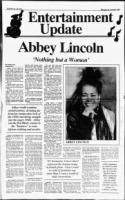

By TUREKA TURK
lllohlq." Cltlan
Abbey Lincoln began as
many young pretty girls did
in the 19508, bursting with
energy to succeed and over
flowing with talent. Yet, at
the hands of male record ex
ecutives, she ended up being
portrayed as a femme fatale
noire, a Black sex kitten. .
But that. portrayal didn't
last long.
Abbey Lincoln was an art
ist ·that wasn't going to be
confined by the boundaries of
a vamp.
In 1955, the back cover of
Abbey Lincoln's first album,
"Affair .. .A Story of Girl In
Love", read "As the cover of
this album would indicate,
Abbey Lincoln has been
bl d it the lin ,
CUrv9S, arcs and mi-circles
i tradi el io
beauty."
oth
b
over the past twenty years
"De 'l' Go v. '
V, 8 t xour Tongue"
div into the same past that
also nourishes the Digable
Planets, Boss, or Eric B. and
Rakim.
Like a griot, Abbey returns
to her ancestry to create a
web of praises for existence.
Among those due of Ab
bey's praises are her parents,
the inspiration for "Deoil/«
Got Your Tongue" and to
which. she has written two
songs. With their guidance,
Abbey discovered her own in
dependence, which surfaced
in 1957.
"(That was) when I gave up
singing songs of unrequited
love and slavish devotion to a
man," she says emphatically.
UT .n.uuo
does not consider herself
fj miniat.
"It's humanist. I know that
Abbey would continue
circled journey. deviating far
from her immaculate look of
the 1950s and diving straight
into the angry 1960s. Abbey
was the first Black women in
the "business'" to wear .
African clothing and an afro.
THAT SUPERFICIAL
DEBUT caused Abbey Lin- .
coln to go on a journey for
herself.
FI ash forward 40 years.
Abbey Lincoln is still blessed
wi th the lines, curves, arcs
and semi-circles in the tradi
tion of a classic beauty.
Only, digging deeper than
_ the classic 60's chauvinism
that turned every young star
let into a Marilyn Monroe
clone, Abbey's curves and
semi-circles are descriptive of
the lyrical geometry of her
voice.
Abbey Lincoln's name may
escape your memory or con
sciousness unless you have
jazz in your veins or Black
cinema happens to to be your
thing.
And, to untrained ears iso
lated in the world of hip-hop
and R&B, the music of Abbey
Lincoln may be as unrecog
nizable as the music of Sarah
Vaughn, Betty Carter, or Bil
lie Holiday.
BUT B LI COL
manages to remind us that
the lineage from jazz to even
the hardest rap is still a con
nected one. Without one, the
. other would not exist.
Lincoln's newest release,
"Deoil's Got Your Tongue", is
evidence of this. Written
I represent the human being
in female form. I don't want
a world of feminists any more
than I want a world of male
chauvinists." .
Her statements are evi
dence of the journey that Ab
bey has ventured since 1957,
also the year she discovered
that the smokey forbidden
tem ptress im age was too con
fining. Abbey sought out mu
sicians and material that
would give substance to the
talent she believed she had.
One of the musicians she
found was the legendary Max
Roach. After meeting Max
Roach, Abbey literally threw
the tight temptress dress
that had once belong to Mar
ilyn Monroe, she had beer!
given to sing in her movie de
but, a bit part in a Jayne
Mansfield fi 1m, in the gar
bage.
Her sex kitten days were
over. Max Roach, Abbeys
says, saved her.
EVERW TEDTO
be a star," Abbey explains.
I t was Max Roach who be
lieved that Abbey was plenty
more inside than her past al
bum covers let on. It was also
Max Roach who introduced
her to Riverside, the record
comp ny that immediately
signed her.
The year 1957 also gave
Abbey and Max their first
session together for Ri ver
side, "That's Him!", with
Sonny Rollins, Wynton Kelly,
Paul Chambers and Kenny
Derham.
Abbey would continue cir
cled journey, deviating far
rom her immaculate look of
the 1950s and diving straight
into the angry 1960s. Abbey
was the first Black women in
the "busin "to wear Afri
can clothing and an afro.
Abbey's look wasn't just
show. The "Freedom Now
Suite ", a collaboration be
tween Abbey and Max, was a
ferocious indictment against
the tragedies of racism. Ab
bey reached from the bottom
of her soul and used her voice
to Qau, II all t in
et}'. ..
THE 1960&, TIME
when Black cinema was an
art form and not a product,
also gave birth to Abbey's ca
reer 88 an act . Abbey
gave riveting performances
in 1964's "Nothing But A
Man" and 1968's "For Love Of
Ivy" ..
In 1973, Abbey too a pil
gramage to Africa and re
turned with a new name,
Aminata Moeeka, and a new
respect for African culture.
"Ami nata and Moseka are
gods. I t's my African name,
my offering to my African an
cestors. I thank them for my
life," she told Down Beat.
The 19808 brought a trib
ute to those she had been mu
sically related to, including
"Painted Lady" with Archie
Shepp, "The Maestro" with
, the Cedar Walton Quartet,
"Talking To The Sun" with
Steve Coleman and, finally,
''Abbey Sings Billie".
"I'm her spiritual relative,"
she pronounced. "When I
first heard Billie, she went
right to my soul. She was
honest. She didn't garnish
anything. She sang her
heart. Billie inherited 'from
Bessie (Smith) and I inher
ited from Billie. We all in
herit from our ancestors."
t
•
..
documentary, "You Gotta Pay
The Band", also the title of
her debut on Verve.
"Devil's Got Your Tongue"
is a conglomeration of Ab
bey's accumulated experi
ences. Joined by The Staple
end 00" was written after Ab
bey's mother, Evelyn Coffey,
passed, and is a testament to
, the feeling and emotion Ab
bey feels for her.
corpora s. Abb y Lincoln
hae traveled far and wide
within her elf nd outside i�
the world, which will Iways
make her a spiritual, maj -
tical, independent, nd in
credibly in ightful woman,
everything nd nothing but a
woman.
" t' humani t. I kno
• I
repre ent the human bein
in female fi nil. d n t ant
a rid if femin· t an
more than a t a orld of
male c
TORY 0 F -
ther" is a truly spiri ual
prayer to Abbey's fa her, AI·
exander Wooldridg. It is
reminiscent of the hymnals
buried in the Black churches
ofthed psouth. Remem r
"God Is Trying To Tell You
omething" from the movi
"The Color Purple"? The Sta
ple Singers do mad back
ground on this one.
"Jungle Queen" is d .
scribed by Ab y simply. "I
got tired of hearing about
Tarzan and Jane. I am the
Jungle n, know wh t I
m an?" Dig. .
" 'Pring Will Be A Little
Late This Year" i classicj zz,
symbolizing the spirit of in
cerity and honor in the uni
vers .
Thos tracks ar ju t a
ampling of the magic
"Deuil's Got Your Tongue" in-
that I
•
U In
"
bbeymanage
to r mind- that
th lin a eft m
j e en th
hard, t rap i
still a c nn cted
one. ithout
n the oth r .
l ould n t · t.
inc In
rei
e id nee
•
. ABBE EVI ITED
acting roots in the
19908 with a small but
memorable part in Spike
Lee's "Mo' Better Blues" as
the mother of Bleek Gilliam
(Denzel Washington). Abbey
was also the subject of a PBS
Si ngers, The oel i ngers,
Maxine Roach, Babatunde
Olatunji, to name a f w, Ab
bey has created a genuine re
lease. She goes back to the
days when records had m -
sages, a long time go.
"Evalina Coffey (The Leg-