

What to the
lave'
the
ourth of July?
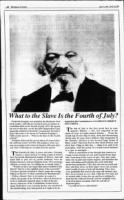
Frederick Douglass was invited by the Rochester (New
York) Ladies' Anti-Slavery Society to give an oration in
Corinthian Hall on the Fourth of July, 1852. He agreed,
but not on that date; on the day after Independence Day,
staunchly antislavery Rochester crowded into the hall to
hear what came to be known as Frederick Douglass's,
Fifth of July speech- "What to the Slave Is the Fourth
of July?"
Douglass delivered this speech almost 10 years before
the outbreak of the Civil Waf. His prophesy of the war
was as accurate as hi vision of America 140 years later
was clear. Following are excerpts from the speech. . ,
his ourth (of) July, is yours, not mine. You may
rejoice, I must mourn. To drag a man in fetters
into the grand illuminated 'temple 0 Iiberty, and call
upon him to join you in joyous anthems, were in
human moe ery and sacrilegious i 0 y. Do you mean,
citizens, to moe me, by asking me to spea today?"
"Would you ave me argue that man is entitled to his
liberty? that h · the right ul owner of his own body?
You have already declared it. Must I argue the wro g
fulness of lav ry? that a questio for epublica ?
.. e low- itizen ! th re i 0 matter in e p ct to
whi h, the opl 0 the orth hav llowed th m elve
to b so inou Iy i po ed u on, t t 0 the pro
slavery c ara ter 0 he .on titution, n that in tru-
m t hold t e i 0 warr nt.. · ce. ,no a cti 0 of
the hateful thing; but, interpreted as it ought to be in-
terpreted, the Constitution is a GLORIOUS [:IBE TY
DOCUMENT ...
. The 4th of July is the first great fact in your
nation's history - the very ring-bolt in ,the'
chain of your yet undeveloped de tiny ... From the
round top of your hip of tat ,da k and threatening
clouds may be seen, heavy billows, like mountains in
the distance, disclose the Ie ward huge forms of
. flinty rocks! That bolt drawn, that chain broken, and
all is lost. Cling to this day - cling to it, and to its
principles, with the grasp of a term-tossed rna iner
. to a spar at midnight.. . . ' I
"There Isconsolation i the t ought that America is
young. Great streams are not asily turned from chan-
•
nels, worn deep in the cour e 0 ag . hey may some-
times rise in quiet and tat Iy m je ty, and inundate the
. land, refreshing and fertilizing earth with their ,
mysterious propertie. hey may al 0 rise in wrath and ·
fury, and bear away, on thei angry waves, the accumu- .
lated wealth 0 y ar 0 toil and a d h ip. hey,' ow
ever, gradually 'flow bac to team old channel, a d.
flow on a eren Iy a eve. ut, · the i e may not
be turned aside, it may dr u and leav noth ing be- .
hind but the withe ed b a unl ight yo'
to owli aby - weeping · . d ta 0
departed glory.
" s with riv 0 wi tion ."
, I