

million
tayh
MI HA L MA L Y. Bob Marley. Thurg od Marshall Frank
Matthew • Oscar Michaux Li tervelt Middleton. Warren Moon Ro rt
Mugabe. Elijah Muhamrnmad, Herb McKin ey, Samuel Mye ,
Kwarne Nkrumah, Julius ycr r • P J. Patte n, Sidney P rtier. A C.
Powell. Colin Powell. A Barry Rand. A. Phillip Randolph.
Paul Ron. Eddie Ro ms n, Jackie Ro mson. Anwar Sad t,
'Haile alassie John S n ta kc. AJ h rpton, George Stalling. Carl
St n . Loui Sullivan. Cl ren c Thomas. John Th mp on. Kwame
Tur , Gcnc Up haw, Melvin V n Pccple . D rek Walcott, B ker T.
W hin ton. Bill White. Chan 'cll r Wilham'. Eddie William. Eric
William. Ranny William. Augu t Wilson. Carter G. Wo dson
Twenty five influential
Afric lea r
.., I'_·
"Boon Come"
As the folks often ay down in
Jamaica, "Soon Come". That
means that we are not quite ready.
but will be oon.
It i beginning to eem almo t
impo ible to come up with that li t
of twenty five influential African
male leadc . Thi . as y u can
gues . i a pleasant ituation be
cause there are and have been mil
lions of out tanding African male
leaders and role models - for me, beginning with my father, Richard
Hilton.
In January, we paid homage to Dr. Martin Luther King. Jr .. while at
the arne time acknowledging twelv other contemporary leaders (1900-
1993).
We tated that it was our intention to pre ent the final results during
or close to the May birthday of Mini ter Malcolm X Shabazz. As you
maybenoticing,weremainone.t pawayfromcompletingthi pruces .
At this time we will Ii t one hundred men who were recommended.
This i truly an international Ii t, with nearly twenty countries repre-
sented. The men on till Ii t al r present various philo ophies and
ideologies as well. .
We encourage erious tudent of African i u to hare thi list with
others because we doubt if you will cc su h a varied Ii t again for a
while. Tlu i African Power.
KEITH
HILTON
HIGHER
EDUCATION
THI I TRUE Human Power. Many thanks at 0 to the many men
and women from coast to coast who called and/or wrote us.
In order for us to rea h our final li t of twenty ive, we are asking
readers to view the Ii t below and then give u your new lists. We will
compare. count and then publi h ourfinalli t in July. therefore. we n ed
your feedback (lists) by June 15.
Please call (909) 899-0650 or write us at 3179 N. Garey Avenue,
#101, Pomona.CA91767. Your li t m y havc few oneorasmany
as twenty five. Let's talk.
Henry Aaron, Ralph Abernathy. Chinua Achebe, Muhanunad Ali,
Fela Anikulapo-Kuti, Ayi Kwei Armah, Molefi Asante, Arthur Ash
Nnamdi Azikiwc, Jame Baldwin Yo ef ben-Jochannan, Steven Biko,
Maurice Bi hop. Jam Br wn, Ron Brown, Willie. Brown, Ralph
Bunchc, Alexand r Bu tamante. Fidel C tro, Wilt Chamberlin. John
Henrik Clark .Alh'rtCl age.Den Cornelius. Bill Co by. William Cox,
Ajayi Crowder. Chuck D .. Ronald Dellum . David Dinkins, Cheikh
Anta Drop, Chart Drew. W.E.B. DuB i . Duk Ellington. Loui
- FarrakhanCl renee G in '. Marcus Garvey, A.S Ga ton. Cito G ton.
Henry L Ul Gate. Moanunar Ghad fy, Dizzy Gill pie.
Barry G rdy, Jr.. Earl Grav . William Gray. Alex Hal y. Richard
Hatcher. B njamin Hook. Lan ton Hughe , John Jacob. J e Ja k
son. Mi hacl Jackson Franklyn Jenifcr. Vernon Johns, Ervin Johnson
Jolm H. Johns n, Robert Johnson. Quincy Jone Scott Joplin, Michael
Jordan, Jomo Kenyetta, Martin Kin '. Spike Lee, Ed Lewi Reginald
Lewi ,J Louis, Patrice Lumurnba, Malcolm X. Nelon Mandela.
, (
•
FRO
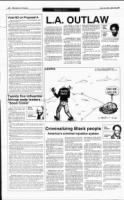
DEATH.
ROW
T Simi V I y"tri :' like th
King tlng i elf, w b th an ob-
enity and a commlonality, for nei-
t r all-whi pro-police juri nor
tate-sanctioned brutality are radii
to tho e who live in U.S. tomb
oppo ed to reading about them. The
point i , the fed ra1 L.A.P .OJ King
civil righ trial w a political pro e
cution, purred by international em
barras ment stemming from the
raging flames ofL.A.,without which
no prosecution would've occurred.
It al 0 reveals how the y t m,
under the pressure of an outraged
Thi we cannot do.
We mu t deny the t t that
power.
The national ACLU i also of the
opinion that the econd, federal
prosecution violated the 5th Amend
ment to the U.S. Constitution, a po-
i tion that eems ound.
I ' th t m ny 0
tho who did not oppo e th federal
civil prosecutions f I it inappropri-
t for th fed ral y t m to revi w
tate convictions und r ha cor
pu tatu
All thi 2nd fed ra1 civil rights
violation e h don i provid the
y tern with camoufl e, to give the
appearan of justic .
The ill usion i n er the real.
The 5th Amendment provid ,in
part; " ... nor shall any person be sub
j t for the arne offens to twice
put in jeopardy of life or limb ... "
HARRrs
() 1993 G.HAR IS P ODOCTIO S
ALL RIGHTS RZSERVED(312) 238-1537
)
-_.I� :>
. "
.. \�h .. L
. ���!E
Criminalizing Black people
America's criminal. injustice system
RON
DANIELS
VANTAGE
POINT
Now that the verdict in the Fed
eral trial in the Rodney King beating
case is in, the City of Los Angeles
and the nation will next await the
verdict in the case of the "L.A. Four"
who will be tried for the beating of
Reginal Denny.
The rebellion in Lo Angeles ex
ploded April 29', in the aftermath of
the shocking acquittal of the four po
lice officers who were captured on
video tape brutally beating Rodney
King. .
As the rebellion unfolded, another
video tape showed the sense of an ry
Black men beating a truck driver on
the comer of Florence and Nor
mandy in South Central.
Only two of the many officers
who beat Rodney King will do time.
And by some estimates the officers
who were convicted could be back on
the treets within two to five years.
in this nation tpe L.A. Four were
arrested and locked up without bail.
And when they are convicted for the
beating of Reginal Denny they will
face life in pri on.
It is thi reality of unequal justice,
injustice within a racist and exploi-:
tive system, which fuel the anger
which could explode in rebellion
again in South Central and the South
Centrals all across this country.
than develop the policies and allo
cate the resource to provide for eq
. uity and pari ty for African people in
U.S. society.
ECON Ml
AND . OCIAL
function of the police and the crimi
nal injustice system is to constrain
HE E TABLI HES AN ir- and contain the victims ofa racist and
refutable link between poverty and exploitive society; tho e who are
ilhteracy and crime and imprison- locked up in the ghetto, the barrios
ment as a historical fact for Black and the r ervations of America
people in the U.S. Record numbers of prisons are
After "emancipating," a largely i 1- being buil t to accommodate a surplus
literate and impoverished African Black population which is of no use
population was not provided "forth in America's emerging new eco
acres and a mule,'( no reparations, no nomic order.
capital or property endowment in a And there is a phony war on drug
capitalist society. And there was no which allows the police to harass and
mas ive and ustained program of lockup huge numbers' of young
education for th former slaves. Black men merely for the pos ession
Thus many of the former laves ofsrnallquantitiesofdrug like mari
were forced to return to their old. juana.
plantations or they were compelled
to become tenant fanners sharecrop
pers and agricultural laborers new
form ofqu i- lavery, �nage, and
bondage.
For those who could not fit into
the new lave y tern, a wide range
of law were enacted in th South
designed to imprison the surplus
Black population for all kinds of
petty offenses like loitering or va
grancy ..
iniustice i a crime. It i a violation
of the human rights of a people to
deprive them of decent job, hous
ing, health care, education and a
clean and safe environment.
Institutional racism is a crime.
It is a crime to 0 erlook or other
wi e neglect the just aspirations of a
people because a nation's culture,
educational process, it's political and
economic institutions and it' people
are poisoned and blinded by white
upremacy and racism.
It i a crim to unleash the police
on the victim of social and ec0-
nomic injustice and hurl large num
bers of a victimized people into jails
and prisons' rather than provide for
tb e ho tile American shores tb
United Stat government has been
guilty of violating the basic human
rights of. African people and' th
criminalization of Black people.
As noted cholar and hi torian Dr.
Cbarshee McIntyre ob erv in her
penetrating book, Criminalizing a
Race, Am rica has always preferred
to put Block people in prison rather
H ITI like W h-
ington. D.C. and Baltimore, upward
of 5 percent of Black male are ex
pected to bc impacted by the criminal
injw tice sy tern by the year 2,
While Lo Angel and the nation
awai the verdict in the pending trial
of th L.A. Four, the verdict on
Am rica h b n in [or quite som
time. '
America's criminal injustice ys
tern i continues t crirninalize Bla k
pcopl .
THROUGH UT THE whole
proceedings the four police officers
were permitted to be free on bail.
The treatment of the L.A. Four i
already much different. M . t Black
people in South Central and aero
the country know in their heart of
hearts that the L.A:Four are d tined
to do orne serious time.
Those whb wi tnes ed or have
been/are the victims of police abuse,
economic neglect and economic vio
lence in the U.S., tho e who rea ted
wi th random rage to a verdict which
mirrored a long hi tory of police ter
rorism and a duel system of "justice"
THO 1 D T victim
of lav ry and the new slave/planta
tion system landed in the chain gang
often being hired out in a convict
lease y tern to labor for white
bo es again for free.
The circurnstanc and poli i
are li ttle different today. A pri ncipal
Ron Daniels serves as President
of the Institute for Community Or
ganization and Developm nt in
Yong. town, Ohio. H may b con
tactedat216) 746- 747 ..