

The E tlans
For th E yptians, east is the
direction 0 life. The sun and stars
ri in the east, and Egyptians
build their homes on the east bank
of the River Nile. West, the direc
tion of the setting sun, represents
death and the royal burial grounds
Livi
gby
J alous 0 hi succ wa
o iris vii br th r th, who t
about to bring d wn 0 iri , cl im
I is hi qu en and com the
new rul r of Egypt. th v ntu
ally killed hi broth rand ruJ d
for a time, but was la raven d
by 0 iri son Horus, who mur
dered Seth and became Egypt'
rightful ruler. When looking at the
night sky, Egyptian see this early
conflict represen d in the stars:
o iris th belov d ruler is th con
stellation Orion, hi wife I is fol
lows close behind as the star
Sirius and the evil eth is repre-
n d as the seven stars of the
Big Dipper.
The famous pyramids re them
selv evidence of what this 'tory
meant to the ancient Egyptians.
Into both the north a d south sides
were built shaft-like openings
r
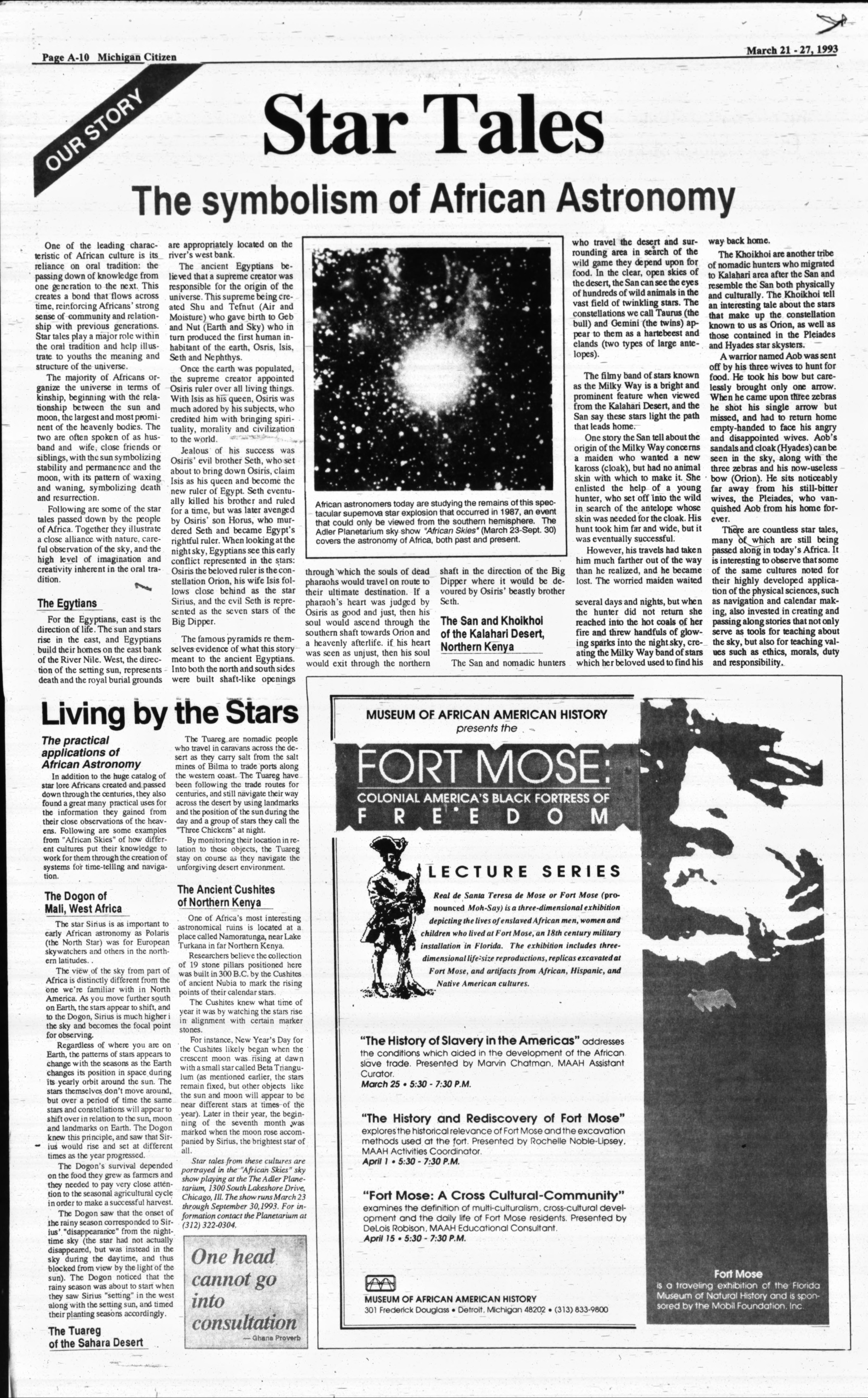
African astronomers today are studying the remains of this spec
tacular supernova star explosion that occurred in 1987, an event
that could only be viewed from the southern hemisphere. The
Adler Planetarium sky show "African Skies· (March 23-Sept. 30)
cove the astronomy of Africa, both past and present.
shaft in the direction of the Big
Dipper where it would be de
voured by 0 iris' beastly brother
tho
The San and Khoikhol
of the Kalahari Desert,
Northern en a
The San and nomadic hunters
One story the n tell about the
origin of the Milky Way concerns
a maiden who wan d new
are coundess tar tales,
many which are, still being
passed along in today' Africa. It
is interesting to observe that some
of the arne cultures noted for
their highly developed applica
tion of the physical sciences, such
as navigation and calendar mak
ing, also invested in creating and
ing along storie th t not only
rve as too for aching about
the ky, but also for teaching val-
sue ethics, morals, duty
and responSibility
several days-and nights, but when
the hunter did not return she
reached into the hot co of her
fire nd threw handfuls of glow
ing sparks into the nightsky, cre
ating the Milky Way band of stars
which her beloved used to fmd his
through "which the souls of dead
pharaohs would travel on rou to
their ultimate destination. If a
pharaoh's heart was judged by
Osiri as good and just, then his
soul would ascend through the
southern shaft towards Orion and
a heavenly afterlife. if his heart
wa en a unj ust, then his soul
would exit through the northern
MUSEUM 0 AFRICAN AptlERICAN HISTORY
presents the
1 E'C T U R E
SERIES
Real de, Sanm Teresa de Mo e or Fort Mose (pro
nounced Moh-Say) is a three-dimensional exhibition
depicting the lives of en laved African men, women and
childrell who lived at Fort Mose, all 18th century military
ill tallation 'in Florida. The exhibition include three
dimensional life:: ize reproductions, replicas excavated at
Fort Mose, and artifacts from frican, Hispanic, and
Native American cultures.
"The History of SlaverY in the Am. ricas" addresses
the conomoos which aided in the development of the African,
slave trade. Presented by Marvin Chatman. MAAH Assistant
Curator.
March 25 • 5:30 - 7:30 P.M.
"Th History and Rediscov ry of Fort Mos II
explores the historical relevance of Fort Mose and the excavation
methods used at the ort. Presented by Rochelle Nobfe-Upsey.
MAAH Activities Coordinator,
April , • 5:30 - 7:30 P.M.
"Fort Mos : A Cro Cultural-Community"
examines the definition of multi-culturallsm. cross-cultural devel
opment and the daily life of Fort Mose residents. Presented by
DeLois Robison. MAAH Educational Consultant.
April '5 • 5:30 - 7:30 P.M.
MUSEUM OF AFRICAN AMERICAN HISTORY
30 1 Fre rk:k Oou ass. Detroit. ch a 48�. (313) 833-9800
"
The practical
applications of
African Astron�my
In addition to the huge catalog of
star lore Africans created and passed
down through the centuries, they also
found a great many practical uses for
the information th y gained from
their close ob ervations of th heav
ens. Following are some examples
from "African Skies" of how differ
ent cultures put their knowledge to
work for them through the creation of
sy terns for time-telllng ard naviga
tion.
The Dogon of
Mali, West Africa
The tar Sirius i as important to
early African astronomy as Po laris
(the North Star) was for European
skywatchers and others in the n rth
em latitudes, .
The' viewof the ky rom part of
Africa is di tinctly different from the
one we're familiar with in North
America. As you move further outh
on Earth, the tars appear to hift, and
to the Dogon, Sirius is much higher i
the sky aoo becomes the focal point
for observing. '
Regard! of where you are on
Earth, the patterns of stars appears to
change with the easons as the Earth
changes its po ition in space during
its yearly orbit around the sun. The
stars tbernselv don't move around,
but over a period of time the same
tars and constellations will appear to
hift over in relation to the sun, moon
and landmarks on Earth. The Dogon
knew thi prin iple, and saw that Sir
ius would ri e and et at different
tim as the year progressed.
The Degen's urvival depended
on the food they gr w as farmers and
they needed to pay very close atten
tion to the se onal agricultural cycle
in order to make a ucc ful harvest.
The Dogon w that the onset of
Ute rainy eason correspond d to Sir
i " "disappearance" from the night
time ky (the tar had not actually
disappeared, but was instead in the
ley during the daytime, and thus
blocked from view by th light of the
un). Th Dogon noticed that the
rainy ason was about to tart when
they saw Siri "etti ng" in the west
along with the tting un, am timed
their planting OIlS accordingly.
lh Tuareg
of the Sahara Desert
The Tuareg are nomadic people
who travel in caravans aero s the de
sert as they carry alt from the alt
mines of Bilma to trade 'ports along
th western co t. The Tuareg have
been following the trade routes for
centuries, and still navigate their way
aero s the desert by using landmarks
and the position of the sun during the
day and a group of tars they call the
"Three Chickens" at night.
By monitoring their location in re
lation to these Objects, the Tuareg
tay on course � they navigate the
unforgiving de ert environment.
The Ancient Cushites
of Northern Ken a
. On of Africa's most interesting
astronomical ruins is located at a
place called Namoratunga, near Lake
Turkana in far Northern Kenya.
Researchers believe the collection
of 19 stone pillars positioned here
was built in 300 B.C. by the Cushites
of ancient Nubia to mark th rising
points of their calendar stars.
The Cushites knew what time of
year it was by watchi ng the stars rise
in' alignment with certain marker
stones.
For instance, ew Year' Day for
the Cushites likely began when the '
crescent moon was n ing at dawn
with a small star called Beta Triangu
lum (as mentioned earlier, the stars
remain fixed, but other Objects like
the sun and moon will appear to be
near different tars at tim of the
. year). Later in their year, the begin-
ni ng of the venth month .w
marked wh n the moon rose accom
panied by Sirius, the brightest stat of
all.
Star tales from these cultur are
portrayed in the "African Skies /I sky
show playing at the The Adler Plane
tarium; 1300 South Lakeshore Drive,
Chicago, Ill. The show runs March 23
through September 30,1993. For in
formation contact the Planetarium at
(312) 322'()304.