

2
"Instead of showing and prov
ing, I'm proving that I'm the
show."
- Arn.,lca·z
Complet Artlat
recapture and bring back that
funk. I want this album to make
music way too, fun�y again."
Growing up the youngest of
ten children, the 22-year-old
Compton native developed a
strong interest in music by the age
of three when he would entertain
his sisters' friends with his un
canny ability to identify a variety
of songs and artists. Being the
baby of the family, Quik enjoyed
the exposure to both '70s funk
and the older, soulful sounds his
sisters and mother listened to.
Few sounds have been more
misunderstood and forgotten in
hip hop than postdisco funk.
Musical pion ers like James
Brown and Funkadelic are
generally credited with shaping
the first two periods of the funk
sound, but few have acknow
ledged the musical contributions
of the last major vestige of funk
creativity that occurred in the late
19708 and early 1980s.
In their time, Zapp, lave, In 1981 Otdk convinced his
Brick, Gap Band, Cameo, Con sister to help him buy hi first
Funk Shun, and The Dazz Band turntables and mixer. However, it
were virtually ignored outside of " wasn't until the N. W.A. ex
R&B circles. Their bouncy bass, plosion of 1988 that Ouik began
rough-and-tumble rhythms, and to give serious consideration to
synthesized keyboards were just his own talents. After trading in
too associated with disco to be his loose gang associations for
taken seriously' by the white time in the studio, Quik landed a
musical and critical estab- contract with Profile based on a
lishment.: Sadly enough, the hip three song demo tape.
hop community has done the
same.
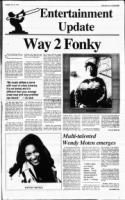
DJ Quik hopes to change all
that. "Way 2 Fonky is a concept
album," he .said, "I really like the
full-bodied sound of all those
post-disco funk groups. Their
music was on it and I want to
WITH HIS 1991 near
platinum debut Quik Is The
Name, Quik proved that there was
more to. South Central Los An
geles than just gangsta rap. The
down-to-earth warmth of Quik's
vocal delivery combined with his
knack for making original music
tha t connects wi the average
homey made him a household
name in hi p hop circles. While he
had his share of doubters -and
critics among the hip hop ta -
temakers and media, Qui J im
pre s ive ale figures
cross-country tour with fellow
rap heavyweights Too Short and
EPMD, and production efforts
for 2nd II None, AMG, Hi-C, and
Penthouse Player's Clique made
him a force too talented and too
popular to b ignored.
"My music strikes a nerve with
most of urban America. It's not
trendy and it's different than your
average break beat and loop
oriented rap record," he said.
"Quik Is The Name had a certain
feeling that catered to the party
mood. And it worked, because
who doesn't like to party? It gave
the people something for their
heads and feet instead of their
minds. It's like too many rappers
have forgotten that the point of
music is to make people happy or
sad. If it doesn't move you than it
isn't funky."
"With my new album I've also
made a � r . 1 'a t
arne kind of in ble 00
the first one, hut thf time around '
I'm also showing what I've been'
through in the last year - where
I'm coming from -and where I
want to take people to back to the
funk."
His desire to reshape the cur
rent sound of hip hop is not
limited to just his musical in
fl uences. Quik wrote, mixed,
played, and produced Way 2
Fonky. His love of instruments as
opposed to programming com
puters and sequences is at the root
of his funk mission.
WHILE HE acknowledges
the place and creativity of the
sampler within hip hop, he and
his creative partner, Rob
" Fonksta " Bacon, would rather
concentrate their energies on
. playing the actual instruments
used in the older funk they rein
vent. "We don't like to sample as
much as replay and rework, the
original," he explains. "Rob and I
hunt down the original, older
hand-clap drum machines and
keyboards used back then so we
can change-up the original song
OTE
"My mu Ic trlk n I"/i
with most of urban America.
It' not trendy and it's
different than yo'!r average
bTl ak beat and loop-oriented
rap record. " - DJ Qulk .
".
without ounding too '90s. Using
the original equipment makes our
song s und like we're actually-in
the studio when the original was
recorded. And outside of the
Roland I just bought for its 808
sound, I don't like to use a lot of
modern drum machines."
Listening to the versatility of
the live fuzzed-out freakboard
Multi-talented
funk bass instrumental bridge of
"America'z Most Complete Art
ist, " the old school hip-hop musi
cal references of "Only Fo' 11aa
Money," the smoothed out Oute
and guitar fusion of "Qllik'z
Groove II," and the rubber-band
bass explosion of "Niggaz StiU
Trippin'i" it's evident Quik is on
See OJ QUIK, 82
Wendy Moten emerge
In an era where music stars are
often manufactured and pack
aged as if they're part of a cold,
dispassionate assembly line, the
emergence 'Of a truly talented
singer like young WENDY
MOTEN is like a breath of fresh
air. On her debut album, the
young Memphis phenomenon
brings a colorful palette of silky
smooth soul, funk and pop to life
with a voice that is able to be
passionate and playful, pure and
oulful, cool and emotional. '
Actually, Wendy Moten didn't
originally plan on having a music
career at all. The Memphis native
started singing in a church choir,
and went on to study at the
renowned Overton Creative and
Performing Arts High School.
Yet, when college beckoned,
Wendy became an accounting
major, intending to follow a busi
ness career. "I didn't plan on a
music career," she admits, 1'1 only
started getting serious about ita
a profession in the.last five yearc:.
There wa n 't anyone instance
which made me decide to serious-
ly get into it either. But I've al
ways been lucky enough to get
opportunities to prove myself. It
just happened that way." Wendy
credits her early mu ical in
fluence to her instructor, Lula
Hedgernan, as well as the works
of Aretha Franklin and Chaka
Khan.
"I didn't plan
.
on a mu IC
career," he
admit "J. only
tarted getting
eriou about it
the /ast five
yea� . " -Wendy
It didn't happen with ut a lot
of dues paying, Her first ready
music gig was as a singer in a
theme park, Liberty Land, for
three summers, in the mid-SO',s.
Then, she landed a job singing in
a 10-piece P,oplR&B house band
in Memphis, which lasted for
another three years. While there,
she sang on some j Ingles and met
a manager, Dick Williams. She
recalls, "He was impressed with
my work, and he said the usual
thing: 'I think I can do something
for You ... ' Well, you hear that a
million times. So I took it very
:lightly at first, but he turned out
to be legitr"
She cut a demo for Williams,
and while he shopped it around,
Wendy left the house band to sing
back-up on a national tour, after
which she went to New Yor to
star in the off-Bro dway version
of "Mama I Want To Sing," and
continued her role as the play hit
the r ad.
DURING THAT time, her
demo ) nded in the hand of
EMIRG, and a deal w truck.
S WENOY,82