

I.
� .
TH NBW YO K TI B, UJ DAY, AUGU T 16. 19 2
117 117 Stock market
declines by 42%.
1 1 U.S. Steel
formed, the argest
company relative the
size of the economy
U.S. history.
1 a Stock Market Crash.
The resulting Great
Depression wipes out many
fortunes.
117 Richest 1 %
have close to the
smallest share of
wealth they've had
in U.S. history.
HI to y
hy:
II Fair Labor
Standards Act creates a
minimum wage.
The gray line shows the percentage of the national wealth held by the
richest one percent of Americans, from 1774 to 1989.
The country has gone through several cycles of concentration and
redistnbution of wealth. Only once before were the rich as rich as tt:ey
were in 1989 - but that too 150 years to achieve.
The chart data are from estimates by three economists - Claudia Goldin
and Bradford DeLong at-Harvard University and Edward Wolff at New York
University.
1 I-I 2
Deepest
recession
since the
1930's.
lei Income tax
created. Doesn't really
affect the middle class
until the 1940's.
19 The New Deal. Creation of
Social Security and pension plans.
Government stops hindering unions.
� 1 Emancipation.
Vast "wealth" - in the
form of slaves - is lost
to Southern landowners
and 'transferred" to the
poor - the freedmen
themselves.
ItO First
assembly line
at Ford.
Colonial era to 1820. Land on frontiers is essentially free for
the taking, and the population is small. Labor is expensive,
compared to Europe, and industry negJjgible. Wealth is
distributed fairly widely. Most of the rich are
Southern planters and coastal
merchants.
1900-1914. Inequality of wealth
becomes a nationat political issue.
Child labor laws, wage and hour
laws, railroad rate controls
created.
Top tax rate slashed from
70% to less than 30%,
shifting tax burden to the
middle class. Federal
Reserve's anti-inflation
stance buoys stocks and
bonds. Fluctuating dollar
sends manufacturing jobs
overseas.
A
1923-1929. Stock market
boom expands richest
people's fortunes.
1941-1945. The draft dries up the
labor supply I putting upward
pressure on wages.
u
•
•
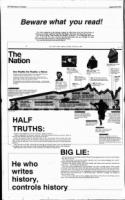
Locate the paragraph at the left entitled: "Agarian Society".
"Labor is expensive in colonial America", the Times notes and then continues, "Mo t of
the rich are Southern planters and coastal merchants."
Those rich planters had the cheapest labor in the world upon whose backs they built
their weath: African slaves. To this date, African Americans have not been paid for their
labor of almost 400 years. This is the free labor which created the wealth of those Southern
planters.
Also, the note for 1862 indicating the opening up of public lands under the Homestead
Act ignores the truth that most states banned Black participation under such programs.
Ignoring these facts makes it easy to dismiss the claim for reparations.
�• < " "
• I
� i\ •
1950-1970. Helped by G.I. bill, many
Americans get college educations, raising
earning power. Strong unions and higher pay
let the middle class buy homes and cars as
never before I putting more wealth in their
hands even as riSing stock markets make the
rich richer.
I
••
•
I
wh
See the picture of Abraham Lincoln? Read the paragraph below his picture that begins
"1865 Emancipation" .
The Times writer corrects the earlier omission by at last acknowledging the 'wealth'
slaves provided the plantation owners. .
However, the big lie comes next. This wealth, the Times writer says was "tran ferred
to the poor _' the freedmen themselves." .
The only thing transferred to the freedmen was their earning' power. They owned
nothing of what they had created. No forty acres, no mule, not even so much as a hammer
or plow became the property-of the Africans. Denied land and tools., the Africans were
ubjected to a system of Jim Crow, segregation, sharecropping and economic subjugation
that left them in economic and - until 20 year ago - political bondage, the vestige' of
which remain today.
If the truth is what sets u free; readers and writers of the ew York Time are far
from free, chained by the racism that blinds them to fact.
wr
y,
r
I