

"Th re ' a tew pot out
there that just cooks these
n , and they come out of
th t," S r cant McBride said,
adding that unemployment,
dru and th Jack of oppor
tunity contribute to the anger
of th young men.
Neighborhood
center .
in trouble
Detroit - The community
center run by the Carton-Me
Farlane Neighborhood As
sociation is in danger of
clo ing because the neigh
borhood group can't afford
the high cost of running it,
estimated at $25,000 to
30,000 a month.
A group of. doctors
donated space in the former
Northwest General Hospital
for recreational and social ac
tivities for neighborhood
youths and senior citizens.
Some programs run by the
20-year-Old group include
Meals on wheels. Neighbor
hood Watch, neighborhood
deteriorau p vention a
Li ttle League.
"We need a building be
cause there's nowhere for the
children and senior citizens
to go," said 74-year old Al
berta Waller.
I HITA, D. (AP) - John
G ton m de four-hour round trip
to Tope recently to 100 t two
photo phs.
He thought pictures of
Il-Bl c Monic Lod e and an
earl y day BI communi ty tring
orch tra nd hoir might . d
project he i underta en to help Old
Cow town Mu eum re arch
African-Americ 0 in early
Wichita.
"It' Ii e a miner out panning
for gold who find a little nugget or
two, and it mak the whole thing
cern worth it, " said Gaston, 48.
Finan ed wi th an $8, grant
from the museum and th Karls
Humanitie Council, Gaston has
been compiling information and
WORLD/NATION
"That doesn't mean part of the
atmo phere. That means the whole
thing. And to thi point we just
haven't had much information on
"If volunteers e illlng to
co tume themselv d interpret
BI c fam.il y, then e ought to be
ble to provide them ith the
infonnation 0 they can do their
job well. To thi point, e ven't
had th t information to share,"
Kennedy 'd.
G TO Y that prior to
1900, Kansas bad one of the largest
concentr tion of
African-American newspapers in
..
ATl..ANTA (AP) - Georgia's
skirmish over removing the
Confederate battle emblem from the
state flag is just the latest in the
South's quarrel with the Civil War
symbols that litter the region.
Thousands of monuments to the
Confederacy, , relic from
battlefields, four tate flags with the
battle emblem, and the anthem
"Dixie" are symbols that propel
arguing - from folks on the street to
the South's state capitals - over the
appropriate way to remember the
Civil War and the people who lived
during it
C C We are their descendants," said
Linda McCall of Florence, S.c., who
has mounted a one-woman
campaign to polish the image of the
Confederacy. "They are our
forefathers. Don't destroy our
heritage.' ,
On the other side are Southerners
who say many Confederate symbols
are racist
Civil War historian Shelby Foote
said the Confederate battle flag and
"Dixie" were co-opted by white
supremacists, who corrupted their
original intent
U RESPONSmLE Southerners
did not protect them from yahoo
Southerners;' Foote aid of the
symbols. "Tbe Klansmen and the
rest of them go out with the
Confederate banner and sing 'Dixie'
and it belongs to them."
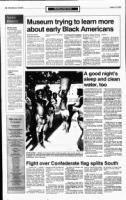
WATER BABIES - Children in the Macina district of M Ii help gath r wat r for their famlll at •
community well. CARE, the world's largest private relief and developm nt organization, h .Iped dozen
of villages In th arid region build wells to bring a steady 8UPPly of cl an drinking water to cloae to
40,000 people. (Photo by Jenny Deem).
By ICHAEL B TES
"The p per re
inatin ." G ton aid." ny
of them ere hort-lived, but they
provide good inform tion on what
ociety a Ii e nd ho the
prominent ci tizens were during the
19th century. "
Church record al 0 haye
proven helpful, hays.
People today are not aware of
the role of Blac in early Wichita,
G ton ays. .
"It n't been included much
in previou work," he said.
"Other people have mentioned it in
ping, but it i very much like
what happened with American
history. It's been glossed over or
, .
excluded.' ,
P OV D
i piration d role mode
modem BI c ,Gaston y the
information hould have
community-wide imp t
"It benefi this city a hole
far etting a better perspective
on the contrlbuti of all 0 i
citizens," he aid. "lbat
people have greater pect for all
people and their contributions. "
Ms. Kennedy i confident
Ga ton's information-g thering
will be carried on by others once be
moves to Georgia.
"It' too good to put down,"
he aid. "You can't j t find out
where to look and then not 100 "
and clean
MACINA DISI'RICT MAU - Now
that Aminta Gnoumanta know her
young children will have clean water
to drink for breakfast, she can, quite
literally sleep easier at night.
It wasn't always so.
In Aminta's rural West African
� w .. \m\ep ,.!il r� 0
I � WH.9� � ,
transp<>rtation is bv ox cart or toot
lite·tltoi en paretrd�wn to ii -qua:�'
tions as whether there is enough food
and water to survive.
It used to be that during the dry
season Aminta and the other women
of her village would stay up all night,
camped by the community well with
their children huddled at their sides.
Just before dawn, when the dew
came and moisture would seep into
the well, the women would take turns
dredging the bottom.
SOMETIMES THERE would
be dead frogs in the muck they pulled
up in leather pouches, but they used
the water anyway.
"We had no choice. We needed
water. Any water had to do," she
says.
"It is nearly impossible for most
Americans to comprehend what it
would be like to live day after day
without water. On average,
Americans use 125 gallons per day
per person. In Mali, entire families
make due with only 3 gallons of
water per day" says Griffin Jack,
deputy director of West African
programs for CARE, the world's
largest private relief and develop
ment organization.
At 22, Aminta is already a mother
offour. She remembers how ber tiny
children ed to be sick about eight
'months out of 12 with fevers,
headaches' and diarrhea.
She used to blame herself, think
ing he was a bad mother.
NOW SHE KNOWS it was be-
Fight over Conf�dera e ·flag
,
The battle over Georgia's flag
highlights the spliL
Gov. Zell Miller in May called for
the battle emblem to be removed
from Georgia's state flag. He wants
the flag restored to its pre-1956
condition, arguing that state
legislators adopted the battle
emblem in 1956 to protest federal
court-ordered integration.
"lbat piece of cloth evokes a
time when people were seen as
chattel. a time that lives in the hearts
of ome Southerners," said Earl
Shlnboster, regional dIreCtor of the
NAACP.
The South indulged in an intense
flurry of monument building,
starting right after the Civil War
00·
cause they were drinking dirty water.
The life expectancy for �nta'.
children, like all children in Mali, is
only 44 years. Nearly three in 10
will never see their.fifth birthday.
And in a country split by the Sahara
desert, only 10 percent of its nearly
t;rlne ��J�pj� ve . to
41eaJlMj . . b ... ..J U j
Three ycam a80, CARE to i
AmhriaYVillaae- atltl wotked in
cooperation with residents there to
build a concrete-lined well, dUI
much deeper than the existing one.
From October 1988 to June 1989
the villagers worked on the well
together, providing not only the
labor but also a small cash contribu
tion towards material costs.
"Water brings goodness to a vil
lage, "say Adama Diana, a villager
elder, "The future of the village
depends on the ability of our people
to work together."
THERE ARE 247 tiny villages
in the Macina district of southern
Mali. CARE has helped build weill
in dozens of villages, which in turn
has provided clean water to close to
40,000 people.
The differences can be seen
everywhere in Aminta's and
Adama's village since a constant
water source arrived: '
Bricks to stabilize houses can
now be made out of mud any day of .
the year. Three years ago mud only
happened after rain.
Goats and cattle can now drink
from troughs. Before, they died
from lack of water or were old for
money to pay for medicine to treat
sick children.
And for Aminta, clean water a
few teps from her door now meaDI
she no longer must stay up all night
to wait for the dew.
"I can sleep until sunrise now, It
she says with a shy smile, "What e1ae
can I ask for?"
outh
ended, to "ease the sense of defeat, . the universities of Georgia, North
the sense of lost manhood," said ,Catolina and South Carolina -
Louisiana State University history won't
professor Gaines Foster. "There is a great fear of
including it in our repertoire," said
UNC band director Jim Hile.
THE LARGEST IS the huge
carving in the side of Stone
Mountain near Atlanta, depicting
Robert E. Lee, Stonewill Jackson
and Jefferson Davis.
But there are thousands more
dotting Southern landscapes,
including the 62-foot statue of Lee
astride his faithful mount Traveller
in Richmond, Va.
Then there's "Dixie." The U.S.
Marine Band, The Citadel and the
University 'of Mississippl marching
bands still play the anthem, but many
other Southern colleges - including
"A CERTAIN GROUP of faDs
wouldaot like it," said Auburn band
dlrector Johnnie Vinson. "Although
there is another group that probably
would." The United Daughters of
the Confederacy is pushing to get the
song accepted again.
"It' right hard to gertt played,"
admitted UDC leader June LeaR.
"Some people are offended when it
is played. We are offended because
they don't play it."