

H HER
Due 0
ILTO: HIGHER
EDUCA no continu to be
.anAfrican centered and multi:
cultural column de igned to
di logue ith college and
orld re e .
Unli e orne, e ve t-
mpled to periodically ta
and 1e our po itio on i -
in order to openly how
c nge and/or in me
, incorrect analya .
One uch topic that we
, have annuall y revisited Ince
1989' the notion of multi
culturali m. We lso continue
to ek input and feedback
from tho e with imilar or dif
fering opinio .
We were probably not the
first, but we are till proud to
be Ii ted among the leading
education sources to que tion
the concept of "minority" as
label for "Black, Red, Brown,
nd Yellow" people.
o TEN YFARS ago,
while working at a university
in New York Town, I recom
mended - and it was ap
proved - that its Office of
Mioority Student Services be
changed to Multi-Cultural
Student Affairs.
Two years ago, the As
sociation of College Unions
International (ACU-I), a very
important tudent activities
body in higher education,
changed the name of one of its
largest ub-committee be
cause of our annual column on
"Multi-Culturalism. "
ACU-I changed the name
nd focus of its Committee on
Minority Programs (COMP)
e . m lti-culturalism
rather than "minority."
Today, "multi-cultural ism"
has come to be synonymous
with an emerging academic
curriculum and nation. This is
a good and just movement. At
the same time, unfortunately,
it has become a very "political-
ly" charged one. .
The concept and definition
varies, depending on whom is
leading the charge. Any way
that one looks at it, it still
should be viewed positively,
except for those who continue
to believe that there is only one
mainstream and many
minorities.
THE TERM as we
originally used it meant to
identify those people who
have come to be referred to as
minorities. We also, aw it as
being a transitional term.
It was and is not intended to
replace the growing
"Africentric or Afrocentric"
movement. Nor was it meant
to drive the Euro-American
way into the sea.
Although there are some
who view multi-culturalism
and Afrocentricity as being
competitors, we don't think
that is necessarily the case.
For example, Keith O. Hilton
is an African who lives in
America (African American).
America is comprised of
people of various ethnlclties.
One key is to remember
that this is a transitional term
and a forward transitional
term, we might add. There
are, however, some who have
now come to embrace the term
because it is fashionable to do.
Also, there is even a group
of progressive people who
have grown tired of discus
sions of multi-culturalism and
even "diversity" and are look
ing for another "buzz word of
the week or academic year."
MULTI-CULTURALI
SM, as we see it, is not a buzz
word or a fad.' Its deflnition
and thrust are till emerging
it should be.
In addition to multi-cul
turalism continuing to emerge,
there is another crucial ue
that is going to need to be ad
dressed soon, and that is the
notion of coalitions. And in
particular, multi-cultural
coalitions.
VIEWS/OPINIONS
o t American re lien ted
and di ted with politici and
politi . But d pi their co tant
complaint , the tem eems to
grind on. In 1990, 94 percent 0 the
member of the Hou e of
Repre ent tive who ought
reelection won.
U ing the powe of incumbency,
neg tive tt ds to confuse nd
lie te voters, and Political Action
Committee I h fun ,incumben
re eldom challenged erio ly.
We need to change the rule of the
political game in order to restore
democracy to our political ystem.
The first tep hould be universal
voter regi tration, and holding
national elections on Sunday rather
than Tuesdays. Over eighty percent
of all people with college degrees
earning above $50,000 annually
vote, while only 44 percent of all
African-Americans voted in the last
presidential election.
Tho e who enerally do not vote
re mong the mo t oppre ed
member of our ociety. For
example, only 38 percent of the
unemployed and 35 percent of all
. pani vote.
Making democ cy wor m
increasing the active participation
for African-Americans, Hi panics,
low incom and jobless people.
We need a publicly-fin need
election y tem, to ta e the
corporations and the pecial interes
out of our decision-making process.
Our political proce mirrors the
inequality of America' cla
y tem, with the rich and powerful
exercising disproportionate
influence over our leaders.
THE SA VI GS and Loan
candal, costing taxpayers billions of
dollars, i the direct consequence of
politcial graft.
We need a "None of the Above"
voter option for all candidates listed
for particualr offices. If voters
di pproved of Clinton, Bush and
Perot, for example, they could
express their opposition by voting
for the ballot line, "None of the
Above" (NOTA).
If NOTA won over all other
candidates, a new election would be
The tate nd federal election
I w re deliberately d igned to
e elude alternative political voi
outsid the Democratic-Republican
consensus.
Th ignature requiremen for
ltemative party candida m t be
reduced, nd ballot maintenance
requirements for al ternative patti
hould be lowered.
THE 0 Tingle effective tep
in reforming the political process
would be to permit candidates to
have "cro -endor ement " or
"fusion" between smaller third
parties and major parties.
Changing the election rules to
penni t cro -endorsements would
mean th t any progre ive party
could run its own candidates for
office on i own sl teo
But if a major party nominated
another progressive on its own ticket
for a particular office-let' y, a
Ron Dellums or Maxine Waters-the
ALLY, WE need to support
all progressive mobilizations t the
national level which q tion and
challenge the policie of both
Democrats and Republicam alike.
One critical event being held this
summer is the People's Progressive
Convention, which is hein led by
noted Black activo t Ron Daniels.
IN A COMPUTERIZED era, it
would be a very simple process for
governments to maintain and to
update lists of voters and to permit
same-day registration. Voting could
easily be set up to occur over the
telephone, greatly expanding voter
acccs to elections.
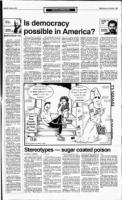
waste our time
The Black vote don't mean
nuthin' in this city
. anyway!
�Your*
Vote
Counts
Register
*to Vote�
7�.!
hear you say that I
Guess I'll go cast
a vote for my
favorite
eri
, th tionaJ
Green P rty
USA, the r b-Americ n
Anti-Di crimin tion Committee,
nd loc I form tion uch
Pi usburgh' 11i nce for
Pro ive Action, have endorsed
th convention, et for Au t 21-23
in Y ilanti, Michi
1be goal 0 the convention' to
create "united, independent;
perm nent, and gr root
movemenL" Democracy i not
"thin ," mething we do only t
election time. Democracy a public
p hich m empowering
people to control their own lead
and to make their own political
dec' ions. We have lost America to
the corporate and political elit .
Now its time to tate democr cy
back. Let America be America
again.
Dr. M anning M arable is
Professor of Polilical Science and
History, Ulliversity of Colorado,:
Boullkr. "Along the Color Line"
appears ill over 250 publicaliollS
intematioMlly, and a radio version
is broadcast by more than fifty
SUltiollS across North America.
By JAMES E. ALSBROOK
Two men who never saw each
other symbolize one of the most
tragic but least-clearly explained
problems today confronting
fair-minded people.
One is a 73-year-old white man
who spent 36 years behind bars in
Kentuckey and chose jail instead of
freedom. When released, he asked to
be locked up again.
He said he rejected freedom
becau e he didn't "fit in." His
daughter told reporters, "He can't
cope with the outside world and
adapt to society's way of thinking."
He' felt "at home" in jail.
The other man is a 18-year-old
Black college freshman hoping for
success in mainsteam America.
He said he will keep and spread
his ghetto speech, his rap music and
other values rejected by most
employers and most educated
people. '
He argued that standard English
, is "white folks' talk" and that Nat
Cole, Duke Ellington and Bill Cosby
were "oreos - Black outside but
. '
white inside."
HE SAID THE blues, rap music
and ghetto speech, including
profanity, were his racial heritage.
He felt threatened and uneasy when
physically or psychically away from
the ghetto. He tends to ghettoize his
environment.
Both men are prisoners. One
returned to his physical confinement.
The other chose a mental
confinement and carries his prison
wherever he goe .
Theoldman'stimeisalmo tgone
- his life a waste. The young man's
life is about to be wasted al 0 -
unles he frees himself from two
mental traps.
The first trap is his believing that
whatever i "Black" is best just as
some other people beleive that
whatever is "white is right."
A bl ck pair of shoes, he would
argue, i inherently better than a
white pair of shoes simply because it
i Black.
David Duke probably would
argue the opposite, totally ignoring
ugar coat d poi
on
quality and looking only at color.
The second trap is his confusing
the-concept of race (one's physical
features) with the concept of culture
(one's learned values and behavior).
Guilty of the same stereotypical
thinking that misleads white racists,
he foolishly believes his own culture
and values are inherent in all Blacks.
He made the same error Morley
Safer made on "Sixty Minutes" when
Safer said Arthur Ashe had "the
white man's politeness and
manners,' thereby implying tbat
good manners were characteristic of
only white men.
SAFER HAD CONFU ED
"race" with "culture" and was a
victim of stereotypical thinking.
Ashe and millions of other Blacks do
not fit the popular, ignoramus
stereotype used as a conenient,
handy-dandy, one-size-fi ts-all
image of Black people.
Just as the 73-year-old man was
phy ical confined and
p ychologically conditioned by his
life in prison, so the 18-year-old
student was 'mentally confined and
p ychologically conditioned by th�
mental quirks, preconceptions and
stereotypes he learned in the ghetto.
If stereotypes misled the
sophisticated Morely Safer, they can
inveigle themselves into the belief
systems and thinking patterns- of
millions of others much less
sophisticated.
Right-wing politici-ans,
rattle-brained talk-show bigots and
empty-headed riffraff are
reinforcing negative stereotypes of
Blacks by churning up memories of
Willie Horton, unwed teenage
mothers and welfare families.
THESE STEREOTYPES and
coded insinuations are false.
Government stati tics bow most
welfare recipients and unwed
mother are white. But the
tereotypes hurting Blacks persist
Perpetuating stereotypes
damages Blac and confuses
millions of American people ranging
from the 18-year-oJd Black student
to educated people like Morley
Safer.
Black servicemen, including my
brother, a pilot in the 99th Fighter
Squadron, reported that their
assignments overseas were made
more difficult because foreign
people had seen and believed
negative theatrical images before the
actual Black servicemen arrived. .
This is why Blacks and whites
together must oppose and condemn
hurtful, misleading stereotypical
productions such as "Mo' Better
Blues," "Porgy and Bess," "The
Color Purple," and "Brewster's
Place."
Stereotypes abounding In these
shows confuse many in addition to
Morley Safer and the Black tudent.
They are sugar-coated poi on,
promoting in whites a false sense of
superiority and in Blacks a false
sense of inferiority. They provide
false excuses for double standards
America uses and exports around the
world.