

.-
,
..
<6
'Written by Stokely Carmicheal
(now Kuame Toure) and Charles V. Hamilton in 1965.
111 t� immediDte aftermath of the Selma-to-Montgomery march,
several SNCC worlcos-including future chairman Stokely Carmicheal;
who hod alreDdy � his organizing spurs in the Mississippi Delta in
1963 cmd 1964, focused their efforts on Lowndes County, Alabama, the
hard-core segregationist stronghold lying between Selma and
Montgomery and through which the marchers had passed. This is an
excerpt from "BlackPower: the Politics of Liberation in America" (1967)
by Carmichael and political sciemist Charles V. Hamilton.
... In March, 1965, not one Black person was even registered to vote;
over the next twenty months, close to 3,900 Black people had not only
registered but also formed a political organization, held a nominating
convention and slated seven of their members to run for county public
office.
... If ever the political scientist wanted to study the phenomenon of
political development or political modernization in this country, here was ,
the place; in the heart of the "Black belt," that range of Southern areas
characterized by the predominance of Black people and rich Black soil.
Most local people readily admit that the catalyst for change was the
appearance in the county March and April, 1965, of a handful of workers
from SNCC. They bad gone there almost immediatel y after the murder of
MIs. Viola Liuzzo, on the final night of the Selma to Montgomery March.
Mrs. Liuzzo, a white ousewife from Detroit, had been driving
marchers bome when she was shot down by Klansmen .on that same
'�ghway 80 in Lowndes County. For the Black people of Lowndes, her
murder came as no great swprise: Lowndes had one of the nation's worst
. records for individual and institutional racism, a reputation for brutality
that made white as well as Black Alabama shi cr.
IN THIS county, 81 percent Black, the whites had ruled the entire area
and sUbjugated,Black people to that rule unmercifully. Lowndes was a
prime area for SNCC to apply certain assumptions learned over the years
of work in rural, backwoods counties of the South.
SNCC bat long understood that one of the major obstacles to helping
Black people organize structures which could effectively fight
institutional racism was fear.
The biJf:Ory of the county bows that Black people could come together
to do only three things: sing, pray, �d dance. Any time they came
together 10 do anything else, they were threatened or intimidated.
For decades, Black people bad been taught to believe that voting,
politics, is "white folb business." And the white folks had indeed
monopolized that business, by methods which ran the gamut from
economic intimidation to murder. .
\
The ituati�n in Lowndes was particularly notable inasmuch as civil
righ battles bad been waged on an extensive scale in two adjoining
coUDti for years; in Dallas County (Selma) and in Montgomery County.
THE CITY of Montgomery had seen a powerful movement, led by Dr.
Martin Luther King, Jr., beginning 1955 with the bus boycott. But
Lowndes County did not appear affected by this activity.
This is even more striking when one considers that at least 17 percent
of the Black people in Lowndes work in Montgomery and at least sixty
�rcent of the Black J)C:Ople do their major hopping there.
"
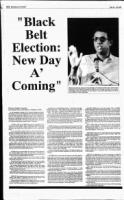
Stokely Carmich I, Honorary Prim Inl ter of th Black Panth r Party at Fr
H dlaagr d with the Panth r. on th Ir d Ir to work with whit �opl ,a
other matter. of their philo ophy.
Lewdness was a truly totalitarian society � the epitome of the tight,
insulated police state. SNCC people felt that if they could help crack
Lowdnes, other areas - with le brutal reputations would be easier to
organize. This might be considered a kind of SNCC Domino Theory.
There were several Black organizations in Lowndes County, all
centered around the church ... Some of the mo t poli tically-oriented people
who subsequently formed the Lowndes County Freedom Organization
were those experienced in the internal politics of the church.
The ability and power of the local leaders, however, rested inside the
Black community and was geared toward religious and social affairs only.
Many people who were very political inside those organizations were
unwilling to enter the public arena. They were afraid.
THE BlACK people mast respected by the whites in Lowndes County
were the schoolteachers and the two high school principals. But, as in
many southern communities, they were at the mercy of the white power
structure .
They held their positions at the sufferance of the whites; the power they
had was delegatedto tbenrby the white community. And what the master
giveth, the master can take away. The power of the Black principals and
teachers did riot come from the Black community, because that communi ty
was not organized around public political power. In this sense, they were
typical "Negro Establishment" figures.
The question of leadership in the county was crucial. If there was to
be a sustained political assault on racism, the Black people would have to
develop a viable leadership group. The white-established Negro leaders
- the teachers and principals - were looked up to by the Black
community because they could get certain things done. They could
intercede with the white man, and they had certain other credentials of
success: a big car, nice house, good clothes. The Black ministers
constituted another source of leadership.
They have traditionally been the leaders in the Black community, but
heir power lay inside the Black community, not with the white power
structure.
IN SOME cases, they could ask white people to do certain things for
Black people, but they did not have the relative power possessed by the
white-made leaders. The ministers, likewise, could invoke the authority
of God; they were, after all, "called to preach the gospel," and, therefore,
their word had almost a kind of divine authority in the Black community.
There was another set of leaders in the Black community of Lowndes
County. This was a group of middleaged ladies, who knew the community
well and were well known. They were to play very important roles in the
political organization of the Blacks.
They had considerable influence in the Black community - being
staunch church members, for example - but they possessed no power at
all with the white community. '
Economically, Lowndes County i not noted for i
distribution of goods and income. The average income la t most 0
them sharecroppers and tenant farmexs,' about $98S per year. Eighty-six
white families won 90 percent of the land. Inside the Black community,
there were in 1965 few people who had running wa r in their houses; only
about twenty families had steam heat, and the rest got by with stove burners
and wood fireplaces to keep warm. The economic insecurity of the latter
is obvious, yet as we have een, even the "Negro Establishment" faced
disaster if they started meddling in "white folks business. "
AGAINST THESE odds, there had somehow been in Lowndes
County along history of Black men who started to fight - but were always
cut down. Mr. Emory Ross, who later became an active participant in the
Lowndes County Freedom Organization, had a father wbo was a fighter.
He was shot at several times, and his home burned down at one ttme,
But he continued 10 struggle, and he was able to impart his determination
to his son.
There were a few more like him. Spurred by the demomt,.ations and
Dr. King's presence in Selma in early 1965, some 17 brave people rallied
around Mr. John Hulett, a lifelong resident of the County, to form the
Lowndes County Christian Movement for Human Rights in Marcb of that
year.
SNCC workers began moving around the county shortly afterward,
talking a strange language: "Political power is the first step to
independence and freedom. You can control this county politically." ,It
was exceptionally difficult at first to get Black pe�le to go to the
courthouse to register _;_ the first step.
THE FIGHT at tbatpoint was waged simply in terms of being able to
establish within the Black community a sense of the right to fight racial
oppression and exploitation.
This w a battle of no small proportion, because Black people in this
county - many of them - did not even feel that they had the right to
fight In addition, they felt that their fight would be meaningless. They
remembered those who had been cut down.
r-rom �h to August, 1965, about fifty to sixty Black citizens made
their way to the courthouse to register and successfully passed their
registration "test." Then, in August, the 1965 Voting Rights Act was
passed and federal "examiners" or registrars came into the county. No
longer did a Black man face literacy tests or absurdly difficult questions
about the Constitution or such tatics as rejection because one "t" was not
properly crossed or an "i" inadequately dotted. The voting rolls swelled
by the hundreds ...
THE ACT of registering to vote does several things. It marks the.
beginning of political modernization by broadening the base of
participation. It also does something the existentialists talk about: it gives
one a sense of being. The Black man who goes to register is saying to the
white man, "No." He is saying, "You have said that this is my place. This
i where I bould remain. You have contained me and I am saying 'No' to
your containment I am stepping out of the bounds. I am saying 'No' to
you aDd theIeby I am creating a better life for myself. I am resisting
someone who has contained me."
That is what the first act does. The Black person begins to live. He
. begins to create his own existence when he says "No" to omeone who
contains him.
But obviously this is not enough. Once the Black man bas knocked
back centuries of fear, once he is willing to resist, be then must decide how
best to use that vote. To listen to those whites who conspired for so many
years 10 deny him the ballot would be a return to that previous subordiDa1ed
condition.
He must move independently. The development of this awareness is a
job tedious and laborious as inspiring people to register in the first place.
In fact, many people who would aspire to the role of an organizer drop
off simply because they do not have the energy, the stamina, to knock on
doors day after day.
This' why one finds many uch people sitting in coffee shops talking
and theorizing instead of org8ni.zing.