

n
F ter'
told in
Photo
Fo ter' influ n on th g m
beg n in e m t when he w hired
by own r Frank LeI nd to man
th Chicago Leland Gi n in 1906.
Leland h d b n involved with other
club before Fo ter arrived, but
Fo ter' Giants were the first to cap
ture the hearts of Chicagoans -
often drawing up to 6,000 people on
a Sunday wh n Fo ter w pitching.
THE LELAND GIANTS were
regarded a the one of the toughest
teams in th country, and an August
1908 erie against Mike Donlin's
All-Stars highlighted the early years.
. Fo ter was the centerpiece of the
Giants' triumph in the ix-game
series and he played his role for all it
was worth.
After the Giants took the field in
the first inning, Foster would wait in
the dugout until all were in position.
Then he would stroll slowly to the
mound, the ovation growing with
each step.
Leland and Foster parted ways in
1909, when Leland refused to relin
quish part of the control of the busi
ness side to Rube.
'In a s ubseq uent court case,
Foster, oddl y enough, wa allowed
In 1910, th Gian went n maz
in 123-6 - winning percentage
of .954. In the Indi n poli
Fre m n, a Bl c n w paper, Fo ter
i ued n open challenge: the
Leland Giants ould meet "any club
in th world for eries of gam to
decide the ch mpionship, for a ide
bet of 500 to $3,000, or for 75 per
cent to the winner and 25 percent to
the 10 er, or for all the gate receipts."
Th next year, Fo ter joined for
ces with owner John Schorling, who
rebuilt the former White Sox park
into a 9,000- eat stadi urn and named
it after himself. With a new home to
play in, the team was renamed the
Chicago American Giant. And
Leland added to the confusion by
reclaiming the name "Leland
Giants" for his ballclub.
The American Giants continued
their domination over opponents for
the next several years, al though there
were two glaring defeats. In 1911,
Jess McMahon's Harlem-based Lin
coln Giants took a hard-fought series
from the Chicagoans. And in 1913,
Foster's temper helped the In
dianapolis ABCs to beat the Giants
in a nine-game series, 5-4.
In the econd game of the eries,
Foster, coaching first base, had pick
ed up his first baseman's mitt and put
it on. (In those days, it was common
practice for players to leave their
glove on the field.) The ABCs first
baseman, Ben Taylor, asked the um-
New book on
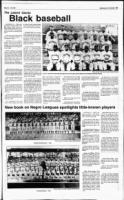
In 1911 the team' nam w
Photo court_y of the Negro Leegun Be
chang d from th Chicago L land Giant. to the Chicago Am.rlc n Glanta.
�
pire to tell Fo ter to remove the
glove. Foster refused, a ruckus en
sued, and Foster was ejected. Fo ter
left the field, taking hi team with
him, and the game was declared a
forfeit. Foster protested, but the for
feit stood.
Both league uffered orne tough
time in the first few years, and
Fo ter wa often the ubject of team
owners' ire.
As National League president and
secretary, he received five percent
off the top as booking gent for all
league contests. He w also in
charge of hiring and firing umpires,
and it was up to him to settle dis
putes. And, naturally, he was still
erving manager of the American
Giants.
FO TER HAD LONG advo
cated the formation of a Negro
League, and he finally saw his dream
realized in early 1920, when the
Negro National League - termed
"experimental" by its founders -
formed. The National League wa
comprised of teams in the Midwest.
In 1923, th Ea tern Colored League
was born.
Rube's far-reaching power
frustrated the owners.
Criticizing Foster was a joke, ac
cording to one owner: "[We can] file
a complaint against Manager Fo ter,
mail it to Secretary Fo ter and then
President Fo ter will decide."
Foster's fortunes started downhill
in May 1925, when the team 'was in
Indianapolis for a eries against the
ABCs.
OSTER WAS ALONE in his
hotel room when a pipe ruptured;
he w unconscious when found by
one of his players who had stopped
by to visit. After a brief stay in the
hospital, he went back to Chicago to
recuperate.
He came back to run both the:
NNL and the Giants the next season, .
but it w apparent that tress and his :
near-fatal accident were taking their
toll. He left on what was to be a long:
and re tful vacation, but he returned :
to work after just a few days. ·
Shortl y thereafter, he utIered a:
nervous breakdown, was declared:
"mentally irresponsible" and placed:
in a mental institution in Kankakee,:
Ill, He remained there until he died'
.
December 9, 1930.
egro League
potlight
llttle-known players
Kan.a. City Monarchs - 1942
The 0 roit Star. - 1921
MA ITfTUCK, .N. Y. - Some of the
names are familiar: Josh Gibson,
Jackie Robinson, Cool Papa Bell
and, of course, Satchel Paige.
A new book will shed light on
numerous other players who starred
in Black baseball from its beginn
nings after the Civil War to the
demise of. the Negro Leagues in the
195CB.
"The Negro Baseball Leagues: A
Pbomographlc History," published
by Amereon House, is scheduled for
release June 1.
The book, authored by Phil Dixon
with Patrick J. Hannigan, i the first
comprehensive history of Black
ba eball ever .published. The 364-
page work contains more than 600
photographs, many never before
published.
Some thumbnail sketches of
lesser-known players who e careers
helped shape the success of Black
baseball:
Smoky Joe WID m Williams
played for a number of teams in a
career than began in 1897 and ended
in 1932. In a 1952 poll of former
Negro League players and officials,
he was voted ail-time best pitcher
finishingjustahead of Satchel Paige.
The 6-foot, 5-inch right-hander once
struck out 27 Kansas City Monarchs
in a lO-inning game.
Wilber (Bullet) Rogan Rogan
pi tched for the Ka nsa Ci ty
Monarchs for 17 years and, despite
hi diminutive tature (5-foot 7-1/4)
boasted a wicked fastball. "Don't
think they called him Bullet for noth
ing," said one of Rogan' catchers.
"That guy had a ball that w almost
too fast to catch." Another catcher,
Frank Duncan, used to put two three
inch steaks . into hi glove before
g me . Rogan pitched. "Rogan'
would pound them into ground beef
before th eighth inning," Duncan
aid.
Bud Fowler Born John W. Jack
son (why he changed his name is
unclear), Fowler became the first
Black man to participate in a profes
sional baseball game when he took:
the mound for the Lynn (Mass.) Live
Oaks in 1878. His 1913 obituary
said Fowler was "at one time one of
the most famous ballplayers of thC
country ... The man who was first to
eros the color line, the founder o(
the Page Fence Giants, who prac
ticed his craft in all corners of the
country, was 54 when he died of
pernicious anemia." �
Oscar Charle too Charleston,
an outfeilder, played for In
dianapolis, Chicago and Pittsburgh.
Dave Malarcher, him elf an out
standing player and manager, called
Charleston one of the greatest of all
time. He was "greater than Ty Coob
and Babe Ruth," Malarcher said, be
cause Charle ton was a "good defen
sive .as well as offensive player."
A nnth,.r nnc:,.r"pr nnt,.r1 thA.t
George (Mule) Suttle A fIrst.
baseman, he wasn't strong defen-.
sively and he didn't hit for 11 great
average.
But he was famou for the
thunderous home runs he launched
for the St. Louis Stars.
Norman (Turkey) tearne
One of the game' great outfielde�
and luggers, he first made a name:
for himself with the Detroit Stars iIl
the 1920s. "lfTurkey Stearnes i n']
in the Hall of Fame, " aid Cool Pap.
Bell, "I don't know what I'm doin
there."