
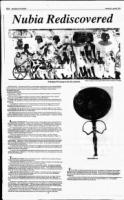

A NLiblan Prince
in h r Ox-chariot.
(Photo courtesy of The Oriental I ntiMe of the University of Chicago)
EDITOR'S NOTE: Never heard of Nubia? No, your knowledge of ancient history is not necessarily «/icielll.
Even top scholars have gNOI short shrift to this important African civilization that vanished centuries ago. Now
Nubia is being given its place in the sun, thanks to organizations such as Chicago's Oriental Institute. '
BY HERBERT Q CCANN
ASSOCIATED PRESS WRITER
CHICAGO (AP) - Artifacts saved from the waters of the Nile are helping to shed light on a little-known great
civilization of ancient Africa.
While the world .long acknowledged the importance of Egypt, neighboring Nubia, whose civilization
. began 10 flower around 38(X) B.C., bad fallen between history's cracks 1lIltil recently,
A c1iIplaJ at the Univemty of Chicago' Orientallnstitute i among the latest evidence of archaeology' new
appreciation of the significance of this sophisticated ancient culture, which may have given Egypt the concept of
the Pharaoh.
"It i important for everyone to realize that sophisticated civilizations other than Egypt existed at the time;
that central Africa has a place in history," says Timothy Kendall, associate curator of Egyptian and ancient
near-Bastem art at Bo ton's Museum of Fine Arts.
The beginning of this new-found interest in Nubia can be traced to a decision by Egypt in the early 1960s to
harness the power of the Nile River by building a high dam outside Aswan. Before construction began, Egypt and
Sudan opened the area south of the city to archaeologists.
More than 30 years later, the fruits of that labor are going on display in a few museums around the world, as
scholars reassess the intertwined civilizations of Egypt and Nubia. The exhibit at the Oriental Institute contains
more than 100 Nubian artifacts, including jewelry, pottery, statues and a pair of sandals - a fraction of the 5,000
items uncovered by the institute during decades of digging;
A MORE COMPREHENSIVE and permanent exhibit of Nubian artifacts will go on display May 10 at
the Museum ofFme Arts in Boston. Nubians "were interacting with the Mediterranean world," Kendall says.
"They were llterate, urbanized. They had sumptuous tombs and temples. The Greek poet Homer describes the
Cushites - as they were then known - with h�roic adjectives. The Egyptians were awed by their wealth.
"As a result of excavation in the 19608, enough has been recovered to show that Nubia was a sophisticated
culture _ outside the shadow of Egypt," says Emily Teeter, curator of the exhibit at the Oriental Institute. The
most significant artifact on display in Chicago is an incense burner engraved with a seated ruler and a crown and
a faloon, twin motifs that became the symbols of Egypt's kings. The burner dates from 3100 B.C. or earlier,
meaning it oould have predated Egypt's Pharaohs.
"The idea of a Pharaoh may have come down the Nile from Nubia to Egypt," says Bruce Williams,
cataloguer of the artifacts in the exhibition. "That would make Nubian civilization the ancestor of Egypt's, at
least in one cri�cal peel"
For years little was known about the Nubians. Even accounts from the time when the civilization was at its
peak are sparse .. "They were so far from the Mediterranean world, that not much of their history was written by
classical writers," Kendall says. There were explorations in the region at the turn of the century. One notable
foray was in 1909 by George Reisner, the Museum of Fine Art's curator. But race tinged the scholarsbip of
Reisner and OtheIS who dug in the area.
"A product of his times, Reisner didn't understand he was digging up an lndependen; African kingdom as be
moved up the Nile into Nubia," Kendall says. Instead, arcbaeologists of the time portrayed the Nubians poor
neighbors and imitatOlS of the Egyptians.
"In the past, white European scholars that explored the Sudan couldn't believe the works they found were the
works of Black people," Kendall says. "A lot of early writing (about Nubia) was confusing because it took away
the credit due to the Africans."
T EETER SAYS NUBIAN culture was divided into periods. At different times in its history. Nubia bad
different bunel patterns and varying tomb types and art.
"What caused these differences, we don't know," Teeter says. "If there is a change in art or tomb styles, does
it mean diffe�nt people lived in the region? H so, where did they come from?'" .
Teeter says that what is certain i that Nubia had a very strong effect on Egypt. Kendall says the Egyptians
had wealth in food, but their luxuries came from central Africa. The Nubians were the middlemen in that trade
bringing in herbs, ivory, ostrich feathers, leopard and giraffe skins, and gold. "Nubia became rich and powerfw
something like the oil states of today," Kendall says. "Eventually, they became so powerful they were a threat t�
Egypt, and it became simpler for Egypt to take control.'
"Egypt ruled Nubia from about 1500 B.C. to about 1100 B.C.," Teeter says. There isn't a great amount of
evidence of what life was like in Nubia then because mo t of the records of the time are from the Egyptian
perspective, and they treated the Nubians as inferior.
. "We do know the Egyptians installed governors and maintained trade between the two cultures," she ys.
In fact, the age in which the Egyptians controlled Nubia is considered Egypt's Golden Age. Most of the
well-known treasures of Egypt, including those from the tomb of King Tutankbamen, were from Nubia, Teeter
says. .
The tables were turned about 750 B.C., when the Nubians conquered Egypt and established what is known
the 25th dynasty. When the Nubians arrived, Egyptian culture was stagnant. But it flowered again under Nubian
rule, which fostered art and grand temples. "They were portrayed good and pious rulers; beneficial to the
country," Kendall ays. "They were more feeling than the earlier kiri�. They showed mercy to their opponents.
They didn't butcher people. They didn't put prisoners to death. They put them to work."
The Nubians were well on their way to re-establishing the power of Egypt when they were pushed out by the .
invading Assyri� a century later, Kendall says. The Nubians returned south, where they continued to prosper,
although their temples and pyramids became smaller an� more influenced by the cultures to their south.
Hand Mirror
. F OR A.TIME, � Nublaos communicated and �te in the language of the Egyptians. They eventually
developed theu own language, which bas yet to be deciphered, However, they did expand south of modem
Khartoum, where burial mounds and jewelry have been found. Nubia remained independent long after Egypt
fell to the Gree , Rd'maDs, Byzantines and Arabs. It extended civilization to other Africans along the Nile,
Ke�gys. .
Most Nubians converted to Christianity about the 6th century and historians note that Nubia participated as an
ally in the Crusades launched by Europeans to free the Holy Land from Moslem rule. The dvilization
�ventually disappeared, but DO one knows why, Teeter says.