

,
rTHO. H ro
WE ARE
EVERYWHERE. ot only
re African America in
Utah, but they are doin
eno earch itb re
to Afroc::entri m.
Afrocentricity a con-
cept developed by Dr.
M left ICc Aland, Pro(i r
of African American Studl
at Temple Unive ty, PA.
Two prime exampl are
D • Fo t C. Crawford aDd
Dally E. Oliver of Weber
St te University in Ogden,
Utah.
I d the pie ure of at-
tendin timely ion that
they pre ented at a con
ference of the National As-
ociation of Black Cultural
Centers titled "The Role of
Afrocentri m in Multi-Cul
tural Centers: Perspecuv
from the Intermountain
West."
THE REGION called the
Intermountain West covers
Utah, Wyoming, Idaho and
Montana.
As you know, from time to
time, HILTON: HIGHER
EDUCATION pre ents
profiles, articles and opinions
of other scholars, prac
titioners and re ders.
We are confident that you
will find their ob ervations
and comments valuable.
Educators of African descent
continue to forge inroads na
tionally and internationally.
The workshop that they
presented ad as its purpo
to "discus the challenge of
Multi-cultural Centers tn a
region dominated by Anglo
Americans (Intermountain
West)."
In addition, the presenters
discussed "Afrocentricity" as
a means of "preserving the
strength, self-di clpltne and
intellectual growth of centers
charged with enhancing the
relevance of the African
American student'S college
experience. "
AS A FORMER dean ofa
multi-cultural student affairs
office at a major university on ..
the East Coast, and now as the
Dean of a center primarily for
students of African descent
- on the West Coast, I under
stand firsthand the discus
sions within African Cultural
Centers regarding "our fu
ture."
Forrest Crawford and
Daily Oliver should be com
mended for their efforts in ex
plaining and strengthening
the issues of Afrocentricity
(Africentricity) and Multi
Culturalism in higher educa
tion.
This is particularl y
relevant when one realizes
that during the fall of 1990, in
the Utah Higher Education
System, only 575 African
Americans were reported as
enrolled.
"WHETHER ITS cur
riculum infusion in public
schools, studies in Africa or
slavery and the Black
American experience," they
noted, "Afrocentrism is a
widely recognized movement
that combines scholarship
and the sense to reconstruct a
definitive world view that
place them at the center' of
hi torical development; in
fact becoming the subject, not
the object."
They concluded by iden
tifying the following as cru
cial delivery systems for
Afrocenterism in Utah:
1) Departments of Black
Studies, 2) African and
African American History
Cia es, 3) African/African
faculty Member(s) Applied
Pedagogical Methods, 4)
Multi-Cultural Centers and 5)
Community Ba ed Leader
Ship.
Let's talk. (114)899-0650.
Ethical behavior to rd e ch
other w an important fe ture of
the African- erican communi ty.
The violence of Blac -on-BI c
crime and the peddling of dru to
innocent children ere denounced
socially de tructive behaviors
hieb have to be espclled from the
Black community, if it is to
survive.
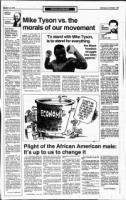
However, during the recent rape
trial of former he vyweight
champion Mike Tyson, distwbing
trend developed ithin the
national African-American
community. Some compare
Tyson' pro ecution unfa orably
to the acquittal of William
Kennedy Smith in last years
controversial rape trail. Others
complained that the behavior and
motive of Ty on's victim were
"highly questionable."
Why would De tree
Washington, an intelligent woman
who had been crudely
propo j tioned by Ty on earlier in
the day, willingly go back to his
hotel room in the middle of the
night? Black Baptist ministers
clustered and prayed for the Black
pugilist in his hour of need.
WITH TYSON'S conviction,
VIEWS OPINIONS
ome of these sentiments umed
ugly dimensions. A Black tudent
new paper in New York City
declared that the young woman
raped by Tyson "willin y went to
'Dis hotel room to win hi ame and
fortune, but realized that a
one-night stand would not have
been enough." Tyson's conviction
was "a grave injustice to the whole
Black community," because the
"10 of another Black role model
means tbe imprisonment and death
of many of our Black youth."
At ome BI ck radio stations,
telephone call ran at least five to
one in favor of Tyson and gainst
the woman he had raped. Many of
the callers supporting Tyson were
BI ck women.. Some argued that
the woman's decision to enter a
man' bedroom voided any right
she held to claim that she had been
sexually violated. The same
attitude could be observed on the
stree •
In Lo Angele everal days
ago, I itne ed leveral BI ck
young dults- male and female
��W�Sw" hlm ch
prote ted the Tyson rape
conviction in bold letters. In
vulgar, sexist language, the shi11l
proclaimed: "The b-aet me upl-
Enough il enough. On thil
issue, we must draw a line. To
rican
light of the A rican �m
It' up o u to change it
As I anticipated reading the
<summary of the legislative hearing
of the African American Male, I
was looking forward to seeing the
projected facts, solution for solving
the problem and changing the
decaying ituation of African in
America.
But before I was able to read the
summary, one of the "major"
presse had an article that
summarized the hearing ummary
by saying tbat a University of
Chicago report predicted that at
least 70 percent of all Black male
would be on drugs, impri oned or
dead by the year 2000.
One would believe from the
article that the University tudy
wa the conclusion of the
Legislative hearing. In reality it
was only a added point to validate
the severity of the hearing.
Ironically after staying up late to
finalize thi article, the next day 1
came home for lunch and the
telephone rang.
operator said, "You have a collect
call from a Kenneth (my son). Will
you accept the ca1l?" I said yes.
Then the. person on the other end
said, "Dad I been shot, come and
get mel" I said, "Where are you?�
He said, "On Greenfield and
Fenkell."
I panicked and ran to my car and
race to Fenkell, to find no one
there. I then went to his chool to
ee if he wa there. He was, and
what a relief!
I take serious the University of
Chicago study and the report from
the Executive Hearing that said
today:
- One in every four young
African-American mal age 20 to
29 are behind ba ,on parole, or on
probation.
- The incarceration rate for
African-American male is 3109.
per 100,000 in Democratic
-American. While it' only 729 per
100,000 in South Africa.
- Young African males living
in Wayne County have the highest
ch nee of being a victim of a
homicide than anywhere else In the We don't have to let any
U.S.A. negative prediction become the
- African-American males future.
have the greatest risk of cancer, The hearing concluded lth
diug abuse, hypertension" offering many IOludoDi that ould
homicide, chronic lung disea e, peaktotheneceuaryworkneeded
cerebrovascular di ease, to make change neee Itry for
cardiovascular disease, and creating a new positive
exu11y-transmitted di ea es than environment, capable of
other Americans. developin new and productive
A important point not made at human being! ",'
the hearing by Jawanza Kunjufu in
hi book, "BI ck Economics," is
,that in the African American
community the largest employers
have become the mili tary,
McDonald' , and and drug
dealers." We have a complex
economic, political, nd social
dilemma.
. I believe that the University
prediction reflect a mechnical
approach to reality, that ociety i
static, and can't be Changed. I
believe that thin can continue the
ay they are or we can intervene
and Change The Way Things
Are-That We Can Change The
World Around Us!
I AN WERED it and the
SOME OF THESE positive
projection and lolutions for
olving today problems ioclude:
- African Americans must see
themselves as contributing
members of society.
- To see the need to declare
WaronDru .
- To never give up on the
African American male.
- To develop po Hive role
models etc.
- To include Afrocentric
appro ch in our scboollY tem etc.
It wa clear as that the
leadership of the bearings believes
\
INSTEAD 0 PROJECTING
a vilion of bumani ty blch'
emicbea tile Iplrit, we devalue aad '
degrade ounel
No, doubt, Black men autrer '
dilproportionately from tbe
violence and discrimiDation of the '
political and criminal jUltice '
I,.tem. RaciJm is alive and wen, .
limiting Black males' ecoDOmiC
opportunities. But the pain of :
opp ondoeln'tjUltifyviolcoce I
apiDat another pellOD. TysoD II
pUlJ, aDd for the sake of our own •
humanity. e mUit draw the liDe.
Dr. MlIlIlIill, MGrllble i6 I
Pro/euor of Polilklll SclMce IMIl
Hhtory, UlIlwnity 0/ ColoNilo,
BDMldt:r. -Aloft,. Co"" LiM- ,
.".,S ill tWe- 220 JHlblkllliou
�yllNllI rtUIio ..... 1M
is brolldclUt by IIIore tluut SO
slllliDu.
I
•
•
the recommendatioDl in the report
can erve u a catalyst for the
development of programs that will
preserve the future of tbe African ,
American male. the preaent and
past dilemma is the "consequcncea
of the failure of America society.-
We as African American �CI
must take responsibility for our i
actions, and our future. Changing
our society il something we can't
do alone and that'a hy it'l
important for to organize Itb
other to become a part of tbe
olution.
.
Please get involved by .:
contacting one of the groups listed :1
in the ummary, beca our future .
dependl on it. For copiea of the •
summary please contact the Detroit ·
City Council Youtb Advisory .'
Commi ion or The Detroit Urban •
League.
Kenn th nodgr
)