

ENTERTAINMENT
BRIEFS
front
Byth Y
AQeve
rape Sim
nxms, ("Run" of b � "Run
D ICX:U!Ier
"One d Y I al n in my
net hborhood ith my guitar
e," recall J .R., one-fourth of
tbe new Columbi recordln group
Joe Public, "and this kid com up
to me nd me if I'm carryin
turnt ble . He didn't even think
that it might be n instrument. Th t
Th R port d i one of our inspiratio for play-
B k f G ing live music - e ant to make
r Up 0 uy people appreciate it again."
Ups are flapping about the It i thi ze lous pproach to
rqx>rted b� 0 Guy. BET their music th t m kea Joe Public
and Black Radio Exclusive - J.R., Kev, Jake, nd Pew - 0
"Map:zinc rqx>� "it' 0\Ie('. unique. Each of the Buffalo, New
MCA ys that Guy i till York native has been playing in-
together. Aaron Hall: Itruments and inging inee pre-
We're separated. We are not adol cence and e ch has had little
filmhcd. We've j t Ialcm a little or no formal musical training.
hiau." Now in their early 20's, the
In � meantime, Aaron' 10 members of Joe Public acknow-
project, getting a great deal of ledge a Who' Who of R&B's
airplay. musical giants pivotal to their
development. Thi 11 t ranges from
Facing Vlolenc Sly and the Family Stone, Parlia-
At th Movl ment-Funkadelic, and Rick James
to Prince, Cameo, Teddy Riley and,
Safety became � key ue at of course, the multi-dimensional
a �nl minar speaking i> tm: sounds of the hip-hop nation. "We
impo� ofBlact fibm. are alway on top of what' new
Robert Townsend, George and, between us we have a erious
Jackson, Doug McHenry, War- under tanding and respect for
ring1OnHOOlinmJJohnSinglek>n what' come before us," explains
(who last month became the Dew.
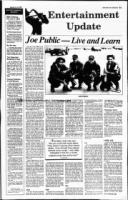
youngestevertobe�fbr JOE PUBLIC, their elf-titled
an Oscar in the best director debut album, is a fusion of all fhe e
caegory) wee on haOO. musical legacies and then some.
"If tb:ater 0WIYlS come k> � Laden with hooks, traditional R&B
concl usion that .they cannot melodies, and an everpresent hip-
properly safely bop Davor, the album· 8 remark·
films,.1hen � q,iadlM.�I��:��4III]�y to .
tIDe films n.te quartet p 8U the Insuu-
qlationposcdbyWilliamF.Kar. ments on the album, collectively
tozian, president eX � 3,(XX)- wrote all the songs, did all the vo-
strong National Association of cals, performed the deejay
1beatre Ownr& cratche ,created the samples, and
The amwer for JmSt preseD even co-produced the album with
. (with � exception of Robert their manager Lionel Job.
Townsend) was to blame � (Joe Public's versatility, it
media for blowbw iI¥:iderra of should be pointed out, is not
violence out of proportion. limited to their own recordings. In
Doug McHemy cl George fact, they co-wrote and played all
Jackson (/{ew Jack City) sug- the music for "Keep It Com in " " the
pled Wednesday night open- title tune single of Keith Sweat's
ing»; the hiring of more mioority third album, a late-'91' release.)
youth at theaters; eliminating � JOE PUBLIC's first ong and
late night showing during � lead single, "Live andLearn", is an
opening wcekemts; mJ PSA's i> uptempo track packed with live
address the· uc of safety in til: drums and bas , gui tar licks, and
theater,asawaytocwbvioleoce. running piano. As Kev and J.R.
share vocal duties, the tune inter-
. weaves catchy samples, a drum
loop and a rap by Kev. A candid
song that encourages the pursuit of
life to its fullest, "Live and Learn"
is a reminder that lessons should
always. be gathered from ex
perience: "Some people have to go
through so much more/before they
really learn about life's scorel the
SUbject i not to be ignored."
"This One's For You" is a
smoothly textured number in the
hip-hop tradition. Sandwiched
neatly between percussions and
bass, J .R. and Kev provide the raps,
as Jake leads over the floating
chorus. Tailing the melody are
"shout outs" to some very famous
ladies. "1 Like ItN. has a deep funk
element provided by guitar,
clavinet, and wah-wah pedal. "That
song definitely has the P-Funk in
fluence," says Jake, who sings lead
on the track.
Equally appealing are the two
ballads, "When [ Look In Your
Eyes" and the seductive "I Miss
You,". which samples actual
thunder howers. Midtempo tunes
"Anything and "Touch You" further
demonstrate Joe Public' musical
flexibility, as does the provocative
"Do You Everynite;" a tune sure to
rai e some eyebrows on both the
R&B and pop cene .
True to the lyric of their first
Ingle, the four members of Joe
Public have been living and learn
ing ince childhood. They grew up
in the ame neighborhood on the
eastside of Buffalo, a working clas
area. But through the course of
their individual journey they came
together to create mu ic reflective
of their arti tic dedication.
WHRE 'nIlS PIAN came
wxlerfire by many iochltingJohn
Singlek>n, spades really began k>
fly when Robert Townsend
pointed to � marketing of tilJm .
(aqd not the press) formuchof�
violence, as well the perpetua
tion of stereotypes tIIlt fee it
"Look at � ads mJ trailers for
these nxMes .• Let's face it," said
TownseOO,'s "some as praying for
a dri�by, because it often nam
that you film ooes well. However,
I'mcoreerred about the welfare of
Blacks in movies.
My next film (with values) is
for children, because they are
being fed a ady diet of violence.
How we're presented on that
screen has got k> be roore hwnan "
Townsend's remarks drew harsh
aiticism.
"Black movies do rot cause til:
violence existing in our society,"
reported Goorge Jackson. "It hap
pens every Friday night but
doesn't get documented. Ore of
the most profouOO statements in
John (Sing1etDn)'s movie is 'my
brother was killed and oobody
reported it'. Somebody subs their
toe in a theater and it's national
news."
The bottom line, counters
Townsend, "is that Hollywood is
beginning to sell violence to
African-Americans, - oothing
but. I think they've taken some
cheap sbos and we have to be
more aware."
A to his own view •
Towmend ys,"1 get,beat \4) on
it alot, but I have a different \'er
ion."
- complied by K. Bar
- special coDtribulora: U ..
Collin (Bebind-The. en )
RadioScope ... The C::olumn
z
JOE PUBLIC
'ODe. "I ��IClPl&�)Aa e hous ' banging on
eight," he say . "�.lJIii� remem rs."1 use to
piano in the attic and I tried to learn mess up my mother' frying pans
how to play by pounding out notes. real bad, just beating on them. But
Noticing that I had an ear for by the time I was 11 or 12, I gue s
music, a teacher at school gave me my mother got the hint because she
some books on piano playing." Ob. got me a set of bongo for
viously proud of Jake's musical Chri tmas." Encouraged by his
prowess, his mother bought a guitar parents and sister, Dew immersed
for him the next year, "a Sears himself in the sounds of jazz and
acoustic guitar," Jake notes. "She P·Funk. "I never had any lessons,"
knew I had ome type of talent and he aays. "I just learned by ear."
wanted to encourage �hat." After Dew teamed up with Jake,
The product of a musical family Kev and other neighborhood pals,
(his mother and older sister Sing in Dew's family invited the young
church choir and his younger iter men to practice in their home.
plays the flute), Jake played trum- "Jake was the guitarist in the band
pet in his elementary school band, and Kev was playing the
more or le putting his intere t in saxophone then," says Dew. "I
keyboards on-hold. By seventh played percussions. We needed a
grade, he had teamed up with Kev, keyboard player, so Jake, who also
Dew, and other neighborhood kids plays keyl, Ihowed me how. I pick-
eager to form a band. Back then ed it up real quick, too. When
Kev was playing the sax. Original. you're in a band, you learn other's
ly there were at least 15 members habits fairly cuily."
in the band; we had a girl ectlon, Jake credit. Dew's manual
a guy section, and even a hom sec- skills with hi -adaptability as a
tion - and nobody was goodl" musician. "We call Dew 'handy-
he started teaching me. It w at
th t IJJatag ,bar developed a
strong R&B base."
Born to a large family, Kev and
his five brothers and two i ters
were raised by hi mother, mainly,
and his stepfather, who played the
blues. Quickly acquiring kills as a
bassist, Kev shelved his musical
skills between ages 11 and 13 while
he played football and hockey. By
the time he entered Seneca High,
however, his musical ta tebuds
peaked again and he joined the
school band, learning and playing
the axophone and trombone with
relative ease.
"The band didn't even know I
played bass until I fined in for the
bass player on a few occasions."
Kev was encouraged in his musical
pursuits by his family, but add that
there was a "you-need-to-get-a
job" tone lingering in the air. "I
worked in a couple of deli's while
in high school, but once I teamed
up with Dew and Jake and later
J.R., when I was 15 or 16, we made
money off our music and that was
fine with me."
JAKE
For Jake, who play keyboard,
guitar, ba ,drums and ing, the
adventure into mu ic wa an off-
liThe tellas' style was raw",
IIBut you .could see super talent.
They weren't copying other bands'
styles. Even though they played
several cover songs, I was really'
interested in the two or three
original songs they performed. II
-Uon IJob
J.R.
J .R., who plays guitar, bas and
sings, was raised by his mother and
says it was his mother and his older
brother (a drummer), who initiated
his musical trek. "I think I was 10
years old and I used to w tch
musicians like the Isley Brothers
on TV. I thought what they were
doing with instruments was real
hip. That Christmas my mother
bought me a guitar; I guess she
figured it was an appropriate gift."
He took guitar lessons but found
them boring. "Les ons taught me
how to read music, which was im
portant. But they were teaching me
ongs I couldn't relate to. I reall y
wanted to learn how to play what
was on the radio."
Undaunted, J.R. began playing
music by ear and listening closely
to popular songs. Six months after
receiving hi guitar, J.R. was play
ing in a band. "My brother was in
this band and he recommended me.
I was still only ten years old and the
band member were big, over
weight, grown men. "I enjoyed
playing the music but it wa kinda
CMY at first. All tho e grown
people and me, thi little kid. I wa
hy growing up 0 wh.en I was on
tage I wouldn't move, even when
the cigarette moke wa bothering
me."
Fate bro,ught J .R. into the roup,
when th� band h \Va in hroke up,
and the uitar player plit frf'",
- _- - � - -- - -� - - - - -�
During the next three years, the
nucleus of the group (Jake, Kev and
Dew) rehear ed religiously and
played loe 1 gigs the band paired
own in ize. The pre ent con
figuration of Joe Public was
formed when the guitar player quit
and J.R. replaced him. Dedicated to
hi music, Jake h worked only
one one job be ides his '"profes-
lonal work" a musician.
As club appearance picked up
for the band, sense of howman-
hip evolved, demonstrated 'by
their self-created stage prop .
Fully .upported by his family,
Jake insists it w their encourage
ment that kept him away from
Buffalo's many street vices.
man' because he can fix anything,"
Jake says with a laugh. Always the
"fixer," I worked at this convenient
mart-and did everything: I was the
cashier, the maintenance man, the
securi ty guard, and I pumped gas."
After high chool, Dew worked
briefly at a chee e factory. "Be
tween there nd rehearsals, I was
the tirede t one in the group." As
the band booked more and more
how outside Buffalo, Dew quit
hi job at the factory. "I never
thought I would be a part of a band
on uch a serious level but it hap
pened."
KEV
Kevattribute his love for music
directly to hi older brother. "I was
about even year old when I
st rted playing music. My older
brother played b and he w my
idol. Seeing that I was intere ted,
DEW
Uke Jake, Dew' m ical creer
also began a creative, inqui itive
child. "I w real young nd going
\
THE EARLY DAYS
Together as a group since 1986,
the foursome received full backing
from their families, taming income
solely from their shows. "Man, we
played everywhere," say Jake,
"bars, clas rooms, school as
semblie , all over Canada, Niagara
Falls, and' Buffalo." Like other
young, inexperienced band, the
group was often robbed by
promoters.
Still adjusting to each other's
tyle, the group played a lot of·
cover tunes by Prince, Cameo, and
Time. The rigors of entertainment
helped solidify the band. "We've
become clo er than brothers be
cause of our experiences and level
of dedication."
LIONEL JOB
In late '87, they took part in a
"Battle of the Bands" at Tr 1-
famador (now a defunct Buffalo
nightspot), showcasing several
local bands. "W� h d developed 8
strang local following by that
time," ay J.R.ln the audience that'
evening was Lionel Job, former
producer nd manager of the
platinum act Starpoint and AclR
man at F mous Music, the publish-' .
ing arm of Paramount picture . In
vited to check out local acts, Job
admits he wa always looking for
new talent.
"The fellas' style was raw," ay
Job. "But you could see super
talent. They weren't copying other
bands' style . Even though they
played everal cover ongs, I was
really intere ted in the two or three
original ong they performed."
Job was so intrigued with the band
that he invited the four of them
back to hi hotel for an impromptu
meeting. .
Job spoke with them extensive
ly. "He b sically ran down the
music industry to us," Kev ays,
"telling us what we h d to do if we .
really w nted to be ucce ful. And
of course he explained to the
hazard of drug and alcohol, but
none of ,becau e of our early
church background , do tho e
thing any�ay." They had been
looking for repre entation, "and we
figured he wouldn't h ve w ted
�A� PIIBLIC 82
. '.