

•
•
1
'!
cont tinwhi htoe amin th i u ,
w '11 continu to mired in rh toric and the
economic eonsequen on to th n xt generation.
2) Employee p rti ip tion program ill in-
ere competition b tween wor ers. Management-
i well ware of th unemployment tati tics. The
pre ure to compet for wor will increa e.
Employee p rticipation pro ram which are
p ading to service nd retail industri ,incre -
ingly will le d to wor ers policing th qu lity and
quantity of the wor of their peers. Under a et-up
like thi , where backbiting and fault-finding are
encouraged, the po ibilitie for cap goating of
African American and oth r minority wor ers, or
women, are incre ed.
Through Quality of Wor Life schemes
management induces employees to compete for
bonuses, raises, and jobs. Workers and/or their
wages are the variable that management can
manipulate when interest rates spiral, energy cost
double and health care benefits erode profit mar-
�. '
African American workers frequently are last at
the door for employment opportunities. Ifmanage
ment can train one person to function in three dif
ferent job categories with the same wages, or reduce
. the need for the job category from seven days a
week to three or four days a week, more African
Americans will end up working part-time because
they cannot find full-time employment.
children will work under in the decade ahead.
Regional economic integration prompted by the
US-Mexico-Canada Free Trade Agreement will ad
versely affect both the wage and employment out
look for the African American worker. Unions must
increase educational program which delve into
global economics from the standpoint of the worker,
Comprised of auto, clerical, hospital, po tal,
transit and other union activists, NBRFE members
meet monthly to discuss workplace issues and
strategies and keeps members updated on national,
international, and community issues, from tax
abatement to South Africa.
The National Black Rank and File bas local
chapters and a national steering committee. They
hoI regional conferences and act as a clearin
ghouse to disseminate information.
e Exchange sees two of the chief issues facing
African American workers in the 1990's as business
unionism and mechanisms for holding union
leaders-including African American union
leaders-accountable to the 'rank and file.
The kinds of organizing that these groups-and
others-are doing points the way forward. We also
need to educate ourselves and form links with
others. Here are some ways we can do that:
- Expand education, both in the workplace and
as community outreach, to explain changes in the
global workplace to African American workers and
their community.
- Hold house meetings, establish workplace
educational committees, send in articles to union or
community newspapers.
- Establish correspondence with sister unions
in other countries, such as Mexico, or within your
state to talk about workplace strategies.
Use the editorial page .. end in your views on labor
and workplace issues which affect African
American workers.
- Develop or join community based coalitions
which can connect workplce and communi ty issues.
Clearly the political system in the United States
does not recognize Afrlcan American achievemeftt
or permit a smooth entry into the gre ter SOCiety .
The way we deal with this fact will set the stage for
future growth in wages and employment oppor
tunities.
Because of our history of struggle, African
Americans have a unique opportunity to playa
leading role in any progressive movement for
change in the 1990's-from independent political
action to demanding a peace dividend to fighting the
effects of "free trade." It is very difficult for us to
make progress without allies among white working
people-but it is impossible for them to make
progress without us. Whether the African Ameircan
worker organizes in the workplace and the com
munity will be one of the factors determining what
shape the labor movement and all working people
find themselves in as they enter the twenty-first
century.
The author is the Outreach Coordinator for the
Labor Minority Outreach Project at Labor Notes, I
7435 Michigan Ave., Detroit, MI 48210.
•
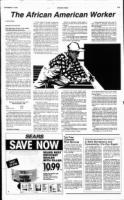
P rcent of Involunt ry Part· Time
Worker by �ac�, 1988
Some models for change:
- The three-month Delta Pride strike was the
largest strike by African American workers in the
history of Mississippi. They took on th largest
processor of catfish in the world. ,
Workers won the right to form a health and afety
committee and gained increased respect for them
selves and their ability to original "can't go any
higher" offer.
These workers, many of whom were single
parents worked to gain the support of their com
muni ties. Some would argue that if you unionize, -
your workplace is more likely to run away. But
Delta Pride is still unionized and still in Indianola,
Missis ippi.
- The Black Workers for Justice in North
carolina are organizing in a right-to-work state.
What makes their work remarkable is that they are
bringing together workers in small groups from
varied workplaces: machinists, City workers, gar
bage collectors, garment workers-you name it.
All
White
African American
25.5%
23.8%
42.4%
Source: State of WorkIng AmerIca, Economic Policy Institute, 1881
3) Deindustrialization and runaway plants. This
point was addressed Under Income above. Plants,
major retail outlets and corporations that shift jobs
from cities to suburbs leave urban communities
devastated. They leave behind a workforce that's
locked into an urban area with few transfers avail
able to the new location and no transportation. The
new workforce is usually quite different. For ex
ample, most of the new auto plants built in the last
five years are in rural locations and with mostly
white workers.
The Path to Change
SEARS
Ten Free
. Colorado
Blu'e Spruces
Minority Ocpupational Health Project Conference:
A Safe )Vorkplace and
Com unity', It's Our Right!
Ten free Colorado blue spruce
trees will be given to each person
who joins The National Arbor Day
Foundation during August 1991.
The free trees are part of the non
profit Foundation's Trees for
America campaign.
"Colorado blue spruces were
selected for this campaign because
of their many uses in the home
landscape," John Rosenow, the
Foundation's executive director,
said. "They lend beauty to their sur
rounding with their silver bJue
green color and compact conical
shape. They Can be used as in
dividual ornamentals, and energy-
aving windbreak, a privacy creen,
or as living Christmas trees."
On Saturday, September 7,
1991 in collaboration with the
Union Minority/Women leader
ship Training Project of Wayne
State U�versity and University of
Michigan the Southeast Michigan
. Coalition on Occupational Safety
.and Health (SEMCOSH) Minority
Occupational Health Project will
put. on a one da conference' to
focus on the pecial occupational
and envi nmental health needs of
the African American and
Hispanic community.
Responding to the fact that
Minority workers .are twice as
likely to become everely disabled
on the job when compared to their
white counterpart, 15% of the
African American worker is par
tially or pennanently disabled due
to injuries on the job, minority
workers have a 20% greater
chance of dying from job related
disease and injury; severe dis
ability is twice as prevalent among
Hispanics as whites; poor and
minority communities are often
hit hardest .by environmental
problem , SEMCOSH will spon
sor the day long conference. The
. conference is designed to educate
and empower area workers and the
community.
The conference will took at the
attack on occupational/environ
mental health and safety legisla
tion and its impact on minorities as
well as specific hazards in the
workplace and community .
Among them: environmental
racism, stress, ergonomics, and
chemical exposures.
. t
THOSE ADDRESSING the
gathering will be Dr. Lind Rae
Murray, M.D. from the Chicago
Area, he will be the keynote
speaker and will address the status
of minorities in the workplace; Dr.
Bunyon Bryant professor at the
University of Michigan School of
Public Heal th, Department on En
vironmental Health, he will ad
dress the issue of Environmental
Racism; and Dr. James Bles man,
M.D., Wayne State University.
. Division of Environmental and
Occupational Medicine, he will
address identifying occupational
and enviromental di ease.
The conference will begin at
9:00 a.m. to 5:00 p.m. and will be
held at the McGregor Conference
Center at Wayne State University.
There is a registration fee of $10
which includes lunch and all con
ference material .
Reg. $'12.99
The trees wiN be hipped postpaid
'at the right time for planting between
March 1 and M8&' 31 with enclosed
planting instructions. The six to
twelve inch trees are guaranteed to
grow, or they will be replaced free of
charge.
To become a member of the
Foundation and to receive 'the free
trees, end a $10 embership con
tribution to TEN BLUE SPRUCES,
National Arbor D y Foundation, 100
Arbor Avenue, Neb ka City, NE
68410, by Augus�1, 991.
Protect and beautify your
drl way now
Heavy-duty rubberized cooting
fills hairline crocks, resists gas
and oil dOmo e.
PfICt good . 7
DRIVEWAY
CRACK
FillER OR
; PATCH IX
YOUR
CHOICE
5.99091.
12.99 ,
Gal,
Reg, SlU9
12.99
Gal.
Reg. SlU9
"543 OR
5650R