

K
Deee her 16-21, 1990
MICHIGAN CITIZEN
P 11
anzaa unveiled at
AAH
By Derrick c. Le
SI!dlWriUr
You know, I've heard a lot
about Kwanzaa but I never
new what the deal was with
it, until I went down to tbe
Museum of African American
Hi tory (MAAH) last Wed
ne day.
The University Cultural
Center was hosting it's 18th
- annual Noel Night and just
about every institution in the
area was hosting orne type
of holiday event.
When I arrived at the
MAAH I got myself a prime
spot.
There were about. 250
people gathered around to ee
the ceremony, mostly parent
ith their children, and
cur:ious onlookers like
my elf.
Before st rting off the
ceremony, we were enter
tai ned by the Art of Motion
Dance Troupe, who per
formed African and modern
dance steps. The young
women wore very colorful
Afric n co tume , and per
formed their step most
lavi hly and with much ener-
gy. They were accompanied
by drummer playing tradi
tional African drum .
The audience was very
much alive during the dance,
and e nthu ia tically par
ticipated with the dancers
during call and re p�nse.
AFTER THE DANCE,
Abdul Rahem and his wife
Aba Yomi, dres ed in tradi
tional African costume,
began explaining the celebra
tion of Kwanzaa.
The word Kwanzaa means
"First Fruit." The ritual i
based on age-old African har
vest celebrations which tradi
tionally took place near the
end and the beginning of the
year.
Kwanzaa i a seven' day
celebration lasting from
December 26 thru January 1.
At harvest celebrations
African peoples' gathered
together to celebrate the har
vest and rejoice in their com
munities collective efforts.
In 1965 Dr. Ron Karenga
created Kwanzaa for African
Americans after observing
various harvest celebrations
throughout the African con-
tinent. He borrowed much of
the symbols and terminology
from African traditions and
applied it to the African
American experience to cre
ate something distinctive for
Us to celebrate.
The celebration is meant
to help Black Americans
develop a greater ense of
unity, identity, and purpo e.
The Mlsbumaa S b (the
seven candles), three red
c ndles symbolizing the
blood of African people 'and
our struggles, three green
candles symbolizing the
struggles after the struggles
and the realization of our
dreams, one black candle rep
resenting the Black man and
his family;
Klkomba Cb Umoj (the
unity cup), used for pouring
libations to invite the ances
tors to enjoy the celebration
and combine the community.
in a household. guests are in
vited to sip from the cup also;
Zawadi (gifts), given on
the last day of Kwanzaa on
the basis of merit.
The ritual calls for light
ing one candle a day for each
day of Kwanzaa.
(creativ ty). lmani (faith).
The last day of Kwanzaa,
Imani, i when libation are
poured, gift are given, and
you can ake a big dinner for
your family and friends.
Kwanzaa is not a
retiglous holiday, it is it cul
tural ho iday to bring Blacks
closer t gether, so that we
can sha in a common bond
based o� our experience here
in America, and call on the
cultural egacy of the mother
land.
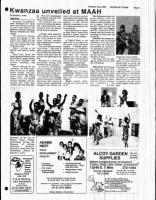
Me bers of teArt of
otion D ee Troupe
performl I durin t e
Museum of Africa
A eric n History'
Kwanza celebr tion la t
Wednesd y. (Photo by
Derrick C. Lew).
Whol Ie'
R an
African
Import.
S d.
Book.
Inc n
B k a& Print
10% -Off
F & S Gallery
1553 Woodw rd
SuJt.202
DetroIt. MI 48228
(313) 964-4247
• Chriatlan
envi ronment
• Hot meal.
• Experlenc d,
Trained ataff
ADA S
EST
CHILD
DEVELOP ENT
FACIUTY
A TABLE WAS in the
room, and on the table were
the even basic Kwanzaa
symbols. A Mkek (mat),
symbolizing the foundation
o( African values and prin
ciples. It was pointed out by
Aba Yomi that African
peoples 'are born on mats,
sleep on mats, and are l�d to
rest on mats. All the other
ymbols stood on the mat:
A Klnara (candle holder),
symbolizing the continent of
Africa;
Vlbunzl (ears of corn),
symbolizing children in the
household, children who
have l�ft, and potential
children;
M zao (crops), repre
senting the bounty of the
earth;
THE DAYS OF Kwanzaa
are called the Seven Prin
ciples. From December 26 to
January 1 the days are called
Umoja (unity), Kujichagulia
(self-determination), Ujima
(collective work and respon
sjbitity), Ujamaa (coopera
tive economics), Nia
(purpose), Kuumba
II
YGARDE �;I
PPLIES I \�!
aments for All occeston«
ALe
S
• Oevelopm ntally .
appropriate toy.
and actlvitle.
• Rea.onable rate.
• Small group.,
Hour. 10 em- 7 p.m. on
Sat 10 e. -5 p.m. Sundey.
VISA & MIls '" CQ,d Accepttld
I
1 S' MYLAR BALLOO S $1 •
PLAIN LATEX BALLOONS $3.S9 ..
STUFFED BALLOONS ertlng 8t $21.
PARTY ARRANGEME TS-
16 BALLOONS For $10.
LO G STEM ROSES $12.98 dz
GRAVE BLA KETS CONES WREATH
. various pric
SCOTCH PINES $19.
Dian. H .ter, tnreetr« a
. I
For A Per.on.' Loving Touch .
& Child Car. You Can Tru tl
Members at. 4C - Group & Fern y Ch Id AeeOCfIItiOn
U o. G082OO172
. (313) 875-8863 ,