

,
lac
Dece ber 9-15,
MICHIGAN cmZEN
p
15
over y
a e 3 -times that of
hites
Co ti
ed fro
1
p
recoverle and rise harply in
rece ions, so it is important
to reduce the poverty rate to
a low a level a po sible
before a rece ion hit. Yet
after even years of recovery,
the n tion failed to reduce the
poverty rate even to the
level of the mo t severe
rece ion ye rs of the 1970's.
With the economy now run
ning out of team and a new
recession threatening, the
poverty rate is likely to tart
rising again .. .lf a deep reces
sion ets in, it could reach
levels not seen in a quar-ter
century, Greenstein said. �
The center aid the limited
. progres in reducing poverty
in recent years also reflects a
larger .trend - an economic
recovery in which the lion's
share of the income gains has
gone to tho e at the top of the
income cale.
This development adver-
ely affect Black, the Cen
ter noted, ince few Black
Iamilie re found in the top
income bracket .
FEWER THAN 10 per
cent of Black families fall
into the wealthiest fifth of all
families, and fewer th none
in 100 Black families is
among the richest five per
cent of all families.
By contra. r, two of every
five Black families have in
come placing them among I
the poore t fifth of U.S.
f milie .
Along with the. increa e
in the number of poor people
ince the 1970' , tho e who
are poor have grown poorer,
the Center said.
The Center noted that in
1979, ome 32 percent of all
poor people lived in familie
with incomes below half the
povery line. In 1989, some
38 percent of the poor had
incomes this low.
IN 1989, half of the pover
ty line was just $4,943 for a
family of three. Families
with incomes below this level
can be termed the "poorest of
the poor, the Center noted.
The increase over the past
decade in the proportion of
the poor who fell into the
poorest of the poor category
wa expecially harp among
Black children, the Center
said. In 1979, some 38 per
cent of all Black children
lived in families with incom
es below half the poverty
line. By 1989, half of all
poor Black children lived in
families this poor.
The center found three
major factors contributing to
higher poverty rate today
than in the 1970's.
Hourly wa res for non-
petcellt
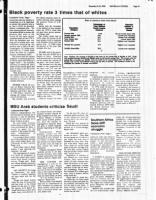
Who In America Get. How
4.6�
10.6
16.5
. 23.1
44.6
11.9
50.8
iDea .. of 116,003 or made up poo ftfth of fair lI\ 19t&. 'J1ae
$16,003 and � IMde up tM..:oM � fifth. The lnco:M for
famWII CUIDff for the next"""'p ftAh w S59,sso. All
lI\ the top ftfth of faJnWII. mlnUnum of
w�.--"111,963.
Middle three-fiftha
management worker w re
lower in 19 <) than In any
year since 197). after adju t
ment for inflation.
New Cen u data how
that between 19 8-89, the io
come of the typical Black
man working full time, year
round fell 4.6 percent, after
adjusting for inflation.
A second factor contribut
ing to ,i ncrea e in pov rty
i nee the 1970' has be en
cut in government benefit
SU Arab students criticize Saudi
p
1
women' independence, but
wa hocked to actually ee it
becau e it was 0 different
from that he w used to in
S udi Arabia; he aid.
Hc id Saudi Arabian
omen have 0 much of th ir
live determined for them, it
would be good for the
country if the women became
more independent, as
American women are.
It i wrong to force women
out of the wor force because
they could make great c�n
tribution to their culture.
B kar aid.
"Even when I wa . in Saudi
Arabia, I wa rejecting thi
tradition," he ide
The egregation of women
ill h ve to dis ppe ar a
An b men re lize ho women
could help Saudi Arabian
ocic ty, Ologl aid. Right
no ,Saudi Ar bian celery i
in a period of adjustment, he
aid.
"MY SOCIETY IS living
in tr n ition," he aid.
"There' a conflict between
the' new ay and the old
ay ."
Ologla left Saudi Arabia
when he a 19-year -old,
and ha lived in the United
States for tbe past 15 ye r .
He agree i th Bak r be
cau American women have
made many contributions' to
the United States and Saudi
Arabian women hould be
given a chance to do thi ,too.
Fauzi Najjar, a retired
MSU ocial studies profes-
or, said the y tern of
segregation require boy
and girls to attend eparate
schools beginning t the ge
of 8.
Co ns e que nt l y. Saudi
Arabian women are not
receiving the same qu lityof
education men, he aid. It
is a belief in Saudi Ar bia
that women will stay at home
all of their live • he aid, 0
they would not need an
education.
Progress throughout S udi
Arabian society i not hap
pening bec use men keep
women uneducated and treat
them a inferior, Najjar aid.
THE YST M OF
segreg tion i like n "in
capacitated lung," Najjar
said. S udi Ar bi , trying to
survive on half of it popula
tion, i like a person trying to
live on one lung, he aid. It
doe not make sense, he ide
"It' an archaic form of
bigotry." Najjar said.
Not all area in the Middle
Ea t are as con ervative in
their treatment of women a
Saudi Arabia, which h the
mo t structured soci I sys
tem, Bakar said.
"In the mid-70' th y in
troduced modernization, but
in the indu trial part of
ciety, not in .thc s ial pat
tern," he said.
There are till doz n of
rule that keep Saudi Arabian
women at a .disadvantage,
Najjar said.
NO WOMEN AR per-
mitted to drive. They also
re not permitted to ride in a
taxi alone, but mu t have a
husband or clo e mal rela
tive with them. Najjar aid.
They mu t be veiled from
head to toe after the age of 8.
He aid they cannot expo e
any p rt of their bodies which
may "entice de ire. It
Regardless of whether or
not women ar from Saudi
Arabia, they c nnot wear
slacks, he aid. becau e they
how the outline of the hip .
Other traditional cu tom
interfere in the u e of medi
cal technology, N jjar ide
For in ranee; if a woman get
ick, onl y a fem Ie doctor
could treat her.
Najjar id if a male doc-
tor treat her, he mu t tand
behind curtain and pa her
hi medical instrument and
tell her ho to u e them. A
male doctor c nnot ee a
women nude, even to ex-
amine her, he ide
en t e r 1\ . 1 r L L. G R
aid. the I k pov
at 3 .7 P rent in 1 ,on
tinued t x iced th Hi P nic
rate. which stood at 26.2 p r
cent. and wa triple the whit
poverty rate of 10 p rc nt.
In ddition, the incom of
the typic I Black h h Id
ro e mod tly to $1 .0 () In
19 9. However, the inc me
of th t pical Bl ac
household till wa le than
two-third the income 0 the
typical white ho u e ho ld.
which tood at $ 0,410.
the
progr rns ,
reported.
A third factor contributing
to increases in poverty rate
ha een the ri e in the
proportion of f'a m i h c
headed by a single woman.
In ] 979, orne 6 per ent
of all poor peopl .lived in
female-headed famile ; in
1989. orne 37 per ent did.
Among Black, 59 p r nt
lived in familie head d by a
single woman in 1 9.
Although the
Hispanic poverty rate in
crea ed between 1979-1 9,
the Black poverty rate
remained unchanged.
Southern Africa
faces stiff
economic
struggle
Continued rom I'u..:
endowed with vast mineral
and natural resource in hort
upply in the developed
world - must inte n ify it
integration movement to
counter the imbalance and
inju ti ce c a ed by South
Africa' economic
dominance.
"I SENSE A premature
conclu ion - a feeling of
achievement that becau e of
Mandela' relea e, the trug
gle i over," offered Makoni.
"Maintain the truggle.
Don't relent until there i a
new, democratic dispen tion
in South Africa."
Ap rtheid i till firmly in
place, he i ued. M ndela i
free ina coun try ti II op
pre sed by racist ystem.
The region still uffer from
gros inequities nd under
development.
Makoni al 0 stre ed that
the U.S. constituency-espe-
uch
". for 10
1.0
1.0
La t aiftce 1969
�t ever recorded
Highest ever recorded
1.0'
t ever remrded
, I
ci lJy the A ric n-American
comrnunu -which pi yed a
pivot I role In the ntiapar
theid truu I' could be vit I
I force in th 'development nd
economic liberation of th
region.
Evid .nce () that i the .uc
ce ful push hy member. of
the Con rr s s io nal BI k
C UCU ro addre the dl -
parity In U .. foreign SI\-
lance. Thc )<)<)1
appropri lion or At r i c a
Development wa. i ncrea cd
from 573 million to SROO
million.
THE E TIR AFRI A
continent till receive a tiny
fraction 0 U.S. foreign aid.
For example,' th mall
country I racl receive morc
than $3 billion annu Ily in
economic and military aid,
compared to the $50 million
lated or the 10 SADCC
countrie . That alloc tion i
Ie th n thc U.S. covert id
given to U ITA. the move
ment fightin J to overthr w
the Angol n government.
"Witnor without p rtheid
here i till "the enormou
need for 'support and
olidari ty for lh develop
ent movement of outhern
frica," Makoni in i ted.