
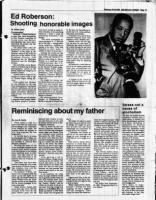

DETROIT - From Presidents
to poor folk, from Nurcmburg
to He Detroit,. rebelJions to
rising stars, one Detroit
photo.r pile, h been there
captunng t people and the
moments on fa • '.
The photo credit under Ed
Roberson's pictures. reads,
"Robbie." If the name is not
familiar, many of hi works no
doubt are to the readers of the
Pittsburg Courier, Life
Magazine, Jet, the Michigan
Chronicle and the Michigan
Citizen.
Hi work fills a room. Boxes
filled to overflowing of fading
photographs peak to the
breath, depth and longevity of
Robbie's career.
Armed with an Argus 3C he
bought at a pawn shop at age
12, Robbie began laking pic
tures.
Pride pushed him. Be�use
he was offended by tbe way
hite photographers portrayed
. African Americans, all of us
bave a richer hi tory of the civil
rights movement, Motown's
beginnings and Detroit's
leaders.
"What really got me started,
I resented white people shoot
ing Black people's picture.
There comes a time in a
man's liCe when be looks at hi
urroundinJ' aDd remember
from whtnce he came. He
wonders about hi purpose in
life an wbether be has
achieved it.
ln the. old day's, as some
young·�ople call it today, my
father Jolin T. Taylor was born
on OctotiCr 9, 1918 in Fort
Deposit, Alabama.
HeariDg the name of the
town, you rmpt imagine an old
western eo n where cowboys
rode tbeir horses on bot weaty
days pac i�8 guns to their
sides. You may think of the
times when hoot-outs in the
saloons ere an everyday oc
currence.
Thi scene may have been
imilar in those day' but in the
year around 1918 and the one's
that folio ed, there were Ku
Klux Kia men instead.
Nicknamed T-Bone, my
f ther w a renegade child that
IIOOd up (or bis rights at an
early ge He found himself in
many crapes witb tbe white
people as ell the Kl men
but he al ay managed 10 es
cape unharmed.
Johns' mother, Nazari, died
at a rly age hich lef r him
- virt Ily alone when
only thirteen )'�ars old. He
You know we had to stand be
hind a monkey or do something
ludicrous. I knew I could do
something honorable, - said
Robbie.
"The white new papers a .. -
ways portrayed us - and still
do to this day - doing some
thing negative, robbing or
raping in an alley. They shot
Negroe at their wor t. I
wanted to show us we are."
Among the events he has
chronicled: the marche , meet
ings, rallies and funeral of Dr.
Manin Luther King Jr.; Stevie
Wonder as a child star to his
wedding pictures; Rev. C.L.
Franklin during his career and
at his funeral; Prophet Jones,
Sweet Daddy Grace, Father
Divine, Malcolm X, Hubert"
Humphrey, John Fitzgerald
Kennedy, Florence Ballard,
and five presidents. And that is
a short list.
He caught for history the
first Black attorneys in Detroit,
. when you only. needed your
two hands to count them. Most
preachers, politician and
businesspeople in Detroit who
ever spoke out or up, marched
and even married are in the film
record by Robbie.
He photographed Gen.
D ight D. Eishenhower in
. Berlin at the end of World War
veled from relative to rela
tive and from city to city until
finally enled down In Bir
mingham, Alabama.
This i when he me t my
mother Cathleen Matthews,
who at the time had a diughter
hose name wu Emma. John
and Catbleen were married
November 23, 1943. Times in
the south were hard but they
somehow managed. After hear
ing or a better life and more
jobs in the north, my rather
decided to move and eight
more children were born after
the move to Detroit. John Jr.,
James, Bruce, Ann, Cathy',
Michael, Harold, and Jac
queline ..
After gelling a job: at
General Motors, things tarted
looking up for our family. We
always had plenty to eat and
clean clothes on our backs. We
never felt that we were poor
becau e we had parents that
loved us and raised us the best
they could.
I can remember the time
when all eight children would
run to ,reet out fatber when we
sa him coming bome from
work. We would all be holler
Ing -Daddy, Daddy: and he
ould try to piC all up at
ODe time. Our bil outinp
'going out to Bell Ie after my
fatber purcb1se4 a 1960 black
Ford. Those ere the ood old
ages
II. He shot the Nuremburg tri
als for the U.S. Army publica
tion, Stars and Stripes.
"I've hot every, all of them,
NAACP dinners since they
&aned in 1952," Robbie said.
Robbie won't teU his age,
but he says he was born in
Nashville 'and came to Detroil
as a cbild.Though he has been
there over the years, he shows
no evidence of slowing down. ..
Friends who know of the
stockpile of history stored
away by this man are urging
him to identify and chronicle
each photo from an amazing
collection.
Ed Roberson, a man who set
out to do his people Justice has
more than accomplished his
goal. He has captured not only
the struggle but the glory of
achievement of African
Americans in Detroit.
A sample of his record of
Black History follows on the
next two pages. More to come
in next week's edition.
day's.
He taught his son's to make
go-carts, cap guns and all sorts
of things. He taught the girls
how to braid hair and clean
chitterlings and sometimes he
would do our hair himself.
I remember the stories he
. told us of the south and the
things he went through as a
child. But he never taught us to
hate. .
Not unlike many black
families in those days, he
taught us value and morals. He
taught us to respect our ciders
and to love and respect oursel
ves as well as others.He always
told us that we were just as
good as anyone else, and that
the sky and the stars were ours;
we only had to reach for them.
Our father was well loved
my many. OUf house was the
house on the block where all
the kid would gather to listen
to my father t Ik and ask for his
advice. He always had the time
to listen and he did his be t to
steer them in the right direc
lion.
A areat man? Yes; to me, his
family, and all that knew him.
A hero? In hi own right he w
. a hero to many.
When I think o( him I smile,
because I al ay lee bim
laughing. He ba� a lauabler
: that wa contaglou. 1"ears
would roll do Ii his cheeks be-
m
idea that people become
.I�bolics because they're
.q f. SIre ,or beca they
,' .... � ..... "' .... � .. - psychological problems
is a myth, according to
authorities at Gateway
Recovery Service . "If this
re trUe, alcoholi m would
affect more than the roughly
ten percent of the population
who have the disease," y
Joyce DeHaan, M.D., medical
director of the facility.
Alcoholics have basically the
same social, emotional or
psychological problems as the
re t of the ociety, DeHaan
says. It's only after .they start
drinking alcoholically that
their problems begin to out-
. weigh those of non-alcoholics,
aOfl their ability 10 cope with
tbese problems decreases.
Seriou psychological
problems requiring profe -
sional treatment affect only
about five percent of the
population, generally about
the same within the al
coholic population.
As an alcoholic's dise e
progress ,he becomes I
and less able 10 cope with the
normal problems of day-to
day living. He uffers mood
swings, and hi emotions are
often exagerated.
"He ' quick to anger,
depressed, fearful and defen-
ive. These . undermine
his ability 10 deal ilb peop
and situatio . In fac� they
of len make thin" one. "
cause he Jaug d so bird.
COUldn't help but feel good
his pre ence because be tra
milted an aura o( good will.
After thirty years with
General Motors, my father w
stricken with cancer. He never
gave up on I1fe but fo.,ght all
the way. Even through his pain,
he managed to talk about pick- I
ing pecans when be was little
by and about riding h horse
Minnie. Hi laughter turned
into smile , but we Iways
knew how much he loved us,
and he knew how much we
loved him, ,.
The Taylor famil)'t down
south has started a (amily
reunion for the past three years.
Some of our family members
have attended in honor of' our
father. It was very exciting to
hear some of the ame stories
that our rather told us and to
actually see the place w ere he
use to live. It gave you a since
of belonging to a time YQu only
bend about. And the
resemblance of some of our
relative to our father, as so
uncanny, but made us fe�1 ev�n
clo er to them although we had
just mel
My father died September
18, 1981. The greatest man I've
ever known.