

J
e Jac son mee
D cu atu
of Afr cana
Studie
Dep rtm nt
By FWD s. RIGGS
StaffRep01ter
DBTROrr - Down with dope,
up with hope.
These are the ever so
familiar words of the Rev. Jesse
Jackson spo en once again
during an anti-drug conference
onOet.26.
This time he delivered the
keynote address Wayne State
University t which members of
t priDg' ll-day "study-in"
were present.
The e partie lar students
said they've heard it all before
and didn't want to hear the
"hope" rhetoric anymore.
One • tudy-in" member
ed J ckson for his support
and Jackson-agreed that
Africana Studies curriculums
ould be implemented in all'
educational institutions.
J n went further to say
that he believed Africana
Studies should be the core cur
riculum because it has been
proven that the . ory of the
orld began in Africa. The
00 of the first hwnan being
found in Kenya and MOses
born in Eygpt, Jackson said.
Ifhistory is corrected and the
pre-Western- orld fact are
made known then the perpetua
tion of racism will end, he said.
"It's hard to hold an African
Jesus in your arms and be
racist," Jackson said.
At this point Mikal Ansaru,
another "study-in" student
ith WSU
jumped up saying he was tired
of peop in positions to help
studen such J ckson, just
using words instead of actions.
An. enraged Ansaru, yelled
at Jackson that WSU had
bro en its contract with "study
iners" and that the students no
longer had patience.
While the university spon
sors events such as the anti-drug
conference it neglects other is
sues such as settling its contract
with the "study-iners," students
charged.
"Don't beleive the hype of
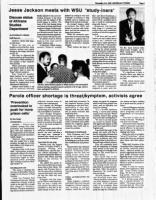
to MlkaI ADsaru, 0 laterrupted
D"'Dn�r period I a nt of rage. ru
this," said 01 Henderson, a
University 0 Michigan political
science Ph . candidate who'
also a "stud -in" spokesperson
along with &sarn. .
Henderson told J ac son
while drugs is a problem, the
students have more immediate
problems of which his support is
needed.
"I will meet with ou and I
respect you and I expect you to
respect me," J ackso told
"study-iners," .again agreeing to
meet with them. ·1 can promise
you I take my dignity riouSly.
During the privat meeting
Jackson cautioned "st dy-iners"
saying that self control is essen-
_ tial in achieving their goals of
implementing the African
Studies Department along with
gaining allies who are not neces
sarily directly involved with the
"study-in."
Jackson committed strongly
to physically support them
during their plight.
"I am with the Afric n
American studies program," he
said. "I'm wi h meeting with you
about it. I'm with meeting with
the president about it.
Jackson told stude ts while
they. should consistently
demand to meet with the
Parole officer shortage is threat!symptom,
'Prevention
overlooked in
pu h tor'more
I prl on cells'
,
Correspondent
DIITROrr - Detroit area
residents dealing with crime
prevention and rehabilitation
agree with tate employees in
the Department of Corrections
that high case loads represent a
"public danger"
Ho ever, they emphasize
that this results from a larger
prob em, the high rate of crime
and a failure to do things neces
sary to prevent it.
Member from UAW Local
6000, representing probation
and parole officers and clerical
workers in the Department of
Corrections st ged an "infor
mational picket" protesting
their working conditions, Mon
day October 16.
$10 ILLIO cur
The union is . claiming that
the state cut $10 million from its
budget for the Bureau of Field
Services.
Local Vice President Fred
Freeman said that stat officials
claimed the cutbacks would be
made up through·$3O oversight
fee charged to offenders.
H ver, Freeman maintained
th often such fees could not be
collected, because many of
fenders were unemployed.
Leo Lalonde, the Michigan
Liaison of Public Information,
representing state government,
was unavailable for comment.
Sister Bridget Klingman,
Director of the Team for Justice
agrees with the union that for
parole officers, there is "too
much to do and too few people
to do it, too much pressure to
get it done."
"Decisions get made without
sufficient information or re
search," 'she said, "including a
few tragic ones. Someone is
released who should not have
been and there is violence.·
TOOFEWTOOOJO
Marth Lum, the Deputy
Director of Project START, a
program dealing with
rehabilitation, agreed tbat it
was "almost impossible" for
probation and parole officers to
monitor their clients and help
them in the proce of
rehabilitation.
She. added that parole of
ficers h d too little time to make
home visits to their clients. She
agreed with Freeman that un
less they knew about conditions
a person lived under, they could
not help the client stay away
from crime.
Klingman said that some
parole officers could spend less
than one hour a month with
each parolee. She added it was
unrealistic to feel that in this
small amount of time, the sys-
tem could help ex-convicts "in
the transition between prison
and getting on with their lives",
particularly if they were
released with few jobs skills,
and no family structure that
could help them.
Klingm n expressed fears
that because of the high case
loads, an act of violence would
create "a backlash" and a public
demand for toughness against
criminals, that would only in
crease the problem.
PROBLEM IS EMPHASIS
Both Klingman and Lum
state that the problem is em
phasi on punishing criminals
by building more prisons, rather
than rehabilitation and preven
tion.
Because there was a demand
-to raise money for prisons
without increasing taxes,
Klingman said the state was
taking money away from
, prevention and early interven
tion programs, " increasing
problems for the future," by"in
creasing the cycle of violence."
The increase in violence
would create demands for even
more pri ons, she predicted,
"throwing good money after
bad."
NEED ALTER ATIVE TO
CRIME
Karen Fogliatti, a volunteer
in SO-SAD (Save Our Sons and
Daughters), a Detroit organiza
tion working to prevent
violence, stated that too little
money w spent for programs
. which would keep people from
crime, such education and
"good job training." -
"It's a terrible handicap
having a record [and seeking
employment)." she said. "WhaCs
available beyond (low paying
jobs in] Wendy's and Big Boys?"
"We have to see that people
are treated as human beings,
with dignity and respect, so they
won't have to go b ck to crime,"
Fogliatti said.
Lum stated that many of the .
people she works with fmd it
hard to keep jobs, because they
have few skills, little experience,
mental problems and little
training in how to deal with COD
flict and anger without violence.
They are constantly faced .
with the temptation of making
more money on the street" by
selling drugs, even though in the
long run this would lead to
death or prison.
She stated that in her
program, there was little time to
help parolees gain self teem
and provide skills necessary for
the working world, but he
added that by caring and show
ing them "what was good in
themselves," her project had
some successes.
SO-SAD Director Clemen
tine Barsfield states that,
"Money should be reinvested in
our youth, helping to preserve
the youth. If we could solve
some of the problems, there
wouldn't be so many people
going through the criminal ius-
3
university's board of go mors
and the president, forming al
lies with other student leaders
such as those at Michigan State
University, University of
Michigan and Ferris State
University is the founda ion.
"It's significant to have a
situation where your allies are
not just your neighbors," Jack
son said.
"(The action) doesn't start
'with ( the university) i tart
with (the allies)."
ts agre
tice system and there wouJdn't
be so much need for paro of
ficers."
Lum and Klingman state that
it is necessary both to provide
more programs and more
Department of Corrections
all
"You have to work 0 all
fronts," Lum said. "Working in
one area is not enough."
One social worker states that
while it is necessary to ge more
parole officers, it is also neces
sary to train parole officers in
dealing with clients.
Many, she said, are arrogant,
• ct as if 'I'm the boss:", do not
convey that they care and leave
their clients with little self-es
teem.
Willie Bell, President of the
Guardians Police Organiza on,
an African American po ice
union , explored another p
preach, suggesting that there be
more public discussion about
legalizing drugs, so that people
will not be forced into crime to
maintain their habit and there
will be no profit or incentive to
push narcotics.
"There is room for serious
debate bout legalization," Bell
said. "Crime revolves around
drugs. We don't see decline of
drug activity. There are more
pipelines than ever before."
"It is driving young adults
into a criminal lifestyle," he
added. The system cannot in
carcerate them all. That is the
reason for the high cas loads."