

Opi n ion/Commenta ry/ Ed itoria I SI Letters
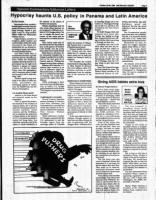
Hypocri y hau ts U.S. pol.lcy
IDtcnatioD f� reached a
freaDcd . chreceat1ywhcn the
. of p.n.m. GeDeral An-
t . Noriega, aiudcd a pos
sible coup by disgrundled
officer ·thin the panamanian
Dcfcose Forces.
Aav! Se ors, member of
Coagrcss, policy analysts and
comment ·thin the mcd·
denounced the Bush Ad
ministration for not directly in
tervening to topple and capture
the drug dealiDg di or.
, You didn't really have to
read between the lines to get the
point that there i a sizeab e seg
ment ithin the American
populace that feels that the U.S.
gove�t h the right to do
ever it pleases in Cc al
America. It' like the United
St e 0 this hemisphere,
and it's awesome military might
can beused at will to make any
thing "right".
America needs to top med
dling in the affair of other na
tions, particul r Iy the
developing nations of Africa,
Asi the Middle E t and the
We tern Hemisphere.
U.s.E
S
HATE
America is the most. feared
nd despised nation in' this
hemisphere.
The U.S. gained th t distinc
tion becau e it has a history of
using it po r, no to aid and
ssist the developing nations of
Central America, South
America and the Caribbean,
but to suppr the pirations
of these nations in the interest
.. of u .S. Corporations seeking to
exploit the cheap labor, raw
materials, and cash crops of the
region to enrieh themselves at
the eIpCDSC of the masses of
workers and pe •• ants
African-AmericaDa must be
c1ear about interests we
arc prepared to delead as it re
lates to u.s. foreign policy if we
are to remain the moral con
science of this nation and its
best hope for a creation of. DeW
society. .
That clarity m. t not be
douded by the fad that-a Black
face, in the non of General
Colin Po , DOW sits at the
helm of tbeJoints Chiefs ofStaft'
B faces in old places do
, not necessarily translate into a
change in perspective or policy.
And so the beat goes on' iD
Central america. Nothing has
changed in more thaD a century.
Between 1823 when the U.S.
claimed latin America as an
area of Influence UDder the
MonroeDoctrine, to 1983 when
the U.S. invaded the tiny island
of Grenada, U.s. troops inter
vened in the region more than
4Otimes.
While' professing to favor
democracy and self-determina
tion, in reality U.S. foreign
policy functioned on the dictum
"The business of govenrment is
business".
CORPORATE COLO IES
everal Central American
nations including EI Salvador,
Costa Rica, Honduras, and
Guatemala were converted into
virtual neo-colonies by the in
famous United Fruit Company.
They became "Banana
Republics".
Multi-millionaire banker
J.P. Morgan conspired with the
U.S. government to take the
Panama region from the
sovereign nation of Columbia
UDder the pretense of "liberat
iD&" Panama from a repressive
Columbian government.
Panama qUickly became a
u.s. Colony and the canal
which the U.S. wanted to COD
. struct could DOW be built and
owned (on 'Panama's land) by
America. '
Por'decades the United
States b eked ruling oligarchi
or elites headed by dictators
who were willing to allow U.S.
business interest to profit
handsomely from the exploit -
tion of the resources of the
region.
DEMOCRACY SOMETIMES
Hence democracy was never
a real issue as long as the dread
dictator Samoza and his family
reled in Nicaragua.
01 ere the dictatorship in
Haiti or Cuba a problem a
long as U.S. business interests
reigned supreme. In fact, U.S.
troops invaded the Dominic n
Republic in 965 to thwart the
democratic election of Juan
Bosch, and the U.s. was direct
ly involved in the overthrow of
the democr ctically elected
government of Allende in Chile
in 1973.
In the more r nt history of
Panama, Noriega appears to
have been just fine as long as he
was co-operating with the
Reagan-Bush Administration
CHIGAN ClI1ZEN
and Latin America
in funneliug illeagaI aid to the
Contras m Nicaragua.Noriega
on the U.S. payroll as was
revealed by the Iran-Contra
scandal.
o doubt Reagan, Bush and
company were aware that
Noriega was dealing in drugs
then. Apparently they were will
ing to look the other way as 10Dg
- as Noriega was their boy.
Something went sour in the
whole affair and their boy be
came the bad boy, subject to
U.S. indictment, economic
sanctions, diplomatic pres
sures, and eYen invasion. Now
the threat is that if the
Panamanian people don't get
rid of Noriega, the the U.S.
may refuse to give them bac
their canal.
I don't like General Noriega,
but that's beside the point. The
'Cnited St tes because of its
'checkered history of self-
scrivng interYentio big tick
diplomacy, greed and
hypocracy has lost the moral
authority to lead in this hemi
sphere.
The Panamanian people
must solve their own problems.
Thus far, U.S. sanctions, threats
and covert C.I.A. actio have
simply made bad matters worse.
Meanwhile we he r DO
. clamor for tougher sanctions
against South Africa, or "inter
vention" to 'bring bout
democracy and Black majority
rule to end the dictatorship of
Apartheid .
U.S. foreign policy continues
to be filled with hypocracy and
contradictions.
Ron Daniels serves as Presi
dent 01 the Institute lor Com
munity Organization". and
Development in Youngstown,
Ohio. He may be contacted at
(216) 746-5747.
Giving AIDS babies extra lov
By M ri n Wright Edelm D
Every baby needs hugs,
caresses and loving talk. But lit
tle babies who are born with the
po ntial of developing AIDS
- more and more of whom are
born each year - deserve our
'special 'attention and love.
That is the deeply held belief
. at Gr ndma's House, a
Washington, D.C. based home
for babi that test positive for
'the AIDS antibody. The
program is a subsidiary of Ter
rific, Inc., a non-profit group,
and is funded by private sources
and the city government.
Some of the babies who
come into this beautiful home
are thin and frail. Some are
stronger. All have no other
place to go because their
parents, usually drug-addicted,
cannot care for them.
If Grandma's House did not
exist, these babies woul still be
in an impersonal h�pital ward,
even though they have DO medi
cal need to be. A hospital is no
place for a b by to call home.
Hard D try to gi these
babies personal ttenti n, hec-
- tic schedules do not allow for
the constan flow of love that in
fants need.
The fe lucky ones that
come to Grandma's House fmd
themselves in a real home for
the first time in their short lives.
T ey a e up in cheerful;
b autifully decorated room
and are fussed over by the warm
d well-trained staff.
These bebies need homelike,
SUITOundiDgs. They oftea arrive
depressed and withdtawn. Be
cause no ODe h been there to
respond, these infants often do
not make eye contact, make
: no' or ugh. Perhaps sad-
dest of all, many DO longer even
bother to cry to get attention.
CHILD
WATCH
The "love teatment" at
Grandma's Hou e works
miracles. Though they may still
lag behind other babies in some
ways, they play and laugh and
enjoy being cuddled. They blos
som under the attention of the
staff and young volunteer from
the community.
Happy as life eems at
Grandma's House, it is impos
sible to forget that these babies'
long-term future is in doubt.
While doctor believe that ome
of these babies will not contract
their mothers' disease, other
will go on to get AIDS and
some, sadly, will die.
Finding permanent homes
for tho e who survive is not easy.
If relatives cannot take them in,
they face a long wait for a fo ter
home.
But long they stay at
Grandma's House; all have-a
chance to live and be loved in a
real home. We should have
programs like this in every city
where AIDS babies re born.
Urge your city government and .,
local churches and charities to
get involved.
For more inform ion about
Grandma's House, contact its
sponsoring organization: Ter
rific, Inc., 1222 T Street, NW,
Washington, DC 20009, 202-
234-4128 or 462-8526.
Marian Wright Edelman is
President of the Children's
Defense Fund, a national voice
for children.