

A
HUG
drug
.for
I
female
abusers
A H . the to the
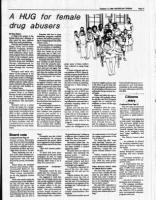
drug users' dilemma of
o cares for t eir c . dren
. they see rehab'· .
Director aDd Founder of the
Hope, U nily and Growth
(HUG) Progr m, Maisha
ICenyatta, said HUG· a 12-
bstance abuse tre t-
program re the die
reside on the treatment center
grounds while participatiDg .
inteDSiYe group and individual
therapy administered by
tr ined profess' assisting
them through the recovery
process.
Kenyatt aid hile this
pea of her program' not
unique, HUG the only(i
drug rehab f cility in Mte' .... po
thal tobring r
children' er • eform-
ing r old bah' . S said there
are only four uch f ... in
the United States.
Kenyat said the Progr 's
primary focus is on family
therapy, well the in roduc
tion of wholistic methods of
tre t nt thro the absence
� of medcines nd Iternative
drugs.
Kenyatt aid oci I
or er he beg n the concept
based on her kno ledge of what
many men encountered in an
effort to find a suitable rehab
program. She said tr ditiona1ly,
mo t ubst nee buse programs
re geared to ards men, h ving
11 males facilities, with the
rch bbilitation treatment
foe ing mainly on m'
10
dec ion proces , Hernandez
id, Th aref doriesdealiDg
. th food d are particularly
vulnerab e to poUution and en
viro en aI ccident d were
·right where the . e is: he said.
These busin are not a
part of the Chene B' As
sociatio which inwhed in
negotiations with CEI and
favored the permit, Her dez
·d.
Bruce D vis, the Assistant
Director of the Division of En
vironmen al Haith for the
Department of Health,' �he·
W yne County representative
on the Sit SeJedion Review
Board.
D' 0 edtop cethe
treatment plant' the middle of
the city, . d bile these
bu ine ses did oppo e the
facility up to the end, !hey did
have the right to participate and
evidence d that they had
beea in(! d -the idea of •
uch facility no ne to
ICcDyatta said d e to these
. .. porgr available
She . the partici
. in a program only make
.
matters rse,
Kenyatta said after wrestling
with the problem of re bilitat
ing drug addicted en with
. child care needs for at least
eight years, �, in 1987, con
ceived the idea of combining the
proble solution to both.
Kenyatta • d these mothers
bear b of guilt beca
they properly main-
tanining their children, feeding
them oaIy DOW d again. She
. d eYeD if dinner hot dogs
and chips the mothers felt that
they t provided some kind
of nourishment for their
chiIdreD.
Kenyatta said these mothers
struggled hea ily with the
decision to enron in a ubstance
use program and leaYe their
children or, continue on drugs
remain in the ho . She
until HUG's inception, the
en's only recourde to
pi . cc children . th protective
services, their family rela
ti ns h d been destroyed due to
servcre drug usage.
Kenyalla said in an rnest at
. tempt to rehabilitate themscl
S, the mothers would place
their children with protective
. serivces nd enroll in a
program. She said after success
. fully undergoing the treatment
nd being dcclareddrug-free,
the emotional trauma of fight
ing to reclaim their children
from protective services was so
them."
Hernandez also critical
of amendments the company
proposed fo the permi , which
were opposed to help mitigate
the prob raised by the com
munity.
-ney re mumbo jumbo:
he said
·If there h d been more
cooper . n (on the part of the
company),' be said, -it would
bYe all worked out. They (CEl
officials) didn't want to do it.
�y were scared of it."
QU S' 10 ·HIDDEN"
AGE DAS
Hernandez raised the pos-
sibili t the company may-
have had ,,' dden gend .•
He suggested it could have
been fear of . money,'
. ce . community people
made oflicials reluctant
to invo e other in the par
tici tion process, a mistaken
belief that environmental
group ould attempt to
obstruct tntire faility rather
than making it safer, or plans to
great, many of these m ers
ere reduced to � drugs
again.
A former drug user d cur
rentreside of HUG, Diane B.
said the program turned her life
around and taught her to
live . n, and how to 10Ye and
care (i her children. She said
e k nothing of parenting,
h ving been baby havin
b by.
Dianc id until she wal ed
through the door of HUG he
thought life was about geUing
high, with no responsibility to
herself or her children. She id
HUG provided her with parent-
ing in ion and more she .
presently attending to
recieve her GED.
. Diane s id she has four
children but protective services
h s two of them, while two
reside with her in the program.
She said HUG will t e steps to
help her reclaim her children
after her twelve eeks in the
program.
Di B. said e Iways pos-
sessed the willingne s to be
drug-freebu'd know hat
to do re to go for help, She
said the progr mob ed her
by elevating her self-esteem and
m ing her feel good bout her
self again.
Diane . d while t urge to
use drugs will probably always
be' r, the HUG Program
taught her to udtilize her
wiJlpower to ve off urge
to succumb. ,
Kenyatta said the inde
pendently funded HUG .
program is located at 4875
Coplin on Detroit's Eastside.
. She said the program' reim
bursed for much of its room and
board expenses by the Depart
m'1nt of Social. Scrivce . She
said the. program is financially
at near standstill due tol ck of
"do something more", selting up
a different type of industry and
a different form of hazardous
waste -five years from DOW.-
Hernandez added t the
process of deciding on hazard
ous te facilities . ed
aaalDSl the p lie.
He not there are ooIy two
members 0 repre ent the
general public --- botb ap
pointed by the governor.
One appointee' expected to
represent industry and three
technical fields: geologist,
toxicologist d engiDeer. .
Two members represent the
area of the site, one repre
senting the city and one the
c:ounJY.
Valeria. Jackson, the repre-
entative from the City of
Detro' , voted yes_ D ed
y, e said, try ou can find my
comments in the' of the
mee but I will give an
interview.-
_, BtaCC Davi , the Wayne
County repre entative al 0
edyes.
Davis said the �ty -met all
the requirements of Act 64 and
the zoning require men of the
City of Detroit," .
He claims that after -many
OWly meetings- be,tween resi
dent COIIUIlCTcial orpniza
'ODS, ·an 0 raised objectio
ithdrew," except the Art
Center Citizens D' 'd Coun
cil.
D· riet councils have been
set up under state la to repre
sen residents of their entire
area, while the other groups
only represented portions of it.
WHO WOULD WANT THIS
1 THEI RAC YARD?
He notes that so peop e
did not a f ciIity like 'this
close by, and added, - 0 one
would ant such a facility in
their b ck yard, but' order for
me to do so . I d to
haYe a better reason.·
He . d CEI respo ded to
objection that were raised,
·some ith prod din by the
board, some . prod-"
djDg_.
funds and that generous or
ganizations nd individuals
contribute to this rthy cause.
For more inform tion call (313)
822-8830.
COIDIIlII ... =a
The Art Center is co cerned
that there is no language in the
agreement - Addressing the
safety of the community i case
of accident or p malfunc
tion."
Expressing total opposition
to toxic w te" d urging that
"the proce ses hich create
uch" be removed from our
society entirely, the District
Council charged that certain
items in th company's dr ft
were -vague, insufficient, and
ineffective. •
The District Council called
for:
- An authority be defined
for resolving community ques
tions and concerns regarding
the facility. .
- More frequent Com
munity Relations Committee
meetings with more flexible
hour .
- Continu I reminder to
trucking compani of the ap
proved routes.
- A requirement th t the
company "Jnaintain- it hirng
goal of SO% local residents;
defin local residen to pin
point the explicit area; nd
provide training to insure local
residents re qu ifi d fo the
jobs.
- All jobs be dvertised in
prominent local ne p per .
- Th company coordi e
curity only with 10 ) groups.
The District Arts Council
also called for CEI to provid
more environmental education
program and tours.