

CI'I1ZEN 13
U'
-
YPSILANTI - -rile \'ery
first bead-injured person I eYer
studied for my research
omeone I could very much
identify with. He 31 and a
Ph.D. de t the time I
a Ph.D. be teach-
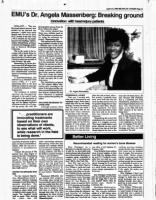
iDgandl tea· wsaidDr.
Angela pro
of speech and lanpage pathol
ogy at Eastern Michig D
UnMnity.
"B the result of his en-
counter with druDk c.tmer, he
couldn't walk, his speech
slurred and i a lS-minute span,
I know be asked me my name at
20 times,. . d.
Massenberg. 29, did er doc>
toral research at MiclUganState
UnMnity · dosed-bead-in-·
jured patients . an innova
tive rehabilitatio technique
aimed in . short-term
memory.
A clo d-h d-injury, also
referred to traumatic brain
injury (TBI), is " non
penetrating blow to the head
. ch has resulted in some type
of cerebral dysfuDction," Mas
senberg said
The incidence of accident
survivors has incre sed sig-
. nificantly in the pas 10 years,
pardy due to the prevalence of
ne , life- ving medical tecnol-
01)', and the highest incidence
of victims is in the 15-to 2S-year
old age group, e said. She
a
p otographed person &om the
photo without the object.
Test results showed that
"there a definite trend for
the TBI patients to perform bet
ter using the memonic ap-
proach, rg said.
This method b, MasseD
bug explained, beea . taps
a different part of the brain,
primarily the right side, when an
image is recalled. However,
even the r�t half of the brain
( here imaging ability is
housed) � damaged, the patient .
still is able to u e imaging. •
"There's something eke going
on in the mnemonic,· she said
"Maybe the patients are ble to
relate it to some past memories,
which are us.ually retained eYen
though patients have severe
short-term memory deficits.
They don't forget the basics,
like apple, because the memory
of their pre-injUl')' life � rela
tively intact.
The rehabilitative propos·
for TBI patients differs, Mas
senberg said, according to the
extent of the injUl')' and the cog
nitive potential they had prior to
their injuries. Patients who had
more education or potential
seem to plateau less quickly, she
added.
MULl1PLE PRO MS TO
OVERCOME -
Although patients often
I
", . . practiti ner are
innovating treatments
ba ed 'on their 0 n
ob ervat on of cl e
to ee hat ill or,
hlle re earch In the field
9 0
,
II
•
noted that 60 percent of the in
juries are d e to automobile ac
cidents, while the rest are at
tributed to mi cellaneous
ps,
"Almost 100 percent of TBI
patients ha\'e degree of
memory disorder: MasseallbCrR
said. "E\'en after' a couple of
months of orkiag . their
therapists, the majority of
patients c n't remember
therapists' name, although
they t to."
e g: B
aki g ground
DEPRESS ON, ANGE
"One guy I worked with,
John, was so depressed he was
coastantly angry. Every time I
ked him how he do·
he'd say, 'I'm mad, rm mad, ter
rible. I'm mad the world. I
hate the person who hit me.
He'd have those outbursts
several times a day," she said
Massenberg found that the
best way to keep up a patient's
morale was to acknowledge the
patient's anger for the first five
minutes of every session, and
then moYe on. WJ let the client
talk about how shelhe feels,
. then we have to stop aDd com-
plete that task at hand After a
few months, I gradually wean
them away from that and tell
them that they need to focus on
the positiYe thinss that are hap
pening in their Ines," Massen
berg explained. • All these
clients, when they think of what
they were able to do (before
they were injured), become
depressed"
Massenberg noted that
rehabilitation for a closed-head
injury is a lengthy process.
"How long. tatea clients to get
better depends OIl how severe
the injury was, we find that
clients imprcwe for four to tiYe
years after the head injury," she
said WSecasue TBI rehabilita
tion is a relamely new field,
rehabilitation pr ctitio ers are
innovating treatments based on
their own ob crvations of
clients, to see what will work,
while research iD the fie d is
beiDg done."
The ne of the field was
part of what attracted Massen
berg to TBJ research (or her
doctoral dissertation. -Since· s
a rare emphasis in my profes
sio rm hoping rn be able to
do a lot. Also, it's ne , still
booming. and there are really
no answers, " she said
Better Living
Recommended reading for
omen's bon dl
own effort a bit? Melinda W OJ
Pomona, Calif.
Dear Melinda: Some wa1kecs
swear: by hand igb. In their
book Walk On, Stephen Kiesl
ing and B.C. Frederick remm
mehd that you walk up a nice
hill A 5 percent grade wiD boost
caJorie burning by SO percent
WalkiDg on soft surf ces, such
as a sandy beac:b. can also . -
crease eocrgy coasumption by
30 percent
make outstanding advances,
Massenberg noted that they
typ. caUy have multiple deficits
to overcome, such loss of spa
tial perception, language or
reading problems, and of
the bility to organize thoughts,
reason or solve problems.
"One 21-year-old patient's c
reading comprehension ad
vanced from the ixth grade
level to the 11th grade level
after tiYe DIOIltbs, but it dif
ficult progress because he
didn't ha\le the attention span
he had before, W Musenberg
said. .
Emo • difticalties also
can impede their progress.
"PI'� ly. these people' had
been iDwhed in many ctivitics,
aad they realize that they can't
or thiDk like they used to.
They have to adjust to beiag
told t to do, bei taken
thr their days. It's a hard I
di bile for them because
typically. they. are 50 youag."
' .. ,ac
espedally i.
e da-
ti E., f!W Y ely.
Dear Bill: Just out is Os
teoporosis: The Silent Thief, by
Dr . William A peck and Louis
Aviolo, two of the nation's
fore autho� on the sob
jec:t. Published by the American
Association of Retired Persons,
AARP Boo Scott, Foresman I
and Company, Dept. 835, 1865
Miner St., Del Plaine. It, 1
60616. Order by mail for $9.95 ot er saYI.
+ $1.75 shippiDg and handling. KS.
Dear Dialogue: If my neigh- . Dear Karen: Hard to say, be
borhood is typical, AmericaDs cause numbers can be mislead
are � the pleasures ing. The recently published
and benefit of alking. results of a 1987 ell""""" taken
Without brWiDl· 0 a job,. nationwide by th; N�tional
there some . y I can boost rrrt Center for Health Statispcs
confirm previous findings:
people who live with a spouse or
lover report they are healthier
than do singles. But inter eta
tions differ. Maybe people
together encourage each other
toward hea.ldiier lifesty . Or
perhaps people who are mental
Iyor physically ill avoid or ter
minate- marriage. Maybe the
best answer for an individual is:
if the ingle life makes you
happy, why not?
Dear DI • I d I can
buy a plrl conllder bly
e per I buJ tJaa I.,
I aU packa es p t P by
War • ".'t a
way to • Sld-
y., V.u. Colo.
Dear SidDey: Witho set ..
ling into a debate bout generic
\'S. name brands of drugs, bear
in mind that O\U a period of
time upirin may deteriorate
into the acid form.