

"
Ie
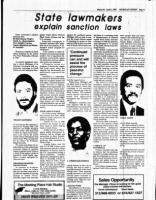
explain
Response to articla Ora South
Africa published by tht Detroit
Free Press Wednesday, Ftb1lUl1Y
8, 1989
As activists legislators work
ing to divest Michigan of its
economic involvment with cor
porations oper ting in South
Africa, we read with great inter-
",
I I
ELSON SAUNDERS
est and concern the opinions ex
pressed by Norman Hill, Cyril
McGuire and Willie Hampton
in their article "The State Fails
to Meet the Spirit of its Divest
men t La and in the article
" outh Africa D' tment Only
l-I urts Those Who Already Suf
fer the Most" by Professor
Ralph Slovenko.
The main issue these two ar
ticles address is the political and
economic impact of sanctions
imposed against South Africa as
a result of that n tion's policy of
apartheid, which' legally man
dates a society segregated by
race and color.
against South Africa will hurt
Black South Africans and the
U.s. economy.
Especially outr geous is
SloYenko' statement that "apart
heid was at its inception, an 'af
fU'mative action' program for
A&ikaners. "
In his attemp to indict af
firmative action and sweeten the
reader's view of apartheid, Mr.
Slovenko conveniently misses
the distincition between affirm
ative action and apartheid
Affirmative action is a
program of democratic origins
that seeks equity where the
majority has intentionally and
maliciously oppressed the
minority.
Apartheid is a comprehen
sive system of domination which
does not recognize human and
civil rights. Apartheid deprives
native Africans of dignity,
livelihood and opportunity. i� is
legal to practice racism, incar
cerate hundreds of thousands of
dissident workers and youth,
and execute innocent' people
under partheid. The struggle
for Black South Africans 'is for
basic human and civil rights,
self-determination and an end
to state terrorism and economic
slavery.
rma
sanction
against the aprtheid system. that there is a continuing trend
Michigan will not help to sup- , of dWnvcstement of domestie
port the South African regime capital form South African's
by investing its money in com- economy. In 1986 this disinvest
panites�chbytheirveryemt- ment amounted to 7.7 percent
ence in South Africa help to ex- of the South African Gross a-
r.==========' =i1 tional Product.
The British Commonwealth
report also concluded that most
international financial institu
tions are rapidly coming to e
conclusion that investment in
South Africa is increasingly
risky. Investors are discouraged
by social instability caused by
th apartheid system and the
re essive measures necessary
to perpetuate it. There can be
no doubt that the sanctions
mo ement, as it gains force, is
having a direct impact on the
health and well-being of the
South African economy.
he thrust of Professor
Slovenko's comments are that
these sanctions are hurting ordi
nary Black outh Afric n
workers. There is no question
but that economic sanctions are
ea ing some degree of disloca
tion. But it is important to
remember that fewer that ne
per nt of South African Blacks
ar employed by U.S.
companies' operation in South
Africa. And it is equally impor
tant to remember that such
sanctions are backed by the
mai rity of Black S uth African
wo kers union and hum n
rig ts groups advocating the
en of apartheid.
f cour e, there is disagree
me t in some quarters bout
this strategy; that is natural. The
point we wish to cmph size is
-that most of South Africa's
Black leadership support the
sanctions movement and that
the alternative to peaceful
economic pressure is an ex
tended race war with millions of
'Continued
pressure
can and will
assist the
process of
peaceful
change.'
I
I
FOUR LAW I ,FORCE
As of this writing, Michigan
� has enacted four laws which
sanction South Africa for its
�- \ policy of Apathcid:
- Public Act 325 of 1980
prohibits the deposit of any
state fund in banks making
loan to outh Africa.
- Public Act 512 of 1982 re
quires public educational in
stitution, such as colleges and
universities, to divest themsel
ves of interests held in U.S. cor
porations with operations in
South Africa.
- Finally, Public Acts 252
and 253 of 1988 require seven
state pensions systems to divest
themselves of interest held in
the U.S. corporations having a
direct investment, franchise
agreement, management agree
ment or licensing contract in
South Africa or with a South
PRO RESSO MISSES Africa person or company.
DISTI eno s Public Acts 252 and 253 allow
In contrast to Professor' for a five year-phased divesti
Siovenko's view, e believe ture of these interests.
that the sanctions movement is The laws sanctioning South
n effective method of fostering Africa serve several important
change in South Africa. purposes. Foremost, they make
. Sloven 0 argues that sanctions a symbolic moral statement
United Nations to the Llty of
Detroi also help to foster a
peaceful resolution of the South
African crisis. These sanctions
provide incentives to the South
African power structure to
negotiate with organizations ad
vocating equal rights for non-
white South Africans.
The Meeting Place Hair Studio LAWS DOW
How effective are these sanc
tions? Areoentreport prepared
for British Commonwealth offi
cals examined South African's'
financial ties to the rest of the
, _ global �ket, and concluded
������������--����--��
tend the reign of terror.
Futhermore Michigan will
not allow itself to profit from
such investments, which take
advantage of the aparthied
system's unequal pa� scales for
Black workers. This symbolic
stance against aparthied is
noted and appreciated
throughout the continent of
Africa.
Michigan's economic sane
tions, together with the sanc
tions that have been imposed by
a vast number and variety of
other organizations, from the
"
'.
\ " .
C. CHEEKS-KlLP TRICK
victims.
A CHOICE 0
SUFFERING,
Professor Slovenko also fails
to me9tion that the problems
caused by economic dislocation
pale b comparison to the suf
fering caused by South Africa's
military and police forces as
they brutally attempt to repress
dissent.
According to Amnesty Inter
national, outh Africa executes
more people an any other
conutry in the world Brian Cur
rin, director of Lawyers for
Hunam Rights, estimates that
sin 1983 there have been 638
ex�tions in South Africa, the
overwhelming majority of them
Blacks who have been convicted
of crim�s committed in the
na e of overthrowing apart
heid.
Comparatively, the loss of a
job or a promotion is a' small
pri for many Blacks to pay in
ord r to bring to a halt a regime
that is bent on total dominatio
VI
over ts Black majority.
e hall continue to adovo
cate an ti ns against the racist
regi e in South Africa. As
ou Africa attempts new tac
tics to by-pass these sanctions,
. I advocate new measure
nter those tactics includ
ing measures to divest
Mic igan's interest in foreign
rations operating in South
ntirlucd pressure can and
will ist the process of peace-
ful�ge.
Af�, Michigan's disvestiture
.law yrol help to convince the
federal government to adopt a
mor aggreSsive policy of
pro oting equal rights .and
basi human dignity for all
peo in South Africa.