

acing_;_Qa t, the odd
e boo·
feature ajor
Taylor
�Gregory y
Contributing Editor, Bicycle
USA Magazine
A READ TO
1878, blazed a trail as the first
African American athlete to be
come a world champion.
Taylor dominated sprint cycling
for a dozen years in Europe and
the United States. He is still
remembered in France for his
triuphant tour of ,1901, which
made him 'an instant superstar,
yet he remains virtually un
known in his homeland
Hoping to change this situation
with this compelling. 'Nell-con
structed biography is author
Andrew Ritchie, who re
searched American and
European archives for ten
years. Interviews with Mrs. Syd
ney Taylor Brown, Major
Taylor' only child, provide
valuable insight into the
champion's life and career.
Bicycle mania held the world
from 1890 to 1910. Through a
"freak of fate," the young Taylor
was introduced to cycling while
employed by a rich Indianapolis
. family. Instantly in love with the
bicycle's freedom and power, he
took mania! jobs in local bicycle
shops, giving trick riding shows
to boost sales. He moved on to
teaching customers how to ride.
At age 13, Taylor entered his
first bicycle race, without train
ing and won a gold medaL In
dianapolis racer and bicycle
manufacturer "Birdie" "Munger
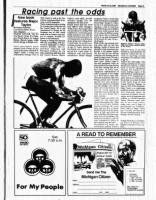
MAJOR TAYLOR; The Ex
traordinary Career 0 Cham
pion Bicycle Racer, by Andrew
Ritchie (Bicycle books, d988,
19.95,304 p ., 0-933201-14-1)
Forty years before sports
pioneers Jessie Owens and Joe
Louis hit thy see e, Marshall W.
"Major" Taylor, a young rural
Indianapolis teenager bom in
/
CI1Y ST_ZIP _
-------------------�
�
WKBO
DETROIT
Sat.
7:30 a.rn.
Send me The
Michigan Citizen
y
o
e
reCognized Taylor's world-class
talent and was soon coaching his
new protege'. By age 19, Taylor
was the U .S. professio� sprint
champion, a title he held from
1898-1900. By the end of �898 he
held seven world records from
1/4 to 2 miles. In 1899 he �on the
world sprint title at Montrea1, �.
and set a one-mile motorpaced
world record of 1 min. 19 sec.-
(45.56 mph).
While Taylor was winning races
with sheer skill, he was also
fighting a battle of nerves and
principles. Each American r ce
became a test against racism.
The fact that he was African
American and winning was too.
much for many racers. H was a
Black bicycle racer in a white
oi'an's sport Taylor's right to
start was questioned Once, he
had a bucket of ice water thr�
jn his face, forcing him out of
first place. In every race,
"dangerous combinations" of
riders conspired to box a or
in, or force him to crash. Offi
cials often looked the other way.
- Racing policies were directed
against him. His greatest
American supporters remained
men like Munger, ·who saw his
talent, and race promoters who
saw his crowd appeal in
economic terms. In Europe, his
color was not a threat, but a
mere curiosity.
Taylor fought his battle very
simply--he rode faster and
cleaner than anyone else. ost
of his victories were de isi e
beyond chalJenge. He r ced
alone, and won alan. A devout
Baptist, he did not smoke, drink,
swear, or fight, and would not
race on Sundays. Because many
races were run on Sundays, this
decision of conscience cost him
many thousands of dollars in
lost contracts over the years.
Throughout his career the
world press praised Taylor's
MICHIGAN CI'I1ZEN
Manhal aaMajor" T.."
I ), the F .. t t �rcM
In the World
high standards of personal
morality at d sportmanship. His
character earned him the es
teem of sporting crowds
everywhere. He retired in 1910,
at age 32.
Taylor's life ended s�y. After
retiring, hardship hit He spent
his last years alond in a welfare
hotel in heavily segregated
Chicago. He wandered the
streets hawking copies of his
self-published autobiography.
The era of TV commercials or
movi options for retired sports
heroes had not arrived He died
in the charity ward of Cook
County Hospital, Chicago, on
June 21, 1932, all but forgotten.
Major Taylor is an engrossing,
sensitively written work. It is the
first biography about an
American champion bicycle
racewr, and' an important new
addition to African-American
history. Extensive notes, glos
sary of turn-of-lhe-century
terms, ind x, and 32 pages of
photographs are included.
Movie rights to Major Taylor
were recently purchased by
Whoopi Goldberg and her Tour
Manager Hector Lizzardi.
Gregory Kavaciny is a Contribut
ing Editor to Bicycle USA
Magazine, and lives in Iowa City,
Iowa.
..
[1 B!LL ME
[ 1 PAYMENT
ENCLOSED:
( }$15 - one year
. [ J 9 - x month
(] 25 .- two years
TOOAYTO:
PO BOX 03S80 -
H GHANO PK. I ..a203