

I . . .
Council activity bear
fruit
t I
·Ordinary' worn
n -·'eave mark 'on history
iDs pOor people from decent
housiDg. ina-easing the housing
shortage and creating home-
started in the U Diversity City
• A· (UCA) area.. The spark Yi8S
the so-caDed "Hobart Street In
cidenr ill 1966, where residents
and clergy moved a home\css
family into a vacanr city owned
and were arrested by the
city for trespassing.
This protest made Detroit
area residents aware of the fact
urban renewal was displac-
It generated demands for
citizen partici pation, so that
residents affected by urban
reaewal programs could have at
least an dvisorJ role in plan
niag them.
The end result was a state lciw
OTE: To commemorate
the first 20 years of citizen dS
trict (X)UDcik, th history of a
different district council and
so of the i dividuals Who in
fluenced it ] presented here
every week.
DETROIT - The protest that'
lead to the creatioa of citizen .
c&trict councils in Michigan
OP: Building :inn� city wo
skills
establishing citizen district
councils, chosen by th resi-
dents themselves. .
What was not generally
kn� was that even before the
supposedly "illegal" move in,
residents of Hobart Street (two
blocks east of Trumbull, now
between Stanley and Elijah Mc
Cqy Drive) re at the heart of
the rebellion against urban
renewal, just by stayuing there.
When the rea was declared
urban renewal, when everyone
around them was moving, 10
families of different races,
refused to leave their homes,
remaining like an island in a sea
of emptiness.
What th y were doing was
completely legal. Federal
regulations specified that those
displaced by urban renewal had
to be relocated in homes just as
good or better than before. In
writing to the federal govem
meat, the city stated that reloca
tion would represent "no
trouble."
The Housing Commission
relocation workers, however,
personally admitted' that uch
comparable housing was one
thing the city could not provid .
Unable to get rid of the esi
dents, city officials ultimately
promised them that new hous
ing would be built for them --
but bureaucracy and red tape
kept delaying action.
In the meantime there were
many pressures on residents to
move out, even into substandard
- housing. before the new homes
were built. Residents con
sidered themselves under "a
I state of seige." City services"
sewage, lighting. trash eollec
bon and even police protection
were rut off.
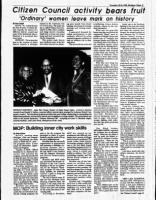
One Black woman,
MILDRED SMI11I, organized
the. residents into an extended
family. When the city failed to
pick up trash, she helped or
ganized the residents to gather
. -themselves. When the city
, failed to take away what they
had collected, she went with
them to city aU to fmd the
reasoowby.
W en the Detroit Police
Department said it couldn't
protect such an iwlated area,
the residents for a time took
some measures to proted them
seku - men looking out for
each other children, while men
patroUed. A�ugb e had
not graduated from high school,
Smith became familiar wi
federal urban reoewa.l regula-
aDd found they e ured
adequate service until per
manent relocation wa
pl'ovided. S worked to make
ore govem.meat lived up to its
0WIl1a
"When Mildred gets OD the
pbooe,. a neiPbor named Mary
Hall said, ·someone gets down
here. We're goeaa ha� com-
pany." I I
Smith was in the forefront,
fighting for the state laws which
created citizen district councils
and- when the councils were
formed, she worked actively on
the U Diversity City "A" Citizen
District Council, serving as
chairperson, pushing for hous
ing an� eighborhood develop-
. ment, even when facing a
serious heart condition and
losing both her legs.
Because of her efforts, hous
ing was built at the Calumet
Housing Development at Third
and Canfield and the Research
Partk development in the urban
renewal area of Trumbull and
Elijah M Coy Drive, where
Smith lived, ensuring the neigh
borhood ould not die.
"Our struggle's no good if it's
for ourselves alone," she id in
the early days. "We want. to
show other neighborhoods what
can be done,"
In 1981 her extended nse of
community may hav sav d lives
all over Detroit. .During that
year U.S. B rax put a dangerous
substance called bex in the.
Whiting Whareh use, a few
blocks from the heavily popu
lated UCA area. Co
dered removed from da by
the Canadian gov roment and
experts warned if Cobex got into
the air, i could spread cancer in
Detroit, Highland Par and
other nearby suburbs.
From her sickbed, Mrs.
Smith created a coalition of
several district councils, chur
cbes, labor union member ,
community and environmental
groups and sent periodic
releases to U.S. and Canadian
newspapers about thi new
. threat to community safety. ig
noring her doctors warniDgs,
she showed up at a demonstra
tion, marching in ber wheelchair
on a bitterly coLd December
day, wearing a gas mask to sym
bolize the danger to the air, tay
� until the pain to her heart be
Came unbearable.
-nus is a matter of life and
death and should be treated
I such," she to d one ne . paper.
-rbe people are no going to die
quietly."
Less than month after that
defaant tatement, e herself
died
" Yet the demonstr tio e
organized aDd the publicity
generated 8 Borax to get rid of
the Cobex and started an ul
timately successful effort to pass
a Michigan Right to Know Law,
informing orkers and com
munity resident bout
dangerous substances near
them.
ABBY LISA scm E
who from 1978 - 1979 served
co-chair with . Smith
'lawyer, a poet and a dedicated
feminist, Schiffer joined the
urban rene fight a Wayne
State University ot aDd un-
. See "CItbe 11