

, ,
Church
Catholic
�
closing -' Can 'city
ep lh'eir roots?
ell
peal i decision. Then the issue
ill go to Cardinal Edmund
zoka, is expected to make
. de . ion in January.
DCP A· aski people to
write the �dinal and to pray
and fast protesting the report
She . dicates some ] DCPA
have considered mOre nillitaDt
tactics.
·k
disease, aime, and drugs."
Quoting one parishoner, he
stated, "A&P, Sears, and so
many other institutions have left
the city. ow the church has left
the city." ,
A far back as the 1920s
Catholic writer G.K.. ClIesterton
stressed that while the Catholic
Church as a universal church
with universal doctrines, a sense
of world brotherhood, and a
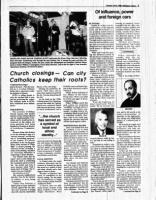
�' .•. the church
has erved as.
a ymbolof
local and
ethnic
·d ntity II
Ie ...
universal respect for human dig
nity and human life,(�ich he
saw a challenge to doctrines
directed against racial groups
and the poor), this developed
from a strong sense of "locality",
strong commun ·ty loyalties,
cred places and shrines.
LOCAL IDENTl1Y
In Poland under the recent
Solidarity Movement nd for
centurje in Ireland, the church
served as a symbol of local
d ethnic identity and a chal
lenge to those in power.
Berman recognized thi
ense of community in the
church, stating. 0 one under
any circumstance is happy .
bout closing a parish, &om the
cardinal on down."
In Detroit, there are addi
tional factor because of the
Black tradition of the Civil
. ights ovement. Many
I Catholics expect such participa
tion in their church as a result of
Vatican II.
'F ther Robert Schramm of
Our Mother of Our Savior
Parish states "There is an awful
lot of hurt and anger in all our
communit' ." I
Father W' tated th t
such actions are weakening
"a-edibility" in church efforts to
evangelize the Black com
munity, recalling bitterly dis
a-imination Black people faced
in individual Catholic Chur
ches, even in the recent past,
despite the churches long held
official stands against racism.
INSI11UI10 AL RAciSM
Sisler Van Handel feels that
the problem is not so much
deliberate racial prejudice as
much as institutional structures
which generate racism and a
failure of those in power to un
derstand· the problems of
. minorities and the white poor.
One problem she felt was
overlooked was the problem of
many residents without
transportation, particularly
sen' r citize and those with
handicaps, would have in get
ting to the remaining churches
after their old ones were
destroyed.
Van Handel and Schramm
state that some of the mergers
would put Blac parisioners
into predominantly white senior
citizen' areas or integrated poor
communities into predominant
ly wealthy parishes, ere the
members uId neither be wel
come nor comfortable."
Schramm contends there has
been "no indication" that the
Archdiocese would provide
help or guidance in dealing with
such ituati Berman says
UMIIIi.'lItd 1
'Ii dJ
Dennis W. Arc er is an As-
socia e Justice of Suprem
Co and Harry Pearce is a
vice presi t and the General
Co I for th eral Motors
Cor ration, whic has its cor
porat headquarte s in Detroit.
ThroUgh mutual a uaintanees,
these two men met bout a year
:�:d, as a resul some good
. have been h ppening for
Bla lawyers in ichigan and
else ere.
t cam fro that meet- .
discussed recently by
men t a br kfast spon
y G s ial Respon
Committe during the
uallegislat v weekeo
Congressi nal Black
Their re rks brought
cbee and appla from the
audie ee of 3(X) r ODS, most
of wb m re la� rs.
Pe ce a tall, oft-spoken
man, emembered at he had
been quite imp essed by
Archer's law crede ials and his
mer�l rise the I gal profes
sion· to become t e youngest
Black elected t the slate
supre co l H also knew
that Archer was a. rong advo
cate for -the emp oyment of
Black lawyers and Black Law
rums by the whit corporate
structure.
"From the- beg nning, he
didn't hold b c ," Pearce
miled. "He Jet m know that
General-Motors co Id do bet
ter, and that he w willing to
help."
Stimulated by Ar er's con
cerns, Pearce too a look at hi
own shop at Gener Motors,
the Office of the Ge ral Coun
sel, and found he had me wor
to do with regard t minority
employment rarst, ere was a
summer associate ogram for
third-year law stu ents who
might be consider or future
employment with companr.
"This year, of the ven stu-
dents in the progra ix were
Black." Pearce obse . "And
when the vote t en on who
we mi&b.t co ider . back,
th six re among th
sidered favorably."
. Pearce also put th
that he wanted his tments
to increase the eff rt to get
minority lawyer . e move
brought complaints om some
that Pearce' office might be
I weri its standards. P arce
respond d that his office con
tinued to employ qu ified and
compe ent lawy r , citing three
lawyer , recently hired, wh e
crede itals includ d ma 1 rs
and ctorate d grees in law
and Ie al experience with ut
stan . g rporati ns.
"AI three were BI.ac ,"
Pearce reported. "And I would
definit Iy say t th y r ised
the standar of ur 0 fice."
Pe r ce conclu d his
rem rks with the n
nounc ment that General
Motor was establishing a
scholarship fu d to' provide
SI00,OOo each to five law moo
for minority students. Pearce
left n doubt that Howard
Unive�ity would be on of th
schools,
The it was Judge
turn, and h hit heavi
under represent ti n of
minorities in th legal profes
sion, noting only 24, Black
lawyers of a national otal of
7fJ7,CXXJ.
He stressed t urg nt need
to get more Blacks i to the
profession and th n em
phasized equally th n djo g t
Bl ck lawyers into t e cor
porate structure.
The second may be e hard-
est task because th tac
are formidable," Arc er ex
plained, "And there's t beli r
out there that minority
can't handle the affairs of
porate clients." I
Archer got this ac oss to
Pearce. He succeeded in getting
him to participate in a Minority .
Counsel Demonstration
Program, which gets a corpora
tion to employ minority law
firms and to urge majority
firms to use minority lawyer in
handling the corporation's b i-
ness. ,
Archer's concern lso ed
Pearce to write a letter to the
so 900 1a farms that repre
sent General Motors indicating
the company's participation in
the demonstration program and
its hope that the I w fU1DS had
adequate minority repre
sentation within their ran .
"That letter by Harry bas
C ti d 10
o SURVIVAL
The ecretary of B' hop
Patrick Coo ey, 0 headed
both the Urban AdYBory Board
d the Imp mentation Com
mittee id he M>uld DO be in
terviewed on tho ubject, but
press questions ere being
handled by Berman • ector
of Archdiocese Communica
f .
Berman claims this decision
to cut the chur . part of a
"surVival situation", an effective '
ay of "marshalling r urees" ------------
as the number of Catholic
�. rs in the citY go e
down, either because of "White
Right- or people pursuing the
American dream" of finding "
bo in the uburbs, It and there
are increasing difficult" in
supporting so many churches..
Van Handel states that the
report and, to some CIt the
bier chy itself· 0 100·
the oommunity spirit in Detroit
the ties, bonds, and roo .
local churches ich "built a
family kind of feeling", th in
cluded even n n-Catholics
the churches served"
She con ends neighborhood
church "lent the last element