

. Dropping ,0
of chool-·
Y Y I
When youngsters threaten to
drop out of school, . is oaiy
natural that e should warn
them of aU the . of
dropping out. But there' the
possibility t t these ·
can dd to their disco
me . A mote positM approach
. t be to help the er
c� up of the prob
'ch m e them t to drop
. udying you do
off."
They that droP-
ping out become a very
reason hie aDd tr . ve alter-
ive en a persoa fee that
their sell-worth' being violated
or diminished in ome aYe
refore, their first Rep is to
establi h respect for the
VOUlDasler intelligeace aDd to
help the youngster e tabli h
re pea for his or her own intel
ligence. They do this by deserib
. the youngsters' qualities in
very positive terms and by ex
plaining. in non-accusing way,
that they understand the r
to pay
1�1", 1
�piece ui no II
I • •
armor agalns racism
By F. Cba , Jr.
One thing our forebears un
derstood the insidious na
lure of racism. They understood
its life-tbreateaing nature and
the necessity for fighting it con-
i ently and in all its many
guises, now there are those -
both Afric n American and
- white -. 0 claim � class is
more important than rate. It .
dangerous position to take, both
personally and a peop .
An article in the W on
Post earlier this year noted, ft •••
(the) Blac middle cl s is
". emerging and succeeding by the
standards of the majority white
culture ... cl is becoming
more an important predictor of
behavior than race. . . This is
. . true not only of Black behavior,
but also f white reactio to this
new Black middle cia ." Al
though the article notes, in pass
ing. the gap between African
American and white emmploy
ment, college enrollment and in
come levels, the majority of the
article is devoted to proving
that, as the article says, white
stereotypes ... often have more
to do with class than color."
This heory doe not give
dequat weight to two �ry im
portant consideration : First,
that tbe 01 jority of African
Americans are still at the bot
tom rung of the ladder, ue to
racist education and employ-
ment policies. And second, that
even when African Americans
move into the middle cl it
remains a very tenuous position
. due to the racism which they
continue to face.
Let's take a look at employ
ment. Certianly, there are now
more Black managers and top
evel executive than ever before.
But let's also remember that in
New York alone, factory jobs -
the traditional rust rung for the
unskilled - have declined by
130,000. In fact, in 1986 only
21 % of employed A rican
America and only 16% of
employed Hispanic eld
managerial, professional or
for anting to drop out.
Their next step is to cknow
ledge that qveryone wants con- -
trol of their own life, and this
de ire for elf-management i
what Ie ds many youngsters to
drop out. The book seeks to belp
the yo er gain control over
their own life while still in school
with step-by- tep procedures "'time--, -·-t-o-·-."-th-e-a-u-th-o-[-als-so--
which are practical and easy to offer � dvice on how to read
accept. I . .bctter and fi er;howtoremem-
For example, they give a ber; h to write good reports
simple but orkable plan for and a number of te t-taking
developing a homework ha .. tri c . .
They advise: Start by planning The boo addr the wide
to work only fifteen minutes on range of problems which make
your math home ork. Sit d wn youngster just stop trying. such
and tart. Don't eat, nswer the family problems; drug and al-
phone, or gel off your chair. J ust cohol ab e; hoedown nd
dig in for 15 minutes. Then get threat from other teenagers,
up and call it day." On the and problem temmin� from
prob m of con!lict with pare racial. ethnic and social
OYer todo omcwor they prejudice.
dYise: i down with your mom PareD well youngsters
work out plan tha lets you can profit from th posirive,
do home at a time you are dOWD-t�earth approach to the
a your best. Once you pick a drop-out problem.
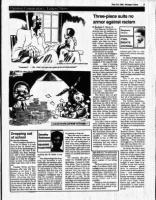
"President? ... No, child, bUt � can grow up to be front-runner/"
Benjamin
Chavis
technical jobs. This in a city
which is 50% rican American
and Hi panic.
Dr. Marian Wright EdelmaD,
President of the Children's
Defense Fund, noted in a
powerful keynote peech at I
year' Congre sional Black
Caucus that, A ignificant
cause of ( the) Black family
problem lies in young Blac
men's eroding employment and
wage base."
- This is not only true,
however, pf young African
American male . In March of
this year the N tional Associa
tion of Black J ournalists
. revealed their study showing
that the number of r cial and
ethnic employees in bro dcast
ne and ctually dropped and
'that all of thi decline h oc
curred among Black men."
For Atric n Americans -
bot male and female - the
e ploymen figur for exeeu
ti j sho that racism is still
alive and well in America. A Na
tional La Journal tudy two
years ago howed th in 246 of
the 250 largest law firm ,
African Americans commposed
a mere 1.5% of the lawyers at
these firms. And don' bout
African American law part rs
the figure' too minuscule eYen
to mention.
As w noted in the Harvard
Bu inc Review, 'There w
trong emph . in e 1970' for
getting the right umber of
Black manager . 8 t 0 we're
stagnating. . . Many companies
hired aggre ive, self-motivated,
high-achieving 81 c who are
now feeling deep frustration." -
The theory that cl is more
important than race h many
dangerous pitfalls. It can make
th e who are the targ�ts of that
racism so foolishly complacent
th t they are QO longe cap ble
or prepared to con ine the
struggle. In these tim of in
creased racism nd racially
motivated violence - against
those in expen ive Ralph
Lauren' uits n those in
jeans - such complacency
could be life-thre tening.
Equally important, it can m e
the tenuous African American
middle cia forget ·from
whence they came" and their
responsibility to other iter
and brothers still hackled in
poverty.
I
\
5
)