

�
I I -
ursing students deliver hope t
I. . I I
ByH Dumt
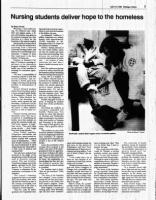
Wearing' a 001 pull-over
cap, fur-collared coat, hite
shirt and pajama pants, a 49-
year-old homeless man grins
he recei treatment for a foot
infection t a clinic for the
homeless in the nation' capital,
But his smile is not�ust one of
relief. He like the attention he's
receiving from a Howard
. University nursing student, and
believes he's contributing to her
education. "I happen to know
that experience is the best
t cher," he blurts out.
Students at Howard's Col
lege of Nursing are gaining ex
perience in an innovative
program designed to provide
health care to the homeless in
exchange for education oppor
tunities.
"W e have a responsibility of
educating students to deal with
current problems," says Dr.
Dorothy L. Powell, dean of the
college, referring to the growing
problem of homelessness in
America.
Several Howard students
spend at least two days a week at
a nurse-managed health facility
in Washington's Federal City
Shelter. Called Medical Ser
vices for the Homeless, the
facility, which opened this past
. I November, is believed to be the
largest clinic for the homeless in
the nation. It offers extensive
medical well as dental ser
vices.
Howard nursing instructor
Bernadine Lacey, who was in
strumental in establishing the
facility, notes that students are
giving the homeless health care
"with some measure of hope."
Says Lacey, "They need these
young people - their bright
faces and � attitudes ... "
Dean Powell explains,
"Homeless individuals and
families live a mere survival ex
istence coupled with general
sense of hopei ... (The)
lack of basic resources to meet
the most fundamental of needs
makes this group volunerab e to
a wide array of physical and
emotional ills." .
Not only have students been
involved in the plight of the
homeless but so have faculty and
staff at Howard's nursing
school. This past October,
Powell and company went to the
elter, operated by the Com
munity for Creative No -
Violence, to administer flu im
munization vaccinations to the
homeless.
The school's homeless
program has been 0 successful
that 'a few students, after work
ing with the homeless part of
the nursing curricul m, have
continued worle at the clinic as
volunteer , Powell indicates.
Thus far, some 40 under
graduate and 15 graduate nurs-
ingstudents have had the oppor
tunity to wor with the homeless
t the shelter, says.
An estimated 2 million to 3
million Americans are Without
homes, with approximately
10,000 home len at the
doorsteps of the U.S. Capitol in
the District of Columbia.
David C. Nelson, directo� of
�e new health facility, points
out that the students get much
more than clinical training. They
witness the political and
economic implications in health
care - the realities of tho e
Americans who don't have a
home or health insurance, he in-
dicates. _
But if the students are getting
a lesson in reality, then how are
the homeless patients benefiting
from the nusring school project?
Lacey, who is a member of
D.C .. Mayor Marion Barry's
Council for the Homeless, says
the presence .of students at the
shelter has already generated
positive impact among the
homeless there. "It's rare for
homeless people to have a feel
ing that someone cares. They
now have a feeling that our stu
dents care," she emphasizes.
Further, they gain "a sense of
pride" in helping the students
learn their chosen professions,
she adds.
• Describing the. stu ents as
"energetic, adaptable and
flexible," Nelson says, "You
should see them (the patients)
on Monday and Wednesday
nights preparing for the student
(who work mostly on Tuesdays
and Thursdays at the shelter).
They want to look good for the
nurses. This is good for self-es-
teem. I
"The students are part of the
homeless patients' socialization
process in beginning to deal with
their problems," he explains,
noting that 40 to 50 patients are
treated a day at tite medical
facility.
Lacey, the coordinator of the
nursing school program at the
shelter, says many oft e under
graduates at far t are apprehen
sive about working at the clinic,
and some even have mixed feel
ings. "This is uncharted territory
for them," she emphasizes, ac- .
kno edging that they don't get
the feeling f security they
would expect in clinical training
at a hospital.
The students want to know:
"Who are the homel�?" What
will we do?"
"The face of the homeless
have .changed," Lacey stresses,
noting that she has seen home
less persons at the shelter who
hold master's degrees. "Some
turn of fate landed them there."
Ruth Auguste, a 21-yeF.-old
nursing junior from Brooklyn,.
says he I had never communi-
. April 3-9, 1
.'
tHe homeless
_.
1 .
I
•
HOWARD sbideDt Rutb A
padeaL.
cated with homeless people she
had seen on the streets 'of
Washington and New York,
believing many of them were al
coholics and drug addicts. "I was
sort of afraid of them, " she em
phasizes.
"I now realize that a lot of
them are here because of cir
cumstances in their lives, such as
losing a job or home."
. Another Howard student, 24-
year-old Debra Staggers of
Chicago, had a perception that
homeless people were men 65
land older who were retired and
had no income or family. Now,
after working with the homeless,
she says, "I've seen some even
close to my age."
Sharon Crane, 20, a junior
nursing student from Cordele,
Ga., was surprised to find the
health facility was so bright and
patients were so accommodat-
The multitude of health
problems facing the homeless'
has provided, Lacey indicates,
"an invaluable experience in
poverty health care" for
Howard's nursing students.
A major life-threatening
problem the homeless face is
hypothermia. At least seven
homeless persons have repor
tedly frozen to death this winter
in the nation's capital.
"In a hospital, there's talk
about 'high tech and low touch.'
Nurses don't lay on hands much
anymore. At the shelter; stu
dents have the oppportunity for
�gh touch bot very low tech.
This will allow our students to be
innovative and creative."
Dean Powell hopes, with
financial support, to develop the
school's homeless project into "a
model for nursing practice,
�ucation and research."
ing in helping each ot ere 'This
is a lot better than I had ex
pected," she says.
On a recent day at the clinic,
Annie M. Thomas; a nursing
graduate student, was examin
ing a 27-year-old h meles
patient who looks 20 ye solder.
Although he came to tile facility
complaining about a st ff leg in
addition to' insomnia, Tomas, a
registered nurse, says h also ap
pears dehydrated.
'The intent of the meless
. person is survival," Lace;>' points
out. "Health takes a 10W�riOrity.
usua1ly when we see th m, they
have a multiplicity of pr blems."
One little-known problem,
Lacey notes, is bums. he em
phasizes that second- d third
degree burns can be stained
fro� sleeping on steam grates, a
frequent resting place for the
homeless during frigid weather.
1 I