
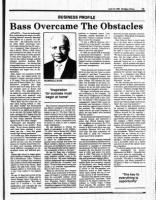

'BUSI
Overca
ATLANTA -- From his f hionable
·ffice ov rlooking the tangle of traffic
:avelin, Atlanta' fr e ay Marshall
reOects on a journey of a dif
eren sort -- t e mile tone that he
nd 0 r Black Americans ve
lOved p t durin, the I t 60 years.
A yopn ter, Ba dreamed of
eing doctor. When a draft notice
rter interrupted his plans, he t hi
: h on becomin an Army general,
ut that never happened, either. In
cead, he helped manage global
o mer products bu ine filth
20,000 employee -- but during tha
_. tinguiahed corporate career, he ha
lso help d heal the ound of the dis
dvan d and ed ar on di -
riminat' pn.
B • nior vice pre ident of RJR
lb' co, IDc., h helped guide the
empany' hu r source policie
>r 20 yean. From hi offices in At-
ta and Winston-Salem, N.C., Bas
dministe progr . that pan
eric d touch many live in di -
m soci tie uch Kenya and
�t Africa. The' ambitioo drive
t make . corporate Program
today ere apparent even
urin . boyhood ye in the mall
Jorth Carolina town of Gold boro. _
Wh n B . five ye ' old, hi
r died, I aving behind 11 chil-
n. 'mo r determined
her 80 and d ughte ould no
limited to an ilhth-grade . educa
.on � sh h d. He biped fulfill ber
ream, eaminc a B.S. decree from the
Jniversity of arylaDd - College Par ,
d later bein a arded honorary
..n"I". from five' 0 er colleg .
"Education and discipline' ere
trY important to my mother," B
!Calls. "In our hou e, m' sing school
. euld ve ., en criminal. Inver
d 0 day -- from fll" t de-
vough high school gr duation."
At a tender e, B displayed the
rae .. ical mind of bu ine man and
elf-di cipline of someone de -
d for ucce . Aa a boy, he to ed
lI'Dace for ealthy homeowners be
e d wn each momin , delivered
.. era! different n sp pe on be
n«:hooI roo and' pOe-
I "Inspiration
for ucce s must
: begin at home"
His viewpoint changed after attend
in officers candidaie chool ancJ· be
ing eommi ioaed .a eeond lieu
tenant at age 19. "By then I had de
cided I anted to be an Army general,
80 I accepted the Army' offer to finish
college t tb Univer ity of Maryland.
Afterward, I eho a: competitive tour
of Nice in order to earn a regular
Army co . ion."
He w de tined to witne the'
"d th of gregation in the military.
"In 1950 I s in Korea 'th a Blac
batWion, stationed aJpngside �
white b ttal· ona. The hi units ere
in trou , 10 the· c0mmand
er asked for reinforcements. The
general came through and found our
Blac battalion playing carda in the
ar area, not permitted to enter com-
t. Th ral rell v d th regimen· ,
tal commancl r of duty on the apot."
. By 34, B a lieutenant·
colo 1 co diq tb north m-
most battalion comb t team ill th
DMZ in Kore "My IDOl cbal1enPnI
military auipm nt as commandin
those 1,500 m n for 13 montba," .. ya
B . "To have that.many live. in your
banda it an eaam re ponaibility.
But e din't 10 e a man."
Wh n h left Ko ea, Baa became
chief of Army promotion at the Pen
tagon. He began to co ider dev tin
from his successful military career
following a mid-air conversation with
Vic Pre ident Hubert Humphrey
durin a flight from Kore to A Ita.
Humphrey I ted that B ami t
e valuabl n contributio
e
and ervice from minority and wom
en upplier . The e kind of program
help a lot of people."
Ba beli ve there i much more
yet to be done; and i bother d b
tho e who are pectator rather than
participant in progre . "Onl a gen
eration ago, Black till had to fight for
the right to vote or to it a' a lunch
counter in a public place," a Ba .
"We have come a great di tance ince
then, but the tragic effec of 200
year of di crimination cannot be
magically wiped out in a couple of
decade -- which explain why about
one-third of Black American tillli e
in poverty,"
Ba fervently believe that the in
piration for ucce mu t begin a
. home. 'It i imperative that Black
parent in till in their children an
appreciation for the value Of a good
education "he ay. '
He al 0 tre e the need for con
tinued growth of Black particip tion
in bu ine , and commen on one key
to ucce . "I believe tron ly tha for
minoritie to ucceed in any enter
pri e, th y mu t under tand ho .
others communicate. For example, a
white upervi or might ay, 'Have you
thought about trying to do thi a dif
ferent way?' But he might really mean,
'Don't do it your ay anymore'."
Ba believe that minoritie mu t
be, expo ed to integr ted environ
me beginnin t a yery young age.
"White account for the majority -
that' ju t th way it i ," ay B
"Black mu t learn to hare th mean
ing of white ,and not ju t in bu ine .
For example, a Blac tudent ho
doe n't fully understand a hite m th
teacher will encounter problem ."
Ba believe that Blac youth mu t 1
be continu lIy encouraged to cro
ne boundarie. "When 1 wa a boy, I
. thought that my choice of a pro
f ional career were limited to doc
tor, lawyer, teacher, preacher, or un-
When the tobacco company brancheCi dertaker," y the man who has car-
into the food indu try and formed R.. ved a ucce Cui career a a enior
ReynoldaInduatrieain 1970,Ba w I executive at one of the nation' Ie d-
promoted to manager of personD. I ing companie .
developm nt for that ne parent cor- "I've known many people ho could
poration. He elected vice pre . - have ou tripped ·my .ccom-
dent in 1982, and senior vice pre i- p lishm en but didn't -- becau they
dent in 1986. That year, he directed ere never given an opportunty, or
th company'a orld 'de public - never eized an opportunity," Ba
. and relations efforts. . conclude . "The key to verythi g i .
During bia career at RJR, B h opportunity, and being prepared to
helped guide the company' up recognize it when it i taring you in.
of educational, civic, health-and-w�1 the face."
fare and cultural programs. He CWTeI1t- oJ -------------:-�
Iy rve on the five-member con-
tributions board at RJR Nabi co,
hich r amon the top 10 cor-
porate dono in h Unite� State '.
"Busine hal played a Vital role in
eq al opportunity," Y B s. "RJR
ab' co it the barge corporate con
tributor to United Negro Colle e
Fund Schoo". We purcha e more-'
than 136 million annually in goOd
political or bu ine career. Coin
cidentally t hortly, thereafter R. J.
Reynolds Tobacco Company invited
Ba s to join the company.
"It wa a difficult decision, but I
wanted to be in the South," ay Ba .
"I believed that if I had any contribu
tion to make to ociety, 1 should do it
where 1 wa born and raised."
In 1968, he joined RJR a manager
of p rsonnel development -- becom
ing the first Blac manager in the com
pany. He a re ponsible for RJR'
federal contract compliance program,
EEO career development, and general
personnel management.
"Some �eople ere hoping I would
fail in my ew job, but I wa too naive
to realize it," ay Bass. "I came from a
sheltered military environment, and
had been in integrated environment
ince college. Not eosing the prej
udice wa probably in my favor, be
cau e my energies were devoted to
trying to do my job well, rather than
orrying about people' attitude "
He began introducing ne per on
nel techniques in the company. "In
1968, the Civil Righ Act of 1964 had
not yet fully taken hold in thi coun
try," he explain. "The company' top
man gement realized that equal op
portunity w becoming a critical i -
ue, and they wanted to get in front of
the problem. The company had al�
ready tried to put ome program iri
'place, but tl)ey hadn't been ati fleet
with the re ults." !
He developed a formalperfonnance
appraisal y tem, .btd instituted a
policy that offered traming 0pPOIi
tunitie' a ed on eniority. By 1971,
the dis ibution of minoritie and
omen in RJR' or force w com
mendable. Between 1972 and 19r76,
more than 160 other companie vi�
ited RJR to tudy the company
, I
equal opportunity program, .
liThe key to
everything I
opportunltyll
."