

9 '
Housing subsidies cut
70010 in Reagan years
ByAnn obear
Capital News Service
LANSING - The federal
government has cut back hous
ing subsidies 70 percent since
1981, the director of the
Michigan State Housing
Development Authority said.
"In fact, some whole
programs have been discon
tinued; like low-income hous
ing," Terrence Duvernay said.
"There's basically no federal
subsidy that encourages
production of low-income hous
ing today."
Renee Vowells, of the
Michigan Housing Coalition,
said there are between 30,000
and 90,000 homeless in
Michigan.
Vowells said cuts in federal
housing subsidies have meant a
25 percent increase in the num
ber of homeless each year for
the past four years.
"Even if (the federal govern
ment) started to re-fund hous- .
ing again i would be five years
-before we would have any new
housing built," she said.
Duvernay said low-income
housing continues to be built
under MSHDA using money
from reserves and sales from tax
exempt bonds.
I I
en al healt
By lch el plan
Capital News Service
LA SI G - Richard Prangley
was only 6 years old when he
began his stay at the former
Coldwater Regional Center for
the Developmentally Disabled
in 1956.
A trouble-making, highly ac
tive child, Prangley was diag
nosed as mentally dis
abled,needed supervision
within the walls of a public in
stitution.
While at the facility, Prangley
continued to cause trouble, but
it was not under tood that be
hind his actions was the
frustrated intelligence and
ability of the average person
living in the outside world.
He was held at the institution
for 16 years.
In 1981, nine years proving
his competency at Coldwater,
Prangley came to Manfred
Tatzrnann of the stale Depart
ment of Mental health with an
idea. .
"He wanted to show. people
. that if they could only learn what
mental health is all about, what
happened to him wouldn't hap
pen to some other child," said
Tatzmann, area manager for the
Upper Peninsula.
The two considered COD-
'We've building all over the
state, but it's harder today,
Duvernay said.
"When we were getting help
from the federal government we
were building 3,000 plus low-in
come multi-family housing a
year, now we're building under
1,000 a year."
Duvernay said most states
don't have the kinds of resreves
built up that MSHDA has, and
their numbers are drastically .
below Michigan's.
Vowells said the private sec
tor is more flexible and a dif
ference can be seen there more
quickly but doesn't have the
capital to' work with that the
federal government has. .
"Nonprofits and churches
have picked up a little bit of the
slack but nowhere near the
amount that's been lost,"
Vowells said.
Elizabeth Thompson, a
member of the Governor's
Steering Committee on the
Homeless, said the federal I
government has cut funding for
public housing from $32 billion
in 1981 to $7.5 billion in 1988.
"There's been a real policy
switch in the past lQ years,"
Thompson said.
tructing a mental health
museum, but state and federal
. budget cuts at the time made
such a grand undertaking im
possible.
PEOPLE NEED PEOPLE
Besides, Prangley and
Tatzmann were most interest in
outreach: Delivering informa
tion to groups of children and
adults for the purpose of br
ing down misunderstandings
about mental health.
Working under the theme of
"People need People," the two
set sight on the Mental Health
Educational Exhibit,the first of
its kin� in this country,
Tatzmann said.When com
pleted, the exhibit wiD target
children and their parents as its
main audience, touring schools,
libraries, museums and com-
munity agencies. The project is '
hoped to be completed by May.
"These days, kids are talking
about condoms and sex educa
tion in schools, but mental
.. health still isn't talked about,"
Tatzmann said. "The general
purpo of the exhibit is to try to
do away with some of the myths
stigmas and biases that still exist
out there about mental health
disabilities in general,"
Consideriq the variety of
•
t ,
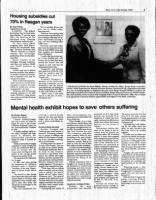
CONGRA�TI� S! Rae Hood Pbillip , Director of �inority Affairs, Burg r King Corporation
nd R v. Wallie Taplin Barrow, N tlon I Executive Director, Operation PU H, congratulate e ch oth r
on a r or orldnl together to implement the loal or the Burger KingiPUSH/M A Coven nt. (In
the background photo are Ch rles S. Olcott, President, Burger King corporation and PU H Founder,
Rev.Jes e Jac 0,0 the occa ion of the re (gnlnlorth Covenant in December, 1986.) The Coven ot
Is an agreement to increa busines opportunitl and dpport in th Black community.
these misconceptions, con
stru ting a successful exhibit will
be no small task. '
Often thought of as a long
term disease, mental illness was
considerred by many too follow
the patient throughout their en
tire life. But studies have shown
that such illnesses are most
often temporary, with many
cases treatable within 90 days,
according to the s ate Depart
ment of Mental Health. After
treatment, patients may go for
years or even the rest of their
lives without further problems.
Another misunderstanding is
expressed in the commdn per
cention of severe depression.
Everyone experience periods of
depression, but many do not un
derstand the illness in its
chronic form.
Clinical depression now is
thought to be caused by chemi
ca] imbalances in normal brain
functioning, and when serious,
requires hospitalization. Doc
tors have tried to impress upon
the public that severe depres
sion should be considered a
physical illness in order to avoid
I misunderstanding.
FIGHTING STERE01YPES
Perhaps the most
widespread and harmful
rs
I
exhibit hopes to save 0 f1
I
stereotype of all is that which
portrays the mentally ill as
dangerous or violent. But once
again, reality proves different, as
studies have shown that former
patients are not prone to
violence.
Re earchers believe that
some of the blame in this in
stance may be placed on
television, where the "ex-mental I
patient" is quite often equated
with a dangerous person. In fact,
one study revealed th t 73 per-
• cent of the mentally .. ill on
.television are portrayed as
violent, compared to 40 percent
of those mentally healthy.
In attempting to shatter the
myths, Tatzmann, who is presi
dent of MentaJ Health Educa
tional Exhibit, Inc., has enlisted
the creative efforts of Impres
sion 5 museum of Lansing.
Designers at Impression 5 have
constructed a model that in
cludes several hands-on dis
plays. Tatzmann is especially ex
cited about the exhibit's own
"robot p ychotherapist." Using
an artificial intelligence com
pute program, the display will
be able to "talk back" to it
audience.
1 Already the exhibit has
. generated po itive feelings in
the mental health community.
II
ufferiMg
The project marks the first time
,that all of the major mental
health organizations in the state
ar pulling togethe as a group,
Tatzmann said.
"Normally they're aU compet
ing for the dollar that's out
there," he said, "but this is th
first time they're all working
together."
To make sure the dollars are
there for the exhibit, the Depart
ment of Mental Health has
sponsored challenge grant that
matches every dollar aised
toward the needed S125,OOO.
With the grant, the project now
has about S46,OOO, Tatzmann
said.
Prangley, who now works as
a mail clerk for the Department
of Mental Health, said he looks
forward to the day when people
everywhere arc accepting and
understanding of the mentaJly
ill.
"Educating people is what
mental health reaJly stands for,"
PrangJey said, "It's taking care of
people who can't take care of
themselves. "
With the kind of support the
exhibit is getting, Richard
Prangley may not have to wait
much longer to see a dream real-
ized .
J