

dieated to his companion that he was speechless,
but e wasn't.
Th nd ofword
"I like it, he said simply. And then quickly
dded: "It's an exciting experience. Pictures of
ousands and thousands of wor . It leaves me in
awe of the experience of the creativity of art"
Because ood is his favorite medium for ex
presison, Little spent considerable time looking at
the Dogon figure from Mali, the Yorouba carv
ings from igeria, the Dan Masks, and the life-size
tomb figures from the Sakalava of Madagascar.
'1 love ood carvings, and these are exquisite
pi ces," he observed. "I pnly wish more pieces
could have been displayed in the open. It alIo
for better visual examination, and it provides that .
sense of feeling of the piece, but, unfortunatley, it
also provid the opportunity for people to ac
tually touch and perhaps injure the art."
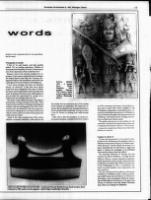
The Benin royal exhibit of copper alloy figures
and plaques of kings and their courts also drew
Little' excited attention. Pointing to the large and
colorful, wall-size photograph of the Oba (ruler)
and his court, he exclaimed: that's the supportive
material I'm talking about. Now when I 100 at the
objects, I have a picture in mind of the people who
made and wore them."
Asked if the strip weaving from West Africa
merited a eparate exhibition, Little said he felt
the textiles were an important part of the totality
of the African art expression. He found the 15-
minute film presentation on weaving informative,
but he admitted with a smile that you have to have
a love for fabrics to prolong your walk-through
here."
Little, who is also the president of a home im
provement business, established his OA Gallery
in 1979 to showcase the talents of local Blac ar
tists and to make their works available to the
Washington community at reasonable prices. Lo
cated in a refurbished townhouse at 132 Rhode Is
land, Northwest, the gallery has sponsored several
exhibitions and hosted poetry readings and lec
tures on Black and African artists.
"The gallery and my art are my vehicles for elf
expression, and the home improvement allows m
to maintain my freedom of choice," Little explain
ed upon the completion of three-hour visit to the
African art museum.
A P ce to re urn to
"To have this museum here, in the nation's Capi
tal and on the mithsonian thor ugh fare where it
will attract thousands of visitors a defmite plus,"
Little observed. "And for Blac Americans, it's a
place hopefully that we will return to again and
again to absorb the meanings of its individual
works and the history that they reflect."
The National Museum of African Art was
founded by Warren Robbins, a Foreign Service
Office,in 1964 as a private education institution
which operated in a eries of nine, interconnected
townhouses on Capitol Hill. When it became part
of the Smithsonian in 1979, a commitment was
made to provide facilities more appropriate and
more spacious.
The new museum has five galleries with almo t
22,000 feet of exhibition space; a library contain
ing 13,000 books and periodicals on African art
and culture, and a permanent collection consist
ing of 6,000 objects of African art. It is open from
10 a.m.. to 5:30 P.m. every day, excep Christmas
D y. Therei no charge fo dmission.
11