

15
APRIL 19-25,1987
THE MICHIGAN CITIZEN
seu sets May 7
for Grand Opening
Openi date for the new into n internationally recogniz- The Museum is both a grass-
home of the u urn of African ed institution dedicated to pre- roots and scholarly institution
merican Hi tory ha been t serving documenting, interpre- involving community groups,
for ay 7 according to advisory ting and exhibiting the rich award winning scholars, artists
board member Dr. David Mil· cultural heritage of African and history buffs in its wor .
Americans and their ancestors. A full range of cultural activities
The Museum's mission in- sponsored by the Museum in.
eludes serving as a repo 'tory eludes the performing and
for collecting and documenting literary arts: workshops, semi-
the contributions of Black peo- nars and lecture series' guided
ple, and as a learning and re- tours; a speakers bureau and. a
source center for all ages and reference library of books, films
ethnic groups; promoting, and audio tapes.
through permanent and traveling
exhibitions, African American
contributions to the humanities
and showcasing the creative
works of Black artists in the
Fine Arts Gallery.
burn.
e are encouraging people
from all over the state to attend
the useurn's opening and to
upport the u urn by becom
ing a member' Dr. Milburn
ide
Built t a cost of five million
dollars the useum is a result
of private donations city and
federal funding.
membership form is print
ed el where in this i ue.
The useum has developed
For further information,
please call 313/899-2500.
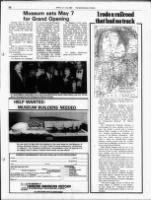
Dr. David Milburn, Janice y, ctor John Amos (Roots-Kunta Kinte), Diane Barney, and Atty. Jerome
Barney discu . g the rich Underground Railroad Heritage.
HELP WA TED:
MUSEUM BUILDERS
Do you want to help with the building of thi new home for the Museum of
African American Hi tory? You don't need to know architecture, contracting,
or carpentry. Your fin ncial contribution, n vertheless, is ju t as important as
th design t am' efforts. Donate what money you can afford.
----- --- ----- -----------
MUSEU MBERSHIP/MILLIO DOLLA CLUB APPIJCATIO
I
Mc � �.ATE�_... __ _... 1
I
_______ � TELEPHONE� �I
I
-------------------------------STATE-----------...----rifii�iijiD�=-P========l-1
DOLLARCLU I
-- Life (UJO) I
-- ()rpDization (SIOO)
__ Patroa� •
-- FamilJ (W) I
-- Individual (SU) I
-- SeniOl' atizcDlStudent (Sll) I
I
. ----------------------------.
I
I
I
I
I
-..I
to the uildin of the f Af
My cashlc: (01' S is attached.
I prefer to pay in: Monthly 0, quarterly 0, annual 0 payments ofS eacb.
HISTORY
.Sl�
•
e
One exhibit visitors to the ne Museum of
African American History will see is the Un
derground Railroad.'
Dr. David Milburn chairperson of the
Underground Railroad Families Historical
Foundation and. member of the Museum
advisory board points with pride to the exhibit.
'The finest hour in the television serie
"Roots" was the indomitable spirit, courage
and foresight demonstrated by Kunta inte
in his repeated attempts at e ape through
the Underground Railroad" Dr. Milburn
explains.
The Underground Railroad Heritage i
acknowledged by many holars a the m ve
ment that played a pivotal role in bringin
Human Rights struggle to the forefront, f r
ever changing humanitorian principles and
ncept in the Western Hemi phere. ith
help from ative Ameri an Indian from
16 ° to 1 40 over 100,000 Black refugees
runaway slaves e aped from the uthern
United States to Michigan and Ontario nada
the promised land of freedom.
Many Blacks refugees came by way of the
Detroit River into Canada because it was the
narrowest point to cross. During the summer,
many refugees swam the river with their few
belongings tied to their backs.
In the winter, many Black families saw snow
and ice for the first time and many lost loved
ones in the process of eros ing the frozen river.
Those Black refugees who survived this ordeal
utilized their trade skills and built strong corn
munities with prosperous farms, busines
churches, schools and homes.
Detroit and Chatham, Ontario i where
abolitionist John Brown Frederick Dougla s
and Josiah Henson, planned the raid on Har
per's Ferry Virginia. After the Civil War,
half of the Black families returned to ichigan
Ohio, Illinois and ew York .
"The great struggle pursuit of freedom and
family dignity i captured in this exhibit,"
he said, noting the Underground Railroad
exhibit will be permanent display at the new
museum.
1
,
t.