

8
o
There re moments in gre .
artist' life which should b
remembered forever. F or Paul
Robe n, tho moment ere
nearly obliter ted, blotted ou
by the fear and political
aruu 1 th t gripped America
in the early 1950' .
Pa Robeson be his
in the early 1920'.
n wa working his ¥
la school by cting
hen he wa wa disco ered
by Eu ene 0' eill ho cast
obe n in revival of his
play "Emperor Jones." While
rehearsing the play, Robeson
ran into a slight problem. '
The la t scene called for hi to
hi le, hich he was unable
to do. Robe n w then in-
tructed to "hum" or to ' sing."
Robe n cho to sing, hence-
forth, hi m ificent age
concert career began.
It a Robe n's perfor-
mance a the Emperor Jone
that brought him to the con-
iousne of the theatrical
world. Although there is no
vi al record of Robe n's out-
anding performanc in 1924
he repri d hi role as Emperor
J 0 s in the film version made
nine years later.
During the next four year
Robe n' voice as heard
around the wod ,in uch places
s England Romarua, Greece,
Yugoslavi and many others.
s Robeson' view of the world
expanded so did hi musi c.
Robe n became competent in
many languages and began sing
ing folk ng in their n tive
tongue, blending them together
during concert suggesting to his
audience that all men are
brother becau of their music.
In 1928 Robeson opened in
the London ta e production of
"Showboat" where he sang the
ng, expre y written for the
dedic ted to him by Oscar
Hammerstein and Jerome em,
01' an River" - the ng
mo t identified ith hi career.
The fir t time Robe n record
ed 01 n River" one year
priorto ho b at, he g it in
it original form which included
the ord nigger".
By 1928 Robe n h d per
ed Hammer tein to chan
the word nigger to doc ie ,
hich by tod v' tandards isn't
much of n impro ement. Yet
th slight change in word wa
the beginning of an improve-
ment. Yet the ight chan
in ord a the beginnin
of a metamorphosi in the word
and meaning f 01' an
River" which ould continue
Robeson's political vie
began to chan e.
His role in
Jones" in 1933
n's fllm career, encomp
elecen film s in all. Robe n
rred in ch film a 'Show
bo t", 'King Solomon' ines",
'The Proud Valley" and more.
eso
-8
8
.0
o be
3
.orgo
,.
hundred and forty people were
injured. After Peek ill, other
cities became fearful. Concerts
were cancelled, records were
pulled from ores, but Robe
son continued to speak out and
condemnation toward him con
tinued, even hi lection as
All-American End for Rutgers
University was wiped from the
record, leaving the only ten
man All-American team.
Shortly after, the Secretary
island in THE E PEROR JONES.
Av 'lab e on videocassette from Embassy
Home Entertainment.
of State cancelled Robe n's
passport because the State De
partment felt hi travel abroad
would be contrary to the best
interests of the United States.
Blacklisted in the United
State and forbidden to travel
abroad Robeson ent nearly
all of the next ten years fight
ing for his rights and in
essence his fellow man's
through the court system.
In 1958 the Supreme Court
ruled that the St te Depart
ment had no right under law
to deny a passport becau
of a man' belief and a cia
tion. Robe n won the fight.
e
but ten year of his life at the
height of hi reer were 10 t
doing it. His health was de .
troyed as well.
Once ain cclaimed and
w lcomed around the world,
Robeson began to ling for
crowd of people. But Robe-
n was tired and emed to
be truggling as his appearance
at a concert in Australia to
con truction workers proved.
His rendition of '01' Man
an extensive European concert
tour. Between concerts Robe
son spo e out plainly for what
he believed to be inustice
toward egros in the United
States, causing ere reaction
in the United State. In War-
"01' Man River" changed
ain for political purpo
The 'ssis ippi River became
symbolic for hat' Robeson
didn't like to be and the verse
"You gets a little drunk and
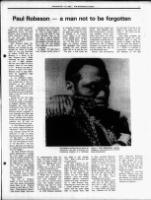
Paul Robeson portrays Brutus Jones, an
ambitious man who becomes the
treacherous emperor of a Caribbean
you lands in jail" becam
"You show a little grit and
you lands in jail."
The first eruption in the
United States to Robeson's out
spo en political views in Europe
began in Peek ill, ew York,
where he was heduled to
appear at hi fourth annual
concert for the Civil Right
Congress. Those who wanted
Robe n silenced, threatened
violence if he sang. On Septem
ber 4, 1949 Robe on sang.
Following the concert there was
a vio nt outbre from pro
testor with the police doing
little to contain them. One
River" illustrated Robe n s
state of mind at the time when
he again changed the w rd
to what had by no become
his trademark ong fr m e
must keep fighting until e're
dying" to 'I mu_ t keep fight
ing until I'm dying."
On January 23 19 6 Paul
R be n's fabulous career and
life ended. Although hi talent
and memory wa nearly wiped
from the re ords, Paul Robe n
will never be for tten ....
Another gre t moment came
for Robeson hen, on January
27, 1938 in Teruel, Spain, a
ar ood still hile he sang.
When Robeson came to the
front line to . g to Republi
can ldieTl, ooting quieted,
loud ipe en were put up� and
for a day the war opped
whlle opposing armies listened
to a man ..
In Spain, "01' an River"
went through another ph of
its m tamorpho . hen the
ver 'I'm tired of living and
ared 0 dying" became ' e
mus keep fighting until we're
dying." , 01' an River"
changed from n of lament
to song of political prote .
ith the death of Pre 'dent
Roo velt in 1945 and the end
of odd War II, Robe n'
political vie separated him
from mo t Americans no ,
more than ever, and hi arti ic
reer wa entirely political.
Robeson sang only for cau s
in which he believed, such
the Pari Peace Conference.
In 1949 obeson unehed