
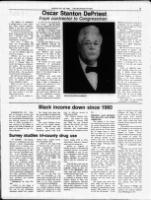

The impact of trailblazers
i ldom easy to trac. How
ever 0 r Stanton DePriest,
blazed a trail that still stands
out, more than 50 years later.
In 192 , he became the first
Blac Congre sman ever elected
from a orthern ate. He
repre nted the 1 st Congres-
ional Di tri t of Illinoi .
Ever since, a Blac
filled that Congressional
in ludin U.S. Rep. Charle
Haye ho hold it today.
Politic and trailblazing were
not new for DePriest when he
rrived in Congre .
DePriest a born in AI-
bama and gre up in Kansa .
a young man DePriest
moved to Chi ago here he
earned his livin a a contr ctor
and pinter. He was active in
the city' p litics and in 1904
hen he 33 won his fir
politic offic. H was elected
County ner.
H u d hi t 0 term in that
office to edu ate r Bl ck
but the welfare rel ief re
urce available t them.
hen he 1 st hi f r
ent b c t hi c n
and paintin busine
n reated very size-
ble pri te fortune.
But the lure of politic re
mained.
GTO - Des-
pite an economic recovery and
the t cut bill pa d in 1981,
the typical Blac hou hold had
le fter-tax income in 1984
than in 19 0, ccording to a
new analysi by the Center on
Budget and Policy Prioritie of
data just rele d by the U.S.
Census Bure u.
ST. JOSEPH - The Human
e urce Commission has ju t
relea d a report documenting
findings from a recently com
pleted a ssment of need for
ub tance abu rvices in Ber-
rien Cass and Van Buren coun
ti s, ey informant survey
format with an intervie follow
up was u d to c llect the d ta
from 65 resp ndent . Thi
rvey was conducted during
arch and pril of 19 (} and
f u d attention on collecting
from h 1 per nnel
rvice providers social
rvice supervisor , man ement
and labor per onnel medical
per onnel; ub tance abu treat
ment provider, and criminal
ju tice per nnel.
Highlighting the main find-
in:
ed to r te drug of
choice, alcohol wa ranked num-
ber one by ey informant
marijuana ranked two, amphe-
Oscar a 0 Pri
From contractor to Congressman
In 1915 he won a on the
City Council - the fir Blac
alderman e cted in the history
of Chicago' city government.
He went to Congress when
the incumbent who repr nted
th Ist Congressional District
died and DePriest as named
to replace him on the Republi
can ticket.
he only Black in Con-
e DePriest a sumed the
role of a national spoke man
for his race.
During his ix year in on
gre DePrie t paid ecial
attention to the field of edu
cation and to trying to get
mor and better education for
Black children.
He worked for more equal
di tribution of government
appropriations for education so
Bl ck tudent would have bet
ter opp rtunities and a greater
share of the federal budget for
Ho ard Uni r ity.
DePriest, who could have
pas d for white stirred up
the ongre in 1934 when he
be an a fight t de egregate a
dinin room restricted to on
gre man and their gue ts.
Although member of the
hite public had been welcomed
and erved there DePrie t s n
and his confidential cretary -
were refu d acces. ost OSC R ST TO DePRIEST
m mber a med the re olution
Blac
-
income. do
The Census data show that
the typical Blae hou hold had
11,675 in income after taxe
in 1984 nearly S 150 les than in
- 1980.
The typi al Hispanic hou -
hold and the typical fern ale
headed hou hold also lost
ground. The typical white
household gained, with 250
more in after-tax income in
1984 than in 1980.
The Center's analysis indi
cates a key reason for these
developments: between 1980
and 19 4, the gap widened
between the wealthy and every
one else in the U.S. Few
minorities and female-headed
hou hold are classified as weal-
s ri county drug use
tamines three, cocaine fourth,
and tranquilizers fifth.
-A ed to rate usage levels
of drug use this year over last
year, respondent indicated
levels of abu were at about
the ame this year with on
not ble exception. Re pondents
indicated overwhelmingly that
cocain u was higher this
year than last year.
-A ed which groups were
at reater ri for alcohol and
drug abu respondents indi-
cated that tho between the
ges of 12 to 29 were at greatest
ri for substance abu .
-A ed to rate their own
level of knowledge of sub
stance abu rvice 80% of all
respondents judged their know
I dge to be from me hat
to extremely knowledgeable.
ed to rate whether or
not juvenile substance abusers'
need were being met in their
respective counties by a very
narrow margin (39% to 37%,
respondents indicated abusers'
needs were not being met.
-A ed to respond to
whether access to residential and
outpatient rvices was limited
by availability to pay for r
vice respondents indicated that
tho rvices were indeed
limited e pecially for tho un
able to pay for re idential r
vices.
-A ed if they made referrals
to drug and alcohol tre tment
program which . do they u
45% of the r p ndents indi
cated they had used facilities
outside the tri-county area.
-A ed to allocate dollar
to con ruct a bstance abuse
delivery ystern in their own
county, respondents indicated
that education/prevention resi
dential and outpatient services
would receive the greatest dollar
amount.
thy.
IDE G GAPS BETWEE
THE WEALTHY D OTHER
ERIC S
The analysis of the Cen us
data find th t the ap in after
tax income between the richest
�20 percent of American hou -
holds and the rest of the nation
hit its widest point in. 19 4.
The top fifth of U.S. hou -
holds received 42.3 percent of
all after-t income in the
country that year the highest
level recorded since the Cen us
Bureau began collecting thes
data in 19 O.
The top fifth' gain fr m
1983 to 19 4 came largely
at the expen of middle income
huseholds. The middle fifth
of all U.S. househ Ids received
17.2 percent of the nati nal
income in 19 4, the lowest
level that has been recorded
for this group. The next-to
the-bottom fifth re eived II
percent, al a new 10 .
The poorest fifth of all
household received 4.7 percent
of the national income in
1984, the ame level as in the
previou year but 1 er than
in 19 O.
The Censu data sh that
since 19 0 the share of nat
ional after-tax income ha
dropped for hou eholds in every
income fifth execpt for tho
in the top 20 percent. If the
3
DePriest intr duced ould die in
committee but he m n ed t
get the i ue brou ht up on the
flo r f the H u .
H wever a pe ial five-man
c mmittee named the Hou e
v ted 3-to-2 to maintain the
statu qu and the re taurant
continued it di rirnination.
D Prie t failed in hi bid
f r a f urth term in 1 34 -
in to aBc 0 m crat ,
rthur it hell.
But the I s did
his intere t in p liti .
stayed a tive in hie and in
1943, a elected a ain t
a n alderman for the
3rd ard.
He rved f ur m re ye rs
before - at the - he
estate-
began
ngr until
buildin
share of national income had
remained the same in 19 4
a th y ere in 19 0 the t p
fifth would have re eived
31. billion less in inc me in
19 4 which would have been
divided instead among all other
income groups.
, The analysis sh w that even
small changes in the di tribution
of incom involve shifts of
billion of dollars" Center
Direct r Robert Greenstein said.
uA transfer of nearly 32
billion a year in income from the
bottom 0 percent of hou -
holds to the top 20 percent i
a shift of nsider ble i ni-
fi ance.
The data al pr vid
evidence that neither the
have been
Greenstein
m derate
ti n in