
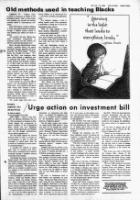

LUBBOCK, TX - Folklo which
proYided an education for Blac in the
ant bellum South, hen no ther means
ere available, may provide De learning
methods useful in comtemporary edu
cation.
Texaa Tech history professor Barbar
L. Green)'l cured an education
through a folklore sy tern created to
train children and cushion the ock of
¥elY.
"As a group," id, "Blacks have
de tremendous contribu tions to
American society and their folklore can
still be a ful and educational tool."
Sines, she laid, learned lessons, found.
comfort, protested wry and gained
self-esteem through pirituals and ork
so Hke "Go Down 0 ,"' obody
Kno s the Troub I Seen," ''If I
d yay," d numerous other
tunes hich became ·pificant part
of American fo m ic. In ddition,
motifs, patterns and rhythmic complex
ity of e music can still be detected
in comtemporary blu , jazz and gospel
music, Green said.
The slave community also employed
tales, proverb and rhyme game to
arpen memory and teach language,
motor skills, numbers and counting.
This of folklore, Dr. Green said, has
modern corollary in "rapping."
Green teache U.S. octal and c ural
hi tory and Afro-American history at
Te Tech. In an article for t winter
1984 ''Texa Tech Journal of Educa
tion" devoted to multicultural and
bilingual education, Green str d that
educator ou d ek to under land
Bl history and culture in order to
effectively te ch minoritie .
The articl d ' with ve com-
Cr� t.
c pita. for
Inorlti ••
•
munity folklore as an educational tool
- a toU Green maintains has applications
today.
"For instance, . rapping, a form of
talking handed down from generation
to generation,' being put to use in the
Philadelphia puhlic schoo .
"They are using rapping to te ch
Black students mathematics, communi
catio and job eking . . "
Green said there are many ways to
learn, 'and if students, particularly minor
ity student , begin ith something they
know well, they have better chance to
learn more.
She . d Philadelphia schools are
also beginning to put ideas to music,
as slav did, in effort to reach Black
youth. Some previously weak' tudents
have own gnificant improvement in
learning skills hen ide have been
placed 'thin their own cultural con
text, Green, id.
"Teachers who want racially ethnic
minority student to re pond effective
ly to public education hould make use
of the tudents' cultural tradition, which
for Blacks include a strong, historical
oral tradition," Green said.
Folklore may al 0 be useful in public
education because it is a ocialization
tool helping students maintain individual
and communal identity, Green said.
"Brer Rabbit and Old John tales
taught slaves to be resoureful, but not
greedy, understand that po er roles are
not tatic, find socially acceptable out-
ets for anger and restraint , and to laugh
in the f: ce of adversity."
Green said urban folktale, "to ts,"
and "dozens" exist in the contemporary
Blac community for similar reasons.
rge
•
10
y . 0 A e
From Am!tmltzm New. Staff
YO - Coast to coast, H.R.
5096, the . ority investment Tax Act
of 1984 introduced in Congre by Rep.
Chule . Rangel and co ponsored by
vera) memb r of the Congre . onal
Bl c C ucus, h won wide pre ad
support among Democrat and Republi
cans; but the e gan Administration
not t en a position on it.
The bill ould "amend the Internal
Revenue Code of 1954, to provide for
non-recognition of gain on sales and
exchang of. capital ts when the
proceeds are reinvested in certain minor
ity investment fund ."
It provide for deferral of capital
gain t on proceeds from invest
men1 used to purch oc in minority
busin through a qualified minority
inv rnent fund company.
Introducing the measure, Congressman
gel tated: 'We beliew that this bill
will provide inve on with the incentive
they n d to in equity capital in the
minority community. The proYisions of
ITA are an attempt to provide a crea
tive elution to the economic challenge
of the 80' ."
Ronald . Langston, Speci . tant
to e Commissioner, Administration for
Children, Youth and Familie , Depart
ment of Health and Human Servi�s,
nt copie of the bill to U.S. Senator
Robert Dole of Kansa , chairman of the
Sen te Finance Committee and to White
Hou e Chief of Staff James A. Baker III.
Langston noted in his letter to Dole:
"as one of the few Black appointee of
thi Administration, I would be very
enthu iastic in supporting uch legis
lation. In ddition, the legislation may
serve an excellent economic package
for the Republican party's economic
platform or legislatiw agenda."
The bill might require some revi . on
''to obtain Senate GOP support," Lang
ston said; I but h thought th concept
ould "compliment the President's Eco
nomic Recovery Program, Opportunity
Wage Act of 1984, Enterpri Zone Act,
Tax Equity Act and . ew 'Federalism
program.
"It might be particularly attractive in
gaining minority Blac busine and pro
fe ionial support," Langston futher
sugge ted to Dole.
Langston had said he received copy
of the bill from Travers Bell, chairman of
the Board of Daniels and Bell, Inc.,
99 Wall St. investment company.
"According to Bell's sources," he told
Dole, passage of the bill "should annually
earn the U.S. government 150 new and
better financed minority firms, $15
billion dollars in new sale, 300,000
new jobs, $250 million in new corporate
income tax, $700 million in employee
tax revenpe and $2 billion in export
le for each $500 million in private
capital."
Hi letter to Presidential Chief of
Staff Backer said e ntially the same
things. Stating that Baker ed him to
reply, James . Frey, . tant Director
for Legislative Reference in the White
House Office of Management and Budget,
wrote to Langston: "As you are pro
bably aware, the Administration has not
taken a position on the date on H.R.
5096. We do appreci ite having the bene-
JULY 25 -31,1984 THE CITIZEN PAGE THREE
eac
•
I
9
on
•
I
ves
fit of your view on this ubject, how
ever, and will keep them in mind should
the Administration develop a posi tion
on this legislation."
The the ew York State Legislature
moved promptly in pport of the Hou
bill and mblyman Alton R. Waldon,
Jr., of Queen sent a copy of the joint .
Senate and A mbly re olution to Sena
tor Dole.
Through the resolution the N.Y.
State Legislature moved ''to petition the
Congre "to pa H.R. 5096, an action
''mo t emphatically" urged. About 30
state legislature have done the same.
''This bill, if passed, will have a signi
ficant impact in' fostering the growth
of the economy and the role minority
busine es play in the economic scenario
of this country," It would "provide
minority busine s with a greater oppor
tunity to compete in the private enter
prise y tern," the Albany re olution
stated.
Out west in the City of Richmond,
. California, the City Council adopted a
resolution endorsing H.R. 5096. City
Clerk Harlan J. Heydon nt copie of
it to President Ronald Reagan, Tre ury
Secretary Donald Regan, Senator Ho
w rd Baker, Pete Wilson and Alan Cran
ston and House members George Mil
ler, Dan Rostenkowski, Baraber Conabl ,
Rangel nd Paren Mitchell.
Tavers Bell who company, Daniels
and Bell, Inc. is theonly minority inve t
ment firm of the ew York State Stock
Exchange urged th p ge of the bill
aying: "If there i anything in minority
bu . ne development; mlnoritie have to
have acce to capital nd thi . it.'
me
Says Bell: "T . is th m important
economic development that been
created for minorit in America and
it requir much attention. H
pushed by the Congr , the adIInms
tion I cannot afford to be negati
bill. "
In his letter of support sent to
same persons, Mayor Edward c-
Intyre of Augusta, Ga. said:
"There's an old aying that no c .
is stronger than its weake link and I
believe the entire bu . ne orld be . e s
th e line in the bu ine orld of
our country is minority participation."
He told Sen. Dole to press for p
of H.R. 5096 "a desperately needed
minority legislation in the current
sion."
Such letters also ent to Do from
th Jackson, Miss., chapter of
ational Busine League. AI 0 from
International Benevolent Society, b
in Columbus, Ga. whose "grand national
president" Jame O. Bro n said:
, e have 6,000 m mbers in the res
of Georgia, Florida, barna, orth
Carolina, lJIinoi and Indiana:' Bro
noted and erted:' e feel this i on
of the mo t important pi s of minority
legislation ever introduced in the United
States Congre in th a/rea of economic
developm nt."