

Sleeping Giant (Continued from page 8.)
DON'T QUIT
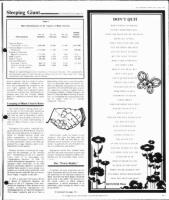
Table I
WHEN THINGS GO WRONG
Black DftIominations in tbe Congress of BllK'k Churches
AS THEY SOMETIMES WILL.
Sunday
School
Members
WHEN THE ROAD YOU'RE TRUDG/'VG
No. of
Members
No. of
Churches
No. of
Pastors
�nonrination
SEEMS ALL UP HILL.
WHEN THE FUNDS ARE LOW
National Baptist
Convention, U.S.A.
5,600,<m
26,<m
27,500
2,407,<m
National Baptist Convention
of America
2,750,<m
11,398
7,598
500,<m
Progressive National
Baptist Convention
521,692
655
863
N.A.
AME Church
1,166,<m
5,878
5,878
363,432
AMEZ Church
940,<m
4,500
5,550
1 62,<m
Christian Methodist
Episcopal Church
466,718
2,598
2,259
115,424
Church of God in Christ
6OO,<m
5,<m
6,<m
N.A. - Not Available.
AND THE DEBTS ARE HIGH.
AND YOU WANT TO SMILE.
BUT YOU HAVE TO SIGH,
WHEN CARE IS PRESSING
YOU DOWN A BIT,
REST IF YOU MUST, BUT
·Based on reported figures in the Yearbook. of American Churches, 1972, published by
the National Council of the Churches of Christ in the U.S.A., New York, N.Y., plus
conferences with responsible church officials.
DON'T YOU QUIT.
LIFE IS QUEER WITH ITS
priority concern, that as a result of such a
black leadership vacuum "cooperative ef
forts were preempted and coopted by the
civil rights agenda and were never
reinstated." Hence, over a period of nearly
one-third of a century now, interraciality of
purpose took over the critically needed
place of a redemptive-oriented black racial
purpose.
diminishing of the role or even the authen
ticity of specifically black institutions. In
deed, the National Association for the Ad
vancement of Colored People went so far in
this regard as to award its highest honor,
the Spingarn Medal, to Mabel Staupers, the
head of a National Black Nursing Associa
tion, for disbanding her racial group as be
ing no longer valid in a "racially
integrated" America.
TWISTS AND TURNS.
AS EVER r ONE OF US
SOMETIMES LEARNS,
AND MANY A fAILURE
TURNS ABOUT
Usurping of 81 ck Church Roles
WHEN HE MIGHT HA VE WO,.\·
HAD HE STUCK IT OUT;
This trend toward "taking a back seat"
on the part of the historically pioneering
and prophetic leadership of the black chur
.hes may be seen as associated r"esently
ith what the church leaders referred to as
"the absence of a clear understanding of
what the Black Church is and of what it
consists. "
DON'TGHE UP
THOUGH THE PACE SEEMS SLOU--
YOU MA Y SUCCEED
WITH ANOTHER BLOW
Throughout the country, especially dur
ing the period since World War II, there has
been a growing abdication of religiously in-'
spired or ethically-centered social and
public responsibility. In the black com
munity. this divesting of moral imperatives
in social and public matters has been ag
gravated by a tragic emphasis upon a one
sided kind of interraciality.
SUCCESS IS FAILURE
TUR/\,ED I/\'SIDE OUT--
Small wonder, under the weight of such
dynamics, that there has been what the
leadership of CNBC has described as "the
declining moral authority of the church"
and an "acquiescence by church leaders in a
sense of uselessness and despair."
THE SIL �ER T1.'VT
OF THE CLOUDS OF DOUBT.
AND YOU NEVER CAN TELL
Segregation would have enabled black
churches and other institutions to grow and
prosper. Integration implicitly tended to de
authenticate alJ historically black institu
t ion s .
Perhaps foremost in fostering this tragic
trend was the aftermath, or the "bottom
line," interpretation by the U.S. Supreme
Court itself of its thoroughly just
"desegregation decision" of 1954. To
outlaw and eradicate segregation-or to de
segregate-black Americans, as the 1954
decision specifically called for, would have
enabled black people to move ahead or to
progress as a racial group unfettered, with
all undue barriers removed. But just the op
posite began to happen a year later.
JUST HOW CLOSE YOU ARE.
IT MA Y BE NEAR
WHEN IT SEEMS SO FAR;
The "Power Reality"
SO STICK TO THE FIGHT
WHEN YOU'RE HARDEST HIT
In perhaps the most promising way for
black Americans and for the entire nation,
the leadership of the National Congress of
Black Churches has been deeply concerned
about what it has called "the discovery of
the power reality in black religious
organization, a careful assessment of its
potentiality, and a strategy by which it can
be actualized. It
IT'S WHEN THINGS SEEM WORST
In 1955, a year after the historic Brown
s. Boord 0/ Education decision, the
ices of the U.S. Supreme Court inter
preted the meaning of their decision as not
simply outlawing segregation (or
desegregating) but as requiring integration!
This meant, implicitly and on its face, a
(Continued on page 15.)