

CAREER
ey
Constance Baker otley was
the first black oman to serve
as judge on a United States
Federal District Court. This is a
great honor. The Federal (cen
tral government) District Court
is the third highest in the land.
The highest is the Supreme
Court. After the Supreme Court
comes th Court of Appeals.
otley erve as a federal
judge for the southern district
of e York. As a federal judge
she hear cases concerning the
United States Constitution and
federal la . She is responsible
any changes in the laws of
country.
C A 0 t
otley began her career as a
I r during th civil rights
mov ment of th 1950s and 60s.
At th t tim blac people e
not allo ed to t in th s me
restaurants, attend th arne
schools or even use the same
throom hlte people.
ot ey orked to chang the
la 0 that black people ould
h ve equal rights.
Constance otley gre up in
t orth, in e Haven, Con
necticut. any people think
t at th only part of the country
blac peopl h d troubl in as
the South. This w not true. In
Connecticut, Con t nce otley
a affected by prejudice.' So
decided to become a
I .., er nd try to change thing .
any people thought it as
foolish for her to go to la
chool. They felt she ould
n v r get a job as a la yer. She
ad t 0 strikes again t
er- he as a woman and she
as bl ck,
..... La
v r encouraged m
to go to I school," h y .
"But t thought I could help in
the area of civil rights. I would
va orked for fr if th t
1949. But a black female lawyer
ina southern court was really
odd.
"I as arguing a case in
Jackson, Mississippi," she
remembers. "It was the first
time those folks had seen a
woman, let alone a black
oman, in court. Well, the
blacks arrived early and took all
the seats in the courtroom. The
white folks came too but re
fused to stand in the back hile
the blacks ere eated. So they
paraded in and out all day long,
atching me and listening to
me fight for equal rights."
otley as n excellent
la yer. She brought about
many change that impro ed
the liv of black people. She
as ctive in the fight to allo
black children to attend white
schools. She fought to get
James MeredJth into the Univer-
ity of Missl sippi. H as the
first black person to be ad
mitted to that school. W n chll
dren in Birmingham, Alabama,
ere expelled from school for
taking part in civil rights demon
strations, otley persuaded the
courts not to t e action against
them. he also persuaded the
schools to allo them to fini h
out the school year and gradu- -
ate.
HI
Co
in
Motley acted as lawyer for
Dr. Martin Luther _ King, Jr.,
Reverend alph Albernathy,
and thousand of others who
were arrested in protest
demonstrations. She helped
make it possible for black pe0-
ple to ride railroads and buses
in Mississippi; buy housing in
Michigan, Missouri, Ohio, New
York, and Georgia; and go to
public places, like restaurants
and movie theaters, in Ten-.
nessee.
In 1964 otley became the.
f{rst black woman elected to
the New York St te Senate. She
was then elected th first and
A only f male bOrough president
in New -York. In 1966 she was
appointed by President
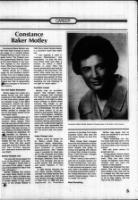
Constance Baker Motley helped to change many of the la s in this country.
Johnson to the Ne Yor State
Supreme Court. She was the
first black female to hold this
po ilion.
any things ha e changed
since the first attempts at equal
civil rights in this country. ore
black people are going to
school and getting the chance
to follow their choice of profes
sions. There are even changes
in the field of la .
"When I went to law school I
as one of a dozen women out
of two hundred men," she says.
"Today one ttlird of all students
in la school are omen. And
now, when I am asked to speak
at schools around the country, I
am invited because I am a suc
cessful female lawyer. Color is
no longer the lssue."
otley has some tips on
hat you should "if you ant
to be a sue
"R e rythlng you can.
You must start very early in life
to get into the habit of reading.
You must ha e a real interest in
school."
S e has: some advice for
gro n-ups too.
"Young peop e should a ays
be taught the re rds of hard
or. They can earn more
money, be happier, more useful
citizens, and can have the
chance to help people."
otley has folio ed her o' n
advice. S and her husband
have. raised a son, and no he
is a la er too. S e ha spent
much of her life I arning h t
to do to P ot rs, nd the
re t of er life doing it.
R
"II