
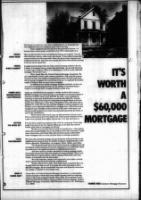

This house' located in a worn-down neighlxxbood in an American city.
The neighborhood is oot �ly goDe, but it's hurting. -
Urban neighborhoods like this have the potential to recover -to
become places here people would like to live. We'l stake rooney on it.
Many people feel they'd miss something by living in the suburbs. The city
offers diversity, histcxy, culture and coovenience. Urban public transportation
means freedom from the automobile. Many city houses have 'Character and
architectural interest. And since moce people still choose the suburbs, housing
in the city can be a good buy.
H people t housing in the city, there can be a housing market in the city.
Lenders of ITkX'tgage rooney, reoognizing this change, can see that this house
is orth a lot to someone. When it is rehabilitated, it will be orth a $60,000
�e. We can it now.
We're Fannie ,the Federal ational Mortgage Association.
are a share der-owned, profit -making corporation, with a specific purpose.
Our job is to help meet people's housing finance needs. We don't make loans,
but by buying mortgages from local lenders who do, we replenish the lenders'
upply of funds so they can grant nue mortgages.
In additKm to our regular � purchase activities, we have se
up a series of special programs that use Our position in the home finance
mark to encourage tmre ITkX'tgage lending in urban areas.
Under our rehabilitation loan program, a lender ouId be able to grant a
,000 ITkX'tgage on a house like this, even though in its present condition it
may have a market value of only $35,000. Its value, when rehabilitated
according to approved, detailed plans, ould be about ,200. A lend
taking advantage of this program could gran a mortgage based on the com-
pleted valu of the house, rather than on its JRSeIlt value. Tbe buyer ho is
I qualified fo a 95%, 3O-year conventional mcx1gage ould be required to put
5% down and ould receive $60,000 as a mortgage loan -95% of the house's
completed value. $35,000 ould go directly to the seller of the house, and
the would be placed in an escro account administered by the lender, to
pay for the rehabilitation.
-Home buyers used to have to go out and persuade meone to give
them a con tru . on loan for the rehab ork with separat transaction costs,
a short -tenn payba and a higher inter rate. 0 they don't have to.
If no kno s about our programs, they on't do much good. Fannie
people from each of our five regional offices go out into the cities and tell
lenders hat kinds of mortgages will b y. .
e also try to convince them of what we already kno -that making
urban loans is good busi for us, f<X' lenders and for the community. People
want urban homes, and Fannie Mae beli ves that properly underwritten
urban mortgages carry no more risk than those on suburban properties.
e or with oommunity groups, local governments and local lenders to ge
ighborhoods turned around. It's already working in neighborhoods in such
cities as emphis, Philadelphia, Los Angeles, Toledo, Seattle, and Dallas.
. The city government has to be involved, because a neighborhood will
improve unless essential rvices are maintained or re-established, Build
ing codes have to be applied nsitively to rehabilitated structures.
And there must be a lender oommitted to lending notgage money. .
Community groups have often seen lenders as unaPJX'()aChable. 'They're not.
Fannie Mae is in a good position, with its ongoing relationship with many
lenders, to bring them into the partnership.
But most important, people in the community mu make a commit-
ment to preserving and improving their neighborhood. ,
People want to live in cities. That means there is economic life to be
brought back into cities as well. It is people who make this house worth a
,()()() notgage. All our rompticated real estate and financial transa '0IlS
are, simply, a response to what people want
_lAY S Fannie Mae, the Federal ational Mortgage Association, is a shareholder-
? owned corporation which helps meet people's housing needs by supplying
rnooey to the home notgage industry, Since 1968, our investment in mort
gages has financed housing f<X' dose to 3 million American families. Federal
ational M<I1gage Association, 3900 isconsin Avenue, . W., Washington,
D.C. 20016. .