

Looking Back
From the William Davidson Digital Archive
of Jewish Detroit History
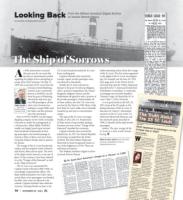
The Ship of Sorrows
A
n 85th anniversary occurred
this past year for an event that
became an international symbol
regarding the plight of Jews attempting to
escape from Nazi Germany. On May 13,
1939, the ocean liner SS St. Louis from the
German-owned Hamburg
America Line (commonly
known as HAPAG) set sail
from the port of Hamburg.
Aboard the ship were just
over 900 passengers, all but
a few were German Jews
seeking to escape Hitler and
his Nazis, and the antisemi-
tism they promoted.
Prior to WWI, HAPAG was the largest
shipping company in the world. Ironically,
it became so under the management of
a German Jew, Albert Ballin. HAPAG’s
wealth was largely based upon revenue
from hundreds of thousands of steer-
age passengers who booked passage to
America. Many of them were Jews from
Germany, Eastern Europe and, in particu-
lar, Russia.
The voyage of the St. Louis became leg-
endary, and has inspired works of history
and fiction, films and an opera. The story
of the ship’s travels, however, is not one of
glory. To the contrary, it has been referred
to as the “Voyage of the Damned,
” as well
as the “Ship of Sorrows.
”
The St. Louis was commanded by
Captain Gustav Schroder (1885-1959), an
exceedingly compassionate officer. The
ship’s initial destination was Cuba. Upon
arrival there, a few passengers were landed,
but 900+ Jews were not allowed to dis-
embark. Captain Schroder then sailed for
America. Nearing Florida on June 4, the
U.S. Coast Guard prevented the St. Louis
from reaching port.
Captain Schroder then steered for
Canada. Again, Jewish passengers were
not allowed to disembark.
Finally, the St. Louis returned to
Europe to the port of Antwerp, Belgium.
After a period of negotiation, the United
Kingdom, Belgium, France and the
Netherlands all agreed to take a portion of
the Jewish passengers. Unfortunately, all
of these nations, save the U.K. were soon
overrun by the Nazis in 1940. Many of the
Jews from St. Louis, sadly, were eventually
rounded up and sent to concentration
camps.
The saga of the St. Louis was tragic.
Finally, in 2012, the U.S. Department
of State issued a long overdue apology.
Fourteen survivors of the “Voyage of the
Dammed” attended the ceremony.
Captain Schroder also received his
belated due. In 1957, the Federal Republic
of Germany awarded him the Order
of Merit. The Yad Vashem Holocaust
Memorial in Israel recognized Gustav as
one of the Righteous in 1993. These are
well-deserved honors.
The William Davidson Digital Archive
of Jewish Detroit History
holds interesting stories about the voyage
of the St. Louis. The first stories appeared
as the plight of the St. Louis was happen-
ing. For example, see the June 30, 1939,
front page story in the Detroit Jewish
Chronicle that cites the “Policy Statement
Issued By J.D.C” (American Jewish Joint
Distribution Committee). A week later,
a frontpage story had this headline:
“Human Cargo, On Board the SS. St.
Louis” (July 7, 1939, Chronicle).
A very good article in the Feb. 28,
2013, issue of the JN speaks to the
lasting relevance of the St. Louis. It
discusses Dr. Diane F. Afoumado’s
research on the St. Louis at the U.S.
Holocaust Memorial Museum, and
the museum’s quest, launched in
1990, to identify all the ship’s Jewish
passengers.
Indeed. The epic voyage of the
St. Louis is a story worth remem-
bering.
Want to learn more? Go to the DJN
archives, available for free at
thejewishnews.com.
Mike Smith
Alene and
Graham Landau
Archivist Chair
70 | NOVEMBER 28 • 2024
J
N
accessible at thejewishnews.com