

20 | NOVEMBER 14 • 2024
J
N
L
ife in the former Soviet Union
was no easy feat for its Jewish
citizens.
Tsila Pleasant (Vinik),
employment specialist at Gesher
Human Services, recalls rampant
antisemitism growing up in
Moldova, a former Soviet republic.
By the time she was ready to attend
college, the antisemitism had
reached levels her family could no
longer tolerate.
In 1973, the Vinik family made
aliyah to Israel. Like many other
Soviet Jews, they sought a better
life where they could practice
their religion freely and have equal
opportunities for their children.
Pleasant spent 11 months in Israel,
one of which included the Yom
Kippur War.
Then, two months before
Pleasant’s 20th birthday, the Viniks
emigrated to the United States.
Holocaust survivors Chaim
and Manya Vinik, and their four
children settled in Oak Park in
1974, which served as the hub at the
time for Soviet Jewish refugees.
Pleasant, who soon became a
young mother, began working at
a local drugstore as a pharmacy
assistant. Her English was limited,
and like most Soviet Jewish
immigrants, she faced the daunting
task of starting over in a world that
was completely unfamiliar and new.
Yet, one day, a chance encounter
set forth a trajectory that would lead
her down a rewarding and impactful
career path that Pleasant continues
to build upon today.
HELPING FELLOW REFUGEES
In 1978, former Jewish Family
Service executive director Samuel
Lerner came to the pharmacy to fill
a prescription. It was a time when
helping Soviet Jewish refugees was
a priority for JFS, so he was familiar
with Pleasant’s story. “You should
come work with us,” he said.
Pleasant was unsure. She didn’t
have the skills, she replied, and she
also had a toddler. However, she
spoke four languages — Russian,
Yiddish, Hebrew and was learning
English — and JFS believed she
would be an excellent addition to
their new resettlement department.
Finally, after much conversation,
Pleasant accepted an interview and
was offered a job in 1979.
“They opened the door for me,”
she recalls.
Pleasant worked with Jewish
Family Service, primarily assisting
Soviet Jewish refugees, from 1979 to
1981. Then, the first wave of Soviet
Jewish immigration stalled during
the Reagan administration, and
she began to look for other ways to
continue helping families in need.
When a new job opportunity
arose at Jewish Vocational Services,
which provided workforce training
and refugee services, Pleasant felt it
was the perfect fit for her skills and
interests.
In 1989, she began work at JVS
as a refugee employment specialist.
Many years later, in 2022, JVS and
Kadima would merge into Gesher
Human Services, where Pleasant
continues to work today. Now, her
title has changed to employment
specialist to support anyone in need.
After 35 years in her current role,
Pleasant is a critical member of the
Jewish community and beyond.
She’s worked tirelessly to help both
Jewish and non-Jewish families,
including generations of families,
achieve financial independence and
access vital resources.
It’s a story not unlike her own.
Thanks to the help of Jewish
organizations that supported
Soviet Jewish immigrants and
her unwavering commitment to
provide her family with a better life,
Pleasant’s children were able to grow
up with the religious freedom she
didn’t have as a child.
“Growing up, there was an
expectation that you’re here for
a better life, so use it,” Rachael
Pleasant, Tsila’s younger daughter,
recalls. “Our grandparents are
Holocaust survivors; our mother
is an immigrant, and my sister and
I were able to live a very full life
[because of their sacrifices].”
GOING ABOVE AND BEYOND
Throughout her more than four
A Life of Empowering Others
Soviet Jewish immigrant Tsila Pleasant celebrates 35 years
at Gesher Human Services.
ASHLEY ZLATOPOLSKY CONTRIBUTING WRITER
OUR COMMUNITY
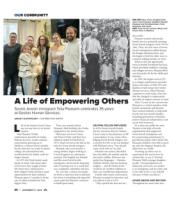
FAR LEFT: Rick Jones, daughter Erika
Jones, Tsila Pleasant, daughter Rachael
Pleasant and Phil Rosentraub. Front:
Samantha with Ozzie.
LEFT: Tsila and her parents, Manya and
Chaim Vinik, in Moldova