

OCTOBER 24 • 2024 | 41
continued on page 42
Bringing It Down to the Bass, a
stylistically wide-ranging new
solo album on which he’s joined
by guests such as King Crimson
founder Robert Fripp, drummer and
college friend Steve Gadd, violinist
Shankar, guitarists Earl Slick and
Steve “The Deacon” Hunter, Levin’s
brother Pete on organ and many
more.
There’s an autobiographical tenor
to the album and, for the track “On
the Drums,” he stacks his own voice
into an a cappella chorus intoning
the names of the many drummers
he’s worked with during his career
so far.
And “so far” is certainly how
Levin looks at it, even 56 years
after his first recording (on Gap
Mangione’s “Diana in the Autumn
Wind”). That means there’s a lot to
talk about, too, as he Zooms in from
his hotel room before an Arizona
stop on the Beat tour.
A CONVERSATION
WITH TONY LEVIN
So “On the Drum” — did you leave
anybody out
who’s angry
with you now?
Levin:
(laughs) Oh,
actually, I left
out a bunch. I did
that track during
the lockdown year,
and I spent a lot of time
not only trying to research what
drummers I’ve played with, ’cause I
wanted to name them all, of course,
but to fashion music just using the
names of all of them and not using
any other words. It was a labor of
love. I’m happy to finally release
that track.
It’s been a big career, by any
measure. Do you have any sort of
big-picture view of what you’ve
done over all these years?
Levin: It’s not something I think
about day to day, because how lucky
am I to be playing day to day? I’m
focused on the music. Looking
back on my career, the one thought
that’s always in common for the last
... quite a while, as soon as I was a
mature adult, I
began to realize
how lucky I am
to not only be
doing what I
love when I go
on the road and
play music live for
people, but in addition
how lucky I am to be able
to have a career of that.
Was a career in music supported
at home or were there dreams of
the nice Jewish doctor or lawyer?
Levin: Both my parents
encouraged it. My brother Pete
is three years older and became
a musician before me. I had very
much followed him in every way
through the years; he’s the one who
told me, “Don’t turn down any
gigs. You never know when you
might meet a good drummer or
something.” I was probably in high
school when he told me that.
So, my parents encouraged us.
They felt that to be educated you
needed to have piano lessons when
you were a kid, and then you could
choose your own instrument after
that, which we both did. And then
you should become a doctor or a
lawyer, which we didn’t. We stayed
with the music and they were fine
with it — once they accepted it. I
appreciate now what I didn’t when
I was a kid, which is that support.
Even if it’s not 100 percent, that
support is critical to become a
professional musician. I have met
quite a few talented people in my
life whose parents made it hard for
them, so somewhere along the line
they gave up doing it.
How did bass become it for you?
Levin: Y’know, I don’t remember.
I’d asked my parents when they were
elderly if I said anything when I was
a kid, and they said I just said, “I
like the bass.” It sounds simplistic
now, after I don’t want to add up the
years I’ve been playing the bass and
not doing much else. Now I realize
it was a profoundly good decision,
and I’m glad it didn’t come from
any part of my brain that had an
objective in mind except for, “I still
love playing the bass.” I love playing
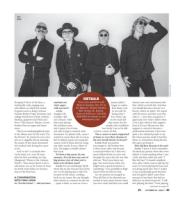
DETAILS
Tony Levin performs with
Beat on Sunday, Oct. 27, at
the Masonic Temple Theatre,
500 Temple St., Detroit.
Doors at 6:30 p.m. Call (313)
548-1320 for tickets or visit
themasonic.com.
COURTESY OF BEAT
The
Beat