
4 | OCTOBER 24 • 2024 J
N
essay
One Year Later
O
ct. 7, 2024.
One year later, it still hurts.
One year later and my hands
are shaking as I put on my “Bring
Them Home Now” necklace. One year
later, and I am feeling the same as the
day our hearts broke.
I woke up to my social
media flooded with
prayers, remembrances
for those whose lives
were taken too soon,
and hope that this living
nightmare will be over
sooner rather than later.
“1 year of heartbreak.
1 year of sadness.
1 year of rising hatred against our
community.
1 year of saying:
BRING THEM HOME NOW
.
”
I wrote those 5 lines on my
Instagram story alongside a post
shared by the State of Israel’s official
Instagram account. As a writer, I’m not
often at a loss for words, but how can I
explain what I am feeling isn’t just me?
How do I explain to my non-Jewish
friends that when our community is
attacked, everyone feels that same hurt
and fear as though we were all one
person?
When my friend wanted to meet
for lunch, I said OK. Once I stepped
outside my dorm building and started
walking to lunch, I got an anxious
feeling in my gut, same as I did a year
ago. The only difference is that this
time I was not hiding the fact I was
Jewish, and I was proudly showing
off my “Bring Them Home Now”
necklace. But the fact that I felt the
same way now as I did a year ago
emphasizes how that fearful feeling
never truly goes away.
I have grown within this last year,
making sure to only surround myself
with true friends, cutting out those
who are not and experiencing the
change I can make by simply using my
voice. While I often feel alone on my
campus, as do my Jewish friends who
are using their voices to stand for Israel
at other colleges, I know that we will
always be connected as we share in the
resilience and strength that is found in
every proud Jew.
I headed off to class with that same
uneasy feeling in my stomach. Seeing
the Detroit Jewish Federation building
vandalized made me even more
anxious. I’ve been to that building so
many times growing up — meetings
for Tamarack Camp, JARC, Hebrew
Free Loan and more. I always thought
of that building as untouchable and
so strong. For it to be vandalized —
especially on this day — felt like the
wall protecting us was breaking down.
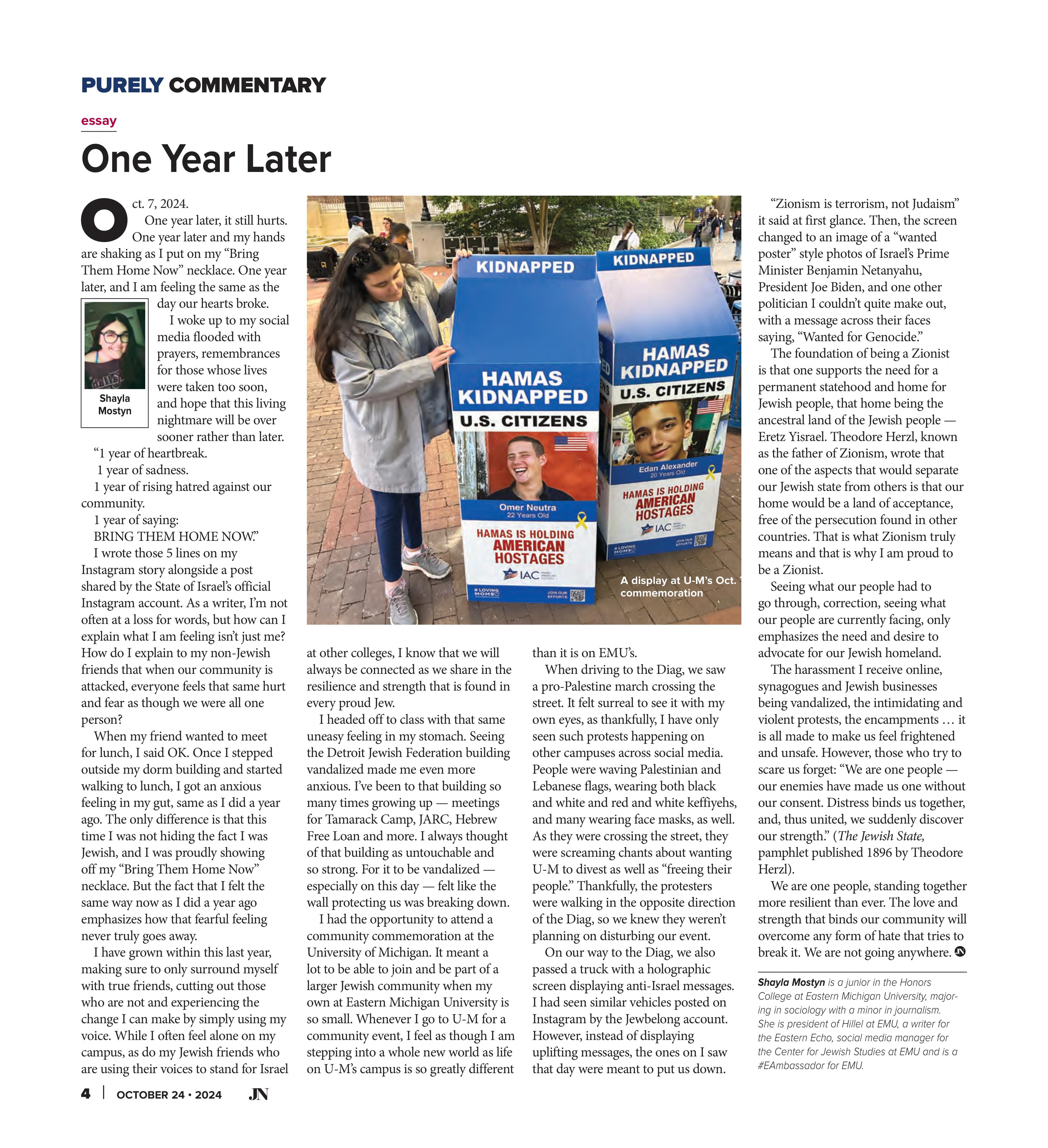
I had the opportunity to attend a
community commemoration at the
University of Michigan. It meant a
lot to be able to join and be part of a
larger Jewish community when my
own at Eastern Michigan University is
so small. Whenever I go to U-M for a
community event, I feel as though I am
stepping into a whole new world as life
on U-M’s campus is so greatly different
than it is on EMU’s.
When driving to the Diag, we saw
a pro-Palestine march crossing the
street. It felt surreal to see it with my
own eyes, as thankfully, I have only
seen such protests happening on
other campuses across social media.
People were waving Palestinian and
Lebanese flags, wearing both black
and white and red and white keffiyehs,
and many wearing face masks, as well.
As they were crossing the street, they
were screaming chants about wanting
U-M to divest as well as “freeing their
people.
” Thankfully, the protesters
were walking in the opposite direction
of the Diag, so we knew they weren’t
planning on disturbing our event.
On our way to the Diag, we also
passed a truck with a holographic
screen displaying anti-Israel messages.
I had seen similar vehicles posted on
Instagram by the Jewbelong account.
However, instead of displaying
uplifting messages, the ones on I saw
that day were meant to put us down.
“Zionism is terrorism, not Judaism”
it said at first glance. Then, the screen
changed to an image of a “wanted
poster” style photos of Israel’s Prime
Minister Benjamin Netanyahu,
President Joe Biden, and one other
politician I couldn’t quite make out,
with a message across their faces
saying, “Wanted for Genocide.
”
The foundation of being a Zionist
is that one supports the need for a
permanent statehood and home for
Jewish people, that home being the
ancestral land of the Jewish people —
Eretz Yisrael. Theodore Herzl, known
as the father of Zionism, wrote that
one of the aspects that would separate
our Jewish state from others is that our
home would be a land of acceptance,
free of the persecution found in other
countries. That is what Zionism truly
means and that is why I am proud to
be a Zionist.
Seeing what our people had to
go through, correction, seeing what
our people are currently facing, only
emphasizes the need and desire to
advocate for our Jewish homeland.
The harassment I receive online,
synagogues and Jewish businesses
being vandalized, the intimidating and
violent protests, the encampments … it
is all made to make us feel frightened
and unsafe. However, those who try to
scare us forget: “We are one people —
our enemies have made us one without
our consent. Distress binds us together,
and, thus united, we suddenly discover
our strength.
” (The Jewish State,
pamphlet published 1896 by Theodore
Herzl).
We are one people, standing together
more resilient than ever. The love and
strength that binds our community will
overcome any form of hate that tries to
break it. We are not going anywhere.
Shayla Mostyn is a junior in the Honors
College at Eastern Michigan University, major-
ing in sociology with a minor in journalism.
She is president of Hillel at EMU, a writer for
the Eastern Echo, social media manager for
the Center for Jewish Studies at EMU and is a
#EAmbassador for EMU.
Shayla
Mostyn
PURELY COMMENTARY
A display at U-M’s Oct. 7
commemoration