

4 | OCTOBER 10 • 2024
J
N
PURELY COMMENTARY
opinion
How to Kill an Idea
O
ver the past year we’ve
heard repeatedly that,
while it is possible to kill
Hamas’ or Hezbollah’s leadership,
it is impossible to kill an idea. We
were told that while Israel should
do its best to defend
against threats (which
includes preemptively
destroying offensive
infrastructure), there
is little to nothing we
can do about the ideas
that drive the Sunni
(Qutbist) and Shiite
(Khomeinist) versions of Islamic
Imperialism. That the best we can do
is draw our swords and wait.
This defeatist attitude not only
leads to the pessimism of militarism,
it is also simply untrue. There is no
way to have victory if the enemy
continually reforms and regroups.
Countless ideas have been killed over
the course of human history; dozens
of political movements squashed in
recent memory alone. Even if embers
continue to burn in odd pockets, the
animating spirit of ideas including
fascism, Leninist Communism and
Klanist white supremacism, to name
a few, have been defeated.
This is how it’s done:
• The idea’s champions need to be
either silenced or defeated.
• The idea’s adherents need to be
starved of resources.
• The idea’s recruits need to
be targeted with a more enticing
alternative.
For example, in the 1930s, fascism
as an idea was on the march. It used
the new social media channel of the
time — radio — to ride a wave of
populism to capture the mechanisms
of state. It then recruited the
economic engines of Europe
and developed for itself a solid
foundation for continued growth. It
used its success to convince those on
the fence that they would be better
off wearing the red armband than
waving the flag of liberal republics.
Despite remaining a minority party
as it rose, Nazism terrorized the
opposition through shows of brute
force to silence opponents.
There are still armband-wearing
Nazis today, but they keep to
the shadows because they are
unwelcome in the limelight. This
is not only because Adolf Hitler
and his band of miscreants and
propagandists are dead. It is
because the enemies of Nazism
worldwide banned the movement
and took industrial capabilities out
of the hands of those who fed it. It
is also because they understood that
to prevent a Nazi resurgence, they
needed to offer an alternative.
The vision of a united Europe
with Germany at its heart, financed
through the Marshall Plan with
the support of Germany’s former
enemies, was sufficiently enticing
to convince former Nazis they
were better off with us than against
us. It justified a rewriting of the
educational curriculum, a retelling
of the German story. The result: a
continent that knew only war for
millennia has experienced nearly a
century of peace.
Importantly, it isn’t enough to kill
the leaders and destroy a movement’s
economic base to end its influence.
The aftermath of the first World
War provides a good example,
where defeat on the battlefield
and economic collapse led to the
mutation of Germany’s imperial
ambitions into Nazism.
Similarly, despite the West routing
the Soviet Union on battlefields
and overwhelming its economy, the
decision to leave Russia out of
Western Clubs opened the door to
a former KGB agent to seek Russia’s
return to glory while other former
Soviet Republics included into the
West have flourished.
Without the victor proposing
an alternative — one that credibly
benefits both sides and provides the
second- and third-rung leaders of
former enemies an opportunity to
gain the dignity they desire within
a new power structure — we restart
the cycle all over again.
Another, more local, example: the
attempted elimination of Baathism
from Iraq. After America eliminated
Baathist leadership and crushed its
industrial base, it made no room
for former Baathists by name or
function, driving them to join with
former enemies who offered them
a dignified way to make a living.
Without a credible alternative,
the myriad peoples of Iraq found
themselves under the power and
influence of their former arch enemy,
the Islamic Republic of Iran, who
were more than happy to pay the
bills of reconstruction. The culprit?
America’s allergy to nation building,
leaving a vacuum that Iran was able
to fill with an alternative.
Or even more local: Israel has
eliminated the top leadership of
both Hamas and Hezbollah multiple
times in the past. Yet each time we’ve
stopped there, leaving Qatar and Iran
to finance their reconstruction while
providing no alternative path to their
potential recruits to find dignity
outside their ranks. If we would
like this set of assassinations to
break with past patterns, we need to
propose an alternative, not only from
the floor of the United Nations, but
directly to the people who are most
likely to fall into the orbit of the
Islamic Imperialist movements. An
alternative that we can credibly live
with, a shared dream they can see
themselves part of.
If we intend for Israel to win — if
we intend for the world to relegate
Islamic Imperialism to the same
heap as Nazism and Leninism — we
need to promise the people of the
region a better future. We need them
to join us to kill the idea so many
have died for in this past year alone.
We need to envision a future in
which we are on the same side and
then back that up with the resources
required.
Israel has completed the first two
steps, and the Abraham Accord
countries plus Saudi Arabia are
waiting for us to present the vision
to make the third step possible. Now
all we need is leadership courageous
enough to make that happen.
Ariel Beery is a strategist and institution builder
dedicated to building a better future for Israel,
the Jewish People, and humanity. His geo-
political writings can be found on his Substack,
A Lighthouse.
Ariel Beery
Times of
Israel
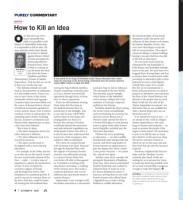
A man points to an image of Hezbollah leader Hassan Nasrallah with a black
stripe for mourning on the frame during a broadcast from the private Lebanese
station NBN in Beirut on Sept. 28, 2024.
JOSEPH EID / AFP / TIMES OF ISRAEL
Jonathan S. Tobin is an American
journalist. He is Editor in Chief of
JNS.org, the Jewish News
Syndicate. Tobin is a frequent
commentator on domestic
politics, Israel, and Jewish affairs.
His column "View from America”
appeared for many years in The
Jerusalem Post. His work has also
appeared in Israel Hayom, the
Christian Science Monitor, The
Forward, Britain's Jewish
Chronicle, the New York Sun and
many other publications.
Tobin lectures widely across the
United States on college
campuses and to Jewish
organizations and synagogues.
He tours North America debating
political and Jewish issues with
J.J. Goldberg of The Forward and
has appeared on CNN, BBC
Radio, Fox News, Newsmax,
i24News and local network
affiliates to discuss politics,
foreign policy and Jewish issues.
Friday, November
1,
2024
6:00 p.m. Lively musical T.G.I.S. service
7:00 p.m. Shabbat dinner (registration required)
Dinner Cost: $30 members | $36 not-yet-members
8:00 p.m. Lecture with Jonathan Tobin
Whitewashing Antisemitism Is the
Defining Challenge of Jewish Life
Saturday, November 2, 2024
9:30 a.m. Shabbat Service
Morning D’var Torah with Jonathan Tobin in the sanctuary
Contemplating with Courage the Possible End of Our World
12:00 noon Shabbat lunch (registration required)
1:00 p.m. Discussion with Jonathan Tobin
Should We Be Debating the Legitimacy of Zionism?
In the Bernstein Chapel after lunch and Minchah
Children’s activities will be offered during the lecture.
To register scan the QR code or
visit tinyurl.com/TobinCSZ
For more information call the
synagogue office (248) 357-5544.
Sponsored by
The Morris and Beverly Baker Foundation
We look forward to
having Jonathan Tobin
join us for the weekend:
SCHOLAR-IN-RESIDENCE
WEEKEND WITH JOURNALIST
November 1 & 2, 2024
JonatanTobin
Sponsored by
The Morris and Beverly Baker Foundation
C
M
Y
CM
MY
CY
CMY
K
Tobin Full Pg Ad Jewish News.pdf 1 10/2/24 3:26 PM