

62 | OCTOBER 3 • 2024 J
N
Looking Back
From the William Davidson Digital Archive of Jewish Detroit History
accessible at thejewishnews.com
Remembering Hammerin’ Hank
C
ongregation Shaarey Zedek held a special event last month. It was a program to honor and celebrate
Major League Baseball’s Jewish superstar Hank Greenberg and his refusal to play in a critical game on
Yom Kippur, Sept. 18, 1934.
The event at Shaarey Zedek was held on Sept. 18, precisely 90 years after
Greenberg’s decision. Aviva Kempner, the writer, producer and director of
the documentary film, The Life and Times of Hank Greenberg,
led a discussion of “Hammerin’ Hank’s” faithful decision.
Shaarey Zedek was also the most appropriate venue for
this event. In lieu of playing in that game, instead, Greenberg
attended services at Shaarey Zedek.
Greenberg is cited on more than 1,000 pages in the William
Davidson Digital Archive of Jewish Detroit History. I thought
I would see what the Detroit Jewish Chronicle had to say about
“The Hebrew Hammer” in the fall of 1934 and his decisions
about playing on High Holy Days.
BTW — you will have noticed that I’ve already used two of Henry “Hank”
Benjamin Greenberg’s nicknames. He had many of them, including “Hankus Pankcus,”
“Lanky” (very popular with Detroit’s media), “Greenie,” and owing to his great
strength, “King Kong” (a reference to the famous movie of the same name released in
1933).
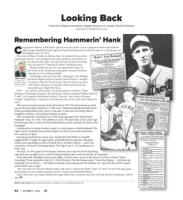
There are several great stories in the Chronicle in 1934. The first prominent article
was on the front page of the June 15, 1934, issue: “Hank Greenberg’s Baseball Career.”
While providing details of his career to that date, it noted that Greenberg offered
insightful comments on Jewish participation in sports.
Three months later, Greenberg was on the front page again with “Hank’s Rosh
Hashanah” (Sept. 14, 1934). The subtitle says it all: “The Epic Story of the Lanky Tiger
First Baseman who is a Hero of Detroit Baseball Fans and is Acclaimed by Boys in the
Synagogue.”
Greenberg had to decide whether to play in a critical game on Rosh Hashanah. The
Tigers were in a playoff hunt and fans (largely non-Jews) were nearly unanimous —
how could he not play?
Greenberg pondered this serious issue. Temple Beth El’s Rabbi Leo Franklin
suggested that “it might be argued quite consistently that his playing in this game
would mean something not only to himself, but to his fellow players … and to the
community of Detroit.” Greenberg played. The Tigers won 2-1 on Greenberg’s two
home runs.
The Sept. 18, 1934, game on Yom Kippur, however, was a step too far for Greenberg.
Tiger fans were enraged, but he could not bring himself to play on the Jewish Day of Atonement.
In the aftermath, Michigan’s famous poet Edgar A. Guest wrote a poem in the Detroit Free Press to honor “Henry
Greenberg.” It was reprinted in the Oct. 5, 1934, Chronicle. The third stanza opens: “Came Yom Kippur — holy feast day
worldwide over to the Jew — And Hank Greenberg to his teaching and old tradition true. Spent the day with his people
and he didn’t come to play.”
The next week, the Chronicle filled its pages with odes to “Hammerin’ Hank” (Sept. 21, 1934). On the front page again,
the message was clear. Hank Greenberg was the “Greatest Jewish Baseball Player.”
Thirty years later, only Sandy Koufax fans might debate this conclusion. But, hey, I’m from Detroit! Greenberg is still the
man!
Want to learn more? Go to the DJN archives, available for free at thejewishnews.com.
Mike Smith
Alene and
Graham Landau
Archivist Chair