

OCTOBER 3 • 2024 | 39
J
N
A
s the anniversary of
Hamas’ Oct. 7 massacre
approached, Israel
assassinated Hassan Nasrallah, the
head of Hezbollah, in an airstrike
in Beirut on Friday, Sept. 27. Since
joining the war in support of Hamas
a day after the Oct. 7 massacre,
Hezbollah has fired more than 9,500
rockets, missiles and drones at Israel
causing the evacuation of upwards
of 70,000 of Israeli residents.
IDF International Spokesperson
Lt. Col. Nadav Shoshani said, “We
hope this will change Hezbollah’s
actions. Hezbollah has started this
war on Oct. 8. They have been firing
at us ever since. And we have been
looking for solutions, looking for
change in reality, that will bring our
civilians home [to northern Israel].”
For three decades, Nasrallah was
one of the most powerful leaders
in the Middle East. As the head of
Hezbollah, he led the best-equipped
terror group threatening Israel and
the region’s largest Iranian proxy,
with control of southern Lebanon
and a reach that spanned the globe.
The development marks an
enormous strategic achievement for
Israel. Under Nasrallah’s leadership,
Hezbollah transformed into a
formidable force, going from terror
organization to terror army, and
carrying out attacks across Israel
and the world.
In a statement on Saturday,
Israeli Prime Minister Benjamin
Netanyahu said Nasrallah was “not
just another terrorist, he was the
terrorist.”
Netanyahu added that the
assassination, reportedly carried out
as the prime minister gave a speech
in New York to the United Nations
General Assembly, could presage
more conflict in the days ahead.
“The elimination of Nasrallah is a
necessary condition in achieving the
objectives we have set: Returning
the residents of the north safely
to their homes and changing the
balance of power in the region for
years,” Netanyahu said.
The unprecedented series of
blows delivered by the Israel
Defense Forces to Hezbollah’s
leadership and arsenal has severely
harmed the Iranian-backed terror
army’s ability to attack.
Recent airstrikes have not only
taken out almost the whole of
Hezbollah’s command structure but
have also strategically crippled its
ability to fire rockets and missiles,
reducing its planned mass barrages
to much smaller attacks.
Hezbollah has long menaced
Israel, including since Nasrallah,
who was 64, took the reins of the
group in 1992. Hezbollah was
founded in the 1980s to combat
Israel’s occupation of southern
Lebanon, where it also killed
hundreds of American troops.
The two sides fought a monthlong
war in 2006 that ended with
Hezbollah retaining control of much
of southern Lebanon. Hezbollah
also played a significant role in
helping Bashar Assad survive the
Syrian civil war beginning in 2011.
It has also killed Israelis and
Jews far from the Middle East. It
was behind the 1994 bombing of
the AMIA Jewish center in Buenos
Aires, which killed 85 people, as
well as a 2012 attack on Israeli
tourists in Burgas, Bulgaria that
killed six.
IDF’s Shoshani said, “Nasrallah
was one of the world’s strongest and
most influential terrorists … and he
was a real threat with the blood of
thousands of people on his hands.
“Under his leadership, Lebanon
became an armed base with
advanced precision weapons of
various ranges aimed at Israel and
in the entire region.”
The IDF has confirmed that
alongside Nasrallah, numerous
other senior Hezbollah leaders have
been killed, further dismantling
the group’s ability to function
effectively. When Israel’s airstrikes
in recent weeks are taken together,
the toll on Hezbollah’s command
structure appears to be catastrophic
for the terror organization.
U.S. LEADERS REACT
TO NASRALLAH’S DEATH
President Joe Biden on Saturday
praised Israel’s targeted killing of
Nasrallah, saying the development
had brought justice to his thousands
of victims.
“Hassan Nasrallah and the
terrorist group he led, Hezbollah,
were responsible for killing
hundreds of Americans over a four-
decade reign of terror. His death
from an Israeli airstrike is a measure
of justice for his many victims,
including thousands of Americans,
Israelis and Lebanese civilians,” he
said.
“The strike that killed Nasrallah
took place in the broader context of
the conflict that began with Hamas’
massacre on Oct. 7, 2023. Nasrallah,
the next day, made the fateful
decision to join hands with Hamas
and open what he called a ‘northern
front’ against Israel,” the statement
continued.
Speaker of the House of
Representatives Mike Johnson
(R-La.) also released a statement
on Saturday praising Nasrallah’s
assassination.
“Hassan Nasrallah’s reign of
bloodshed, oppression and terror
has been brought to an end. A
puppet of the Iranian regime, he
was one of the most brutal terrorists
on the planet, and a coward who
hid behind women and children
to carry out his attacks,” read the
statement, co-authored with House
Majority Leader Steve Scalise
(R-La.) and Rep. Elise Stefanik
(R-N.Y.).
“Thanks to the brave men and
women of the Israeli military, justice
was delivered for Israeli victims of
his heinous crimes, their families
and the United States.
“The world is better off without
him,” the statement continued.
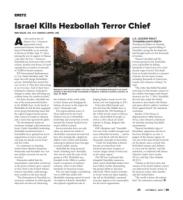
Bypassers and rescuers gather near the rubble of a building destroyed in an Israeli
airstrike in the Haret Hreik municipality in Dahiyeh, in Beirut’s southern suburbs, on
Sept. 27, 2024.
IBRAHIM AMRO/AFP VIA GETTY IMAGES/JNS
Israel Kills Hezbollah Terror Chief
BEN SALES, JTA, AND YAAKOV LAPPIN, JNS
ERETZ