

78 | SEPTEMBER 26 • 2024
J
N
I
t’s hard to believe how different
life was during the High Holidays
last year. We were blissfully
unaware that in just a matter of
days Israel would find itself in the
largest, longest and
most serious war in
its history. We always
knew there were storm
clouds brewing in Israel
prior to Oct. 7, but little
did we know just how
ominous and imminent
those clouds really were.
This year — 5785 — Israel finds
itself in a full-blown war on multiple
fronts against multiple enemies. Given
its enemies’ stated goals, this war is
indeed a fight for Israel’s survival.
We can hope against hope for a good
outcome, but we should not sugarcoat
the fact that the situation there is
indeed grave.
The High Holidays are a time to
reflect on the past year and look
ahead to the coming year with a
focus on themes like repentance,
forgiveness, charity and faith. It’s a
beautiful time to renew and refresh
our souls. But this year everything is
different. This year it’s wartime.
So, how do we juxtapose the
uplifting message of the High
Holidays with the reality of an active
war? How do we embrace forgiveness,
repentance and charity when we know
that Israel’s enemies are trying to wipe
it off the map? And what emotional
toll will the war take on us as we are
tested in the coming year?
So far, I think I’m flunking that test.
If I’m being honest, I must confess
that this war has changed me, and not
for the better. It has brought out an
ugliness in me that I hardly recognize.
Too often I live in a state of rage,
whether it’s against Israel’s enemies,
or Hamas apologists, or all the anti-
Israel news coverage that is wreaking
havoc on my blood pressure. I feel
myself becoming hateful, gloomy and
callous, and I wonder if I’m losing my
sympathy for truly innocent people.
Worst of all, my hope for a good
outcome has been shaken like never
before. Needless to say, this is an
awful way to live.
This year, once again, I’ll recite
the ancient prayers at High Holiday
services and wish people a Shanah
Tovah — a good year. It’s a simple
and beautiful sentiment, but a bit
perplexing for me during wartime.
Short of a real and lasting peace —
purely a fantasy at this point — what
exactly constitutes a “good year” for
Israel for the next 12 months? More
military victories? Fewer incoming
rockets? A hollow ceasefire?
I’ll sit in services and my thoughts
will drift to dark images that are
breaking my heart these days, like
weary hostages huddled in dark
tunnels, or their grief-stricken
families, or terrified children in bomb
shelters clutching onto their parents,
or the countless tears of pain and
sadness that will surely be flowing
down Israeli faces during their holiday
observances.
ADJUSTING MY ATTITUDE
But as the holidays approach, I
think time has come for an attitude
adjustment. I don’t want to spend the
next 12 months in a dark place filled
with pessimism, rage, callousness
and despair. Those emotions are
very unhealthy and actually very
un-Jewish. The Jewish spirit, I’ve
always been taught, is to meet
adversity with positivity, optimism
and hopefulness. “Hope” is literally
the name of the Israeli national
anthem. As Golda Meir once put it,
“Pessimism is a luxury that a Jew can
never allow himself.”
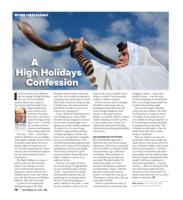
There is a powerful true story of
a Jewish prisoner at Auschwitz who
smuggled a shofar — the ancient
symbol of hope — into the camp.
On Rosh Hashanah, he would faintly
blow it, so enough people could hear
it without him getting caught.
We can only imagine what that
sound must have meant to the other
Jewish prisoners. I suspect it meant
everything. At one point, the man
was ordered into the gas chamber. As
he was leaving, he handed the shofar
to another prisoner and said, “Take
it. Maybe you will make it. Take the
shofar. Show them that we had a
shofar in Auschwitz.”
This war will pass one day, and
surely there will be some rough days
ahead. But as I look ahead to the new
year, I will take Golda’s words to heart
and bury my pessimism. I will take
a cue from our ancestors and clutch
more tightly onto the uplifting values
that have always sustained the Jewish
people. I will do my small part to
show future generations — and our
enemies — that even during this dark
hour, the Jewish people held onto
the essence of our Jewish spirit. We
need to show them that we, too, had a
shofar at Auschwitz.
Mark Jacobs is the co-founder of the
Coalition for Black and Jewish Unity.
Mark Jacobs
Special to the
Jewish News
ROSH HASHANAH
ESSAY
A
High Holidays
Confession