

46 | SEPTEMBER 12 • 2024
J
N
FOOD
I
t’s hard to believe that
a new year will soon be
upon us, including ample
gatherings based around food.
As it is traditional to start a Rosh
Hashanah dinner
by eating simanim
(signs or omens),
foods considered
auspicious for a
positive year, I
include recipes for
dishes incorporating
these foods in Rosh
Hashanah appetizers
and side dishes.
The origin of the tradition to eat
simanim comes from the Talmud,
which describes a Talmudic sage,
Abaye, outlining that “a man
should accustom himself to looking
at squash, beans, leeks, beets and
dates on Rosh Hashanah.”
The idea is that each of these
foods grows quickly and serves
as a positive omen for one’s
actions during the coming year.
It became traditional to eat these
foods on Rosh Hashanah, as
well as other foods symbolizing
positive attributes for the new year,
either related to their physical
characteristics or to word plays
in different languages. These
include an apple dipped in honey
for a good and sweet year, fish
to be fruitful and multiply like
fish, pomegranates so our merits
should increase like the seeds of
a pomegranate, dates (temarim)
so our haters should perish
(sheyitamu), and beets (selakim)
so our enemies should be removed
(sheyistalku). While these are some
examples, there are many more.
I appreciate that this tradition
provides us with an opportunity
to envision the positive attributes
we would like our coming year to
have and to be able to share them
as a community. I also think it can
empower us to think more deeply
about our personal aspirations for
the coming year, to think about
foods with the attributes that we
hope for, and to share those foods
and aspirations with our families
and friends.
I share several recipes
incorporating traditional simanim.
A recipe for beets marinated
in vinegar and mint provides
a counterpart to sweet holiday
dishes with the tart sherry vinegar
and earthy beets, while mint, red
onion and garlic add brightness.
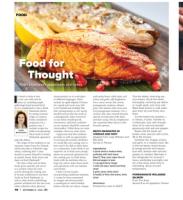
For a sweet-savory fish course,
pomegranate molasses salmon
pairs rich salmon with sweet and
tart pomegranate molasses. For a
sweeter side, date-roasted brussels
sprouts incorporates both dates
and date syrup, which complement
the somewhat bitter flavor of the
brussels sprouts.
BEETS MARINATED IN
VINEGAR AND MINT
Adapted from Jody Williams and
Rita Sodi
Serves 4. Pareve
Ingredients
1 pound small or medium beets,
preferably with fresh leaves
About 2 Tbsp. extra virgin olive oil
Salt and pepper to taste
¼ cup aged sherry vinegar
1 small red onion, halved and thinly
sliced
2 garlic cloves, thinly sliced
A handful of fresh mint leaves, thinly
sliced
Directions
Preheat the oven to 400°F.
Trim the beets, reserving any
nice leaves. Scrub the beets
thoroughly, removing any debris
or rough spots, and rinse well.
Wash beet leaves in cold water,
spin them dry and finely slice
them.
Cut the beets into quarters —
or halves, if small. Transfer to
a sheet pan, toss with enough
olive oil to coat and sprinkle
generously with salt and pepper.
Roast until the beets are
tender when pierced with a fork,
45 to 55 minutes.
Combine the vinegar, onions
and garlic in a medium bowl. Stir
in the hot beets, sliced leaves
(if using) and the mint leaves;
toss well. Season with salt and
pepper as needed. Marinate in
the refrigerator for at least 2
hours, preferably overnight, and
stir a few times while they’re
marinating. Serve at room
temperature.
POMEGRANATE MOLASSES
SALMON
From Tori Avey
Serves 8 as an appetizer. Pareve
Rosh Hashanah appetizers and sides
Food for
Thought
Joelle
Abramowitz