

12 | AUGUST 29 • 2024
union associated with the CIO. Its
first major victory was a landmark
sit-down strike in GM plants in
Flint in 1936-37, perhaps the most
important event in American
Labor history. Auto workers “sat
down,” refused to work or to leave
the Fisher Body #2 plant, despite
GM cutting off the water and
power to the factory. Union wives,
brothers, children and friends
provided the strikers with food,
water and blankets.
After 44 days, GM agreed to
recognize the UAW as the official
bargaining voice for its factory
workers. Soon after, hundreds of
sitdown strikes were held around
the country, and millions of
workers joined unions. It was a
most effective strategy for Labor;
however, sitdown strikes were
declared unconstitutional by the
U.S. Supreme Court in 1939.
The first UAW contract, by the
way, said absolutely nothing about
wages and benefits, just that GM
recognized the UAW. As Douglas
A. Fraser, president of the UAW,
1977-1983, stated: “The number
one issue was dignity for factory
workers.”
The UAW
grew to be the
most powerful
union in
the U.S. by
the 1950s.
Its members
became the elite
of the world’s
industrial
workers and
helped create
the American
middle-class.
JEWS AND RISE
OF U.S. LABOR
MOVEMENT
To say the least,
Jewish Americans
and immigrants
were instrumental
in the growth of
unions. Not just
as members, but
as prominent labor
leaders.
The AFL’s first president was
Samuel Gompers (1850-1924).
Born the son of Dutch-origin
Jewish parents living in England,
and a cigar-maker by trade, he led
this organization from its creation
in 1886 until his death in 1924.
During these years, Gompers
was easily the most powerful and
influential labor leader in the U.S.
In New York and elsewhere in
America, there were hundreds
of thousands of jobs in the
clothing industry, and much of its
workforce were Jewish immigrants.
Their unions were powerful during
the 1930s-60s.
Born in Belorussia, David
Dubinsky (1892-1982) was
president of the International
Ladies Garment Workers union,
1932-1966. Dubinsky was also
involved in the creation of the CIO.
Jewish immigrant from Lithuania,
Sidney Hillman (1887-1946),
was president the Amalgamated
Clothing Workers of America.
Both Dubinsky and Hillman
were also leaders of the Jewish
Labor Committee in America. It
was formed in 1934 by Yiddish-
speaking trade union leaders in
response to the rise of the Nazis
in Germany, as well as home-
grown Nazis such as the German
American Bund. Many of its
leaders and members were from
Russian, Poland, Germany and
elsewhere in Europe. Its mission
was twofold: to protect union
members and activists under threat
around the world, as well as Jewish
traditions.
Historically, Jewish men and
women were instrumental in
building unions in Michigan, and
many became prominent union
leaders. To name just a very few,
Irv Bluestone and Martin Gerber
were vice-presidents of the UAW,
and Maurice Sugar was the union’s
first general counsel.
Sam Fishman was the longtime
president of the Michigan AFL-
CIO, and Bernie Firestone,
although the head of a very small
union, the Michigan Amalgamated
Clothing and Textile Workers
Union, was a legendary, highly
visible labor leader and social
activist in Michigan. Likewise,
Myra Wolfgang was a legendary
leader of Detroit retail workers.
This past June, another longtime
prominent Jewish Labor leader
retired: David Hecker, president of
the Michigan American Federation
of Teachers (AFT). He was the
ranking Jewish union leader in the
OUR COMMUNITY
continued from page 11
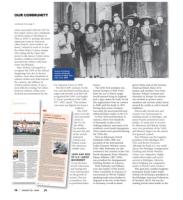
Group of striking
women-shirtwaist
workers in New York
City, circa 1909