

16 | AUGUST 22 • 2024
Management, emeritus, and
professor of urban planning, notes
that members of the academic
community display ignorance when
they issue statements against Israel.
“I am amazed about how little
some colleagues know about
the history of the Middle East
and Jews,” he says. He finds it
overwhelming that people defend
Hamas or use the word “context”
when dealing with the murder and
rape of Jews.
What would have to change to
make the campus feel safe for Jews?
Dunietz answers, “Consequences.
Disrupt campus life … break
into buildings? There should be
consequences for that.”
At the University of Michigan
in Ann Arbor, a pro-Palestinian
encampment lasted for 30 days,
until the administration forcibly
removed the demonstrators on May
21.
WAYNE STATE UNIVERSITY
In response to an encampment
that popped up at Wayne State
University, the WSU campus
closed for in-person meetings,
switching to remote learning only.
The encampment stood for a week,
until University President Kimberly
Andrews Espy had law enforcement
dismantle it on May 30.
Matthew Lockwood, associate
vice president of university
communications at
Wayne State, explained
the decision: “The
encampment presented
legal, health and
safety, and operational
challenges for our
community.” He
specified that “no individual or
group is permitted to claim campus
property for their own use and
deny others access to that property.”
John Klein, professor of
mathematics at Wayne State
University, told Stacy Gittleman
of the Jewish News about anti-
Israel activities at
the university. In
November, the Student
Senate demanded that
the university divest
from Israeli companies
in its portfolio. In
December, the Wayne
Academic Union (WAU) passed a
resolution calling for “an immediate
ceasefire” in the Israel-Gaza war.
Klein observed, “As far as I know,
it was the first time in WAU’s
history that it decided to make a
foreign policy statement. Although
it demanded a ceasefire, it made no
mention of release of the hostages.”
The JN spoke with Hillel of
Metro Detroit Director Miriam
Starkman last spring.
“It is a scary time to
be a Jewish university
student,” Starkman said.
“This encampment was
another example of the
antisemitism that has
permeated the protest
culture. The sign saying, ‘Zionists
are not welcome in Detroit,’ showed
how exclusive and hateful this
movement is.”
Starkman said Hillel is grateful
for President Espy and the WSU
leadership, including WSU Police
Chief Anthony Holt, for taking
swift action. “Holt and his team
keep our campus community safe,
and we are lucky to have him,”
Starkman said.
“I am concerned about what this
fall will bring,” Starkman said. “I
hope the university will continue
to take a strong approach to
making sure all students feel safe
and secure on campus and that
everyone will have an opportunity
to learn and not be subject to such
hostilities.”
LAWRENCE TECHNOLOGICAL
UNIVERSITY
Larry Winer teaches in the arts
and sciences, humanities, social
sciences and communications at
Lawrence Technological
University. He wears
his kippah as he walks
around campus and
when he teaches his
classes. He reports
that he has not seen
or heard of any
demonstrations on campus.
No doubt the campus has
students with strong political views,
or with family ties to the Middle
East, but “LTU is a STEM (Science,
Technology, Engineering and
Mathematics) school. Students just
want to take their classes, get their
degrees and get a job. Getting in
and getting out.”
Demonstrations at other schools,
according to Winer, have often
crossed the line from freedom of
speech to prohibited behavior. “I
teach American legal history. First
amendment rights give you the
right to say what you want to say,
but not to block people’s access or
to threaten people or to destroy
property.”
An Israeli student at LTU,
a member of the soccer team,
Noam Nedivi, allegedly suffered
from antisemitic harassment by
his roommate. The university
disciplinary system and the
Southfield Police Department are
involved in ongoing investigations
of those incidents.
UNIVERSITY OF MICHIGAN –
DEARBORN
Jamie Wraight teaches history at the
University of Michigan-Dearborn
and serves as director
of the Voice/Vision
Holocaust Survivor
Oral History Archive.
Wraight knows that
UM-Dearborn has
many students with
ties to the Middle East,
but the campus has not had much
disruptive activism. He attributes
that relative quiet to the life
situation of many of the students:
“Our students tend not to have so
much time,” he said. They have
“sometimes more than one job;
they have family obligations and
they’re trying to go to college.”
In its efforts to deal with tensions
in an academically sound way, the
school administration arranged
a panel discussion of the issues
back in November and convinced
Wraight to take part. When he
expressed hesitation about speaking
on this topic, the organizers said
that the program would have no
integrity without him to balance
the pro-Palestinian orientation of
other panelists. The administration
would not run the program without
him.
Wraight explains his hesitation:
He teaches military history and
Holocaust studies, but he is not an
expert in Arab-Israel relations.
His Holocaust history course
runs nearly every semester, and it
gets a good enrollment, including
many Arab and other Muslim
students, he says. In his experience,
none of these students deny or
minimize the Holocaust.
The tenor of demonstrations
and even of political discussions at
other campuses disturbs Wraight.
“I am not Jewish, but I am certainly
not sympathetic” to ignorant
vilification of Israel.
He explains: “It is not bad that
they are critical of Israel. I have
been to Israel. I like Israel; but it is
like any other political entity that
should be open to criticism. That’s
what democracy is all about. But
people who should know better use
inflammatory words like genocide,
or carpet bombing; that kind of
rhetoric lights fires. If you look
at Hamas, the legal government
of Gaza, they are the ones calling
for wiping out the Jews from
Israel; they are the ones calling for
genocide.”
Contributing writer Stacy Gittleman
contributed to this report.
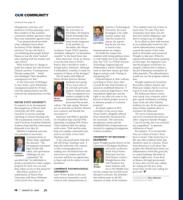
John Klein
Larry Winer
Miriam
Starkman
Jamie
Wraight
Matthew
Lockwood
continued from page 14
OUR COMMUNITY