

58 | AUGUST 22 • 2024 J
N
Looking Back
From the William Davidson Digital Archive of Jewish Detroit History
accessible at thejewishnews.com
Historic Jewish-Owned Movie Theaters
A
llan Gale posed this
question. Have I written
about Jewish-owned or
-managed movie theaters in Metro
Detroit?
What? Jews in the movie
industry? You’re
kidding me!
Well, this did seem
like an excellent idea
for a cruise into the
William Davidson
Digital Archive
of Jewish Detroit
History, but it was not
a straight-forward,
easy search. First, just entering
“theaters” into the Archive search
box raised more than 33,000 pages
where the word “theater” was
mentioned; narrowing the search
to just “movie theaters” raised
more than 1,000 pages. Of course,
one could also search for owners
of theaters if one knew all of the
names.
Suffice it to say that the Detroit
Jewish Chronicle and the JN have
published quite a few stories
related to movies and theaters. So
many that I’ll provide a disclaimer
now — this Looking Back is in no
way a comprehensive history of
the Detroit-Jewish movie theater
connection. I can, however, provide
a few highlights.
For example, movie news can be
found in the Chronicle as early as
the 1930s. See Helen Zigmond’s
columns, “Our Film Folk,” for good
old-fashioned Hollywood gossip
(March 4, 1932).
Perhaps the primary source for
movie and theater news is the
vast array of Danny Raskin’s “Best
of Everything” columns. Danny
wrote about movie debuts, theater
openings, encounters with actors
and, likely, the popcorn served in
the lobby. His columns are a bone
fide potpourri of entertainment
news.
One of the earliest and decidedly
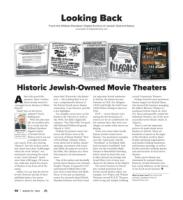
Jewish movie theaters was Littman’s
People’s Theater. It opened in 1927
and featured Yiddish films with
stars such as Paul Muni and Molly
Picon. It was also an important
source for newsreels about British
Mandate Palestine and Eretz Israel.
An important Jewish institution
in Detroit, the theater became
Littman’s in 1938, the Abington
(1945) and finally the Gold Coast
(1956) before closing its doors in
1958.
BTW — movie theaters were
among the first businesses in
America to be air-conditioned. On
hot summer days, they were cool
refuges, no matter what movie was
playing.
There were many other locally
famous Jewish-owned movie
theaters. Two prominent examples
were the “Americana” and the
“Northland” at Northland Mall,
both located in Southfield. And,
there was the venerable Maple
Theater in Bloomfield Township,
which closed its doors this year.
It often showed rare foreign and
Israeli films (a lot of tears were
shed over the demise of the Maple).
The movie business in Detroit
also created prominent local
Jewish-owned theater chains. For
example, Lew Wisper and William
Wetsman owned W & W Theatres,
while Irving and Adolph Goldberg
owned Community Theaters.
Perhaps Detroit’s most prominent
theater mogul was Richard Sloan,
who learned the business managing
his father’s Mercury Theater in
northwest Detroit (April 24, 2014,
JN). Sloan subsequently created the
Suburban Theaters, one of the most
successful movie theater chains in
America.
There is one last important
point to be made about movie
theaters in Detroit. There are
hundreds of reports in the pages
of the Davidson Archive about
Jewish communal organizations
and families holding fundraisers
and business meetings, as well as
bar/bat mitzvahs, birthday parties
and anniversaries in local movie
theaters.
Today, movie theaters are
dominated by national chains.
However, Jewish Detroiters have
had a deep influence on the history
of our local movie business.
Want to learn more? Go to the DJN
archives, available for free at
thejewishnews.com.
Mike Smith
Alene and
Graham Landau
Archivist Chair